Li Zhao-Qing, Li Tong-Xin, Tian Miao, Ren Ze-Sheng, Yuan Chen-Yi, Yang Rui-Kun, Shi Su-Juan, Li Hui, Kou Zhen-Zhen
Department of Anatomy, Histology and Embryology, K. K. Leung Brain Research Centre, The Fourth Military Medical University, Xi'an, China.
Front Cell Neurosci. 2022 Oct 26;16:1028653. doi: 10.3389/fncel.2022.1028653. eCollection 2022.
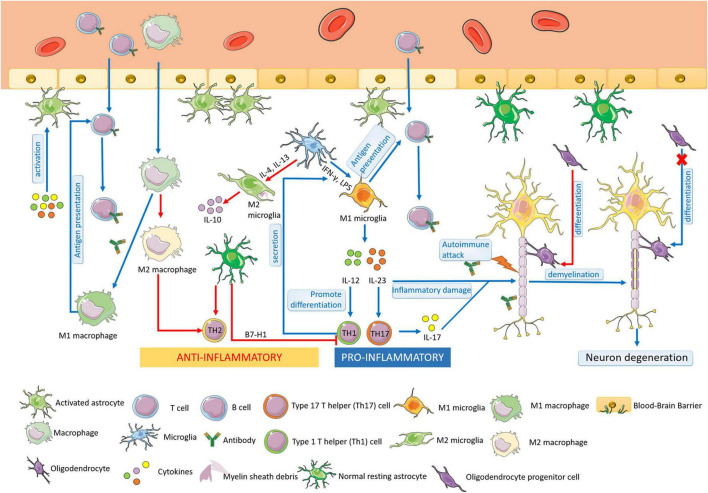
Neurologic autoimmune disorders affect people's physical and mental health seriously. Glial cells, as an important part of the nervous system, play a vital role in the occurrence of neurologic autoimmune disorders. Glial cells can be hyperactivated in the presence of autoantibodies or pathological changes, to influence neurologic autoimmune disorders. This review is mainly focused on the roles of glial cells in neurologic autoimmune disorders and the influence of autoantibodies produced by autoimmune disorders on glial cells. We speculate that the possibility of glial cells might be a novel way for the investigation and therapy of neurologic autoimmune disorders.
神经自身免疫性疾病严重影响人们的身心健康。神经胶质细胞作为神经系统的重要组成部分,在神经自身免疫性疾病的发生中起着至关重要的作用。在自身抗体或病理变化存在的情况下,神经胶质细胞可被过度激活,从而影响神经自身免疫性疾病。本综述主要关注神经胶质细胞在神经自身免疫性疾病中的作用以及自身免疫性疾病产生的自身抗体对神经胶质细胞的影响。我们推测,神经胶质细胞有可能成为神经自身免疫性疾病研究和治疗的新途径。