
微小RNA-137通过靶向非小细胞肺癌中的环氧化酶-2来抑制迁移和细胞运动性。
miR-137 represses migration and cell motility by targeting COX-2 in non-small cell lung cancer.
作者信息
Luo Yutu, Hu Suwei, Wang Fang, Yang Junjun, Gong Daohui, Xu Wenjing, Xu Xingxiang, Min Lingfeng
机构信息
Clinical Medical School of Yangzhou University, Subei People's Hospital of Jiangsu Province, Yangzhou, China.
Department of Pulmonary and Critical Care Medicine, Affiliated Taizhou Second People's Hospital, Medical School of Yangzhou University, Taizhou, China.
出版信息
Transl Cancer Res. 2022 Oct;11(10):3803-3813. doi: 10.21037/tcr-22-2177.
BACKGROUND
Lung cancer is a common malignant tumor, with, non-small cell lung cancer (NSCLC) accounting for about 80-85% of cases. This study investigated the expression of miR-137 in NSCLC tissues and cells and its effects on the migration and invasion of NSCLC cells and related mechanisms.
METHODS
We collected the neoplastic and paracancerous tissues of NSCLC patients, detected the expression of miR-137 in NSCLC tissues and cell lines by real-time quantitative polymerase chain reaction (RT-qPCR), and analyzed the correlation between miR-137 expression and the clinicopathological features and survival of NSCLC. Following transfection with miR-137 mimic or inhibitor in NSCLC cell lines (A549 or H1299) to upregulate or downregulate the expression of miR-137, transwell assay was employed to detect the effects of miR-137 on migration or invasion. Online software was employed to predict and analyze the target gene of miR-137, and luciferase reporter gene system was adopted to validate it. The effects of miR-137 on the expressions of COX-2 and Epithelial-Mesenchymal Transition (EMT) related proteins were investigated by Western blot.
RESULTS
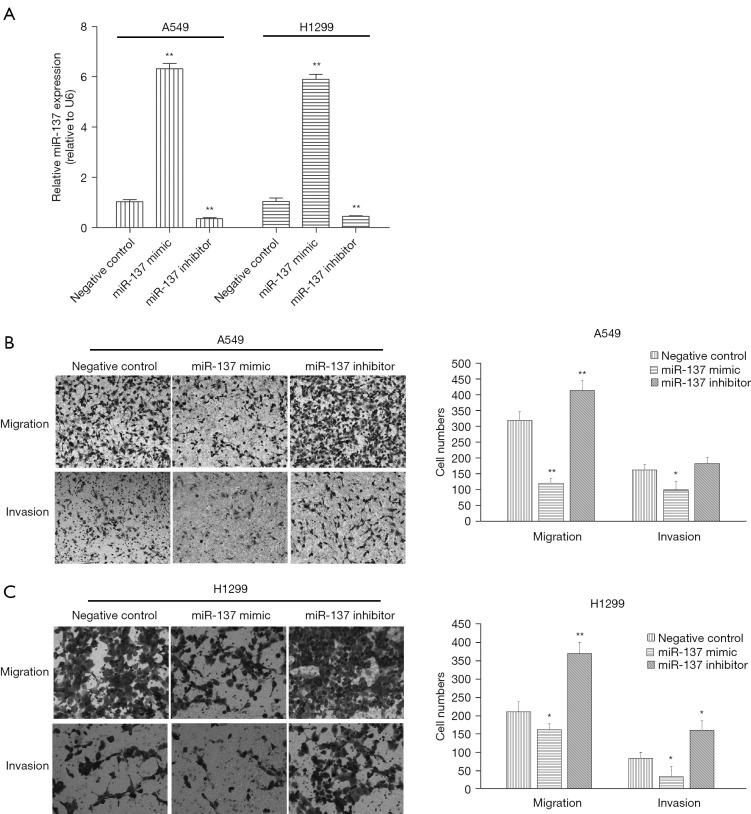
Compared to paracancerous tissues and BEAS-2B cells, the expressions of miR-137 in NSCLC tissues, A549 and H1299 cells were dramatically down-regulated (P<0.01). After transfection with miR-137 mimic or inhibitor in A549 and H1299 cells, the miR-137 expressions were markedly up-regulated or down-regulated (P<0.01), respectively. The number of migrating or invading cells was observably decreased or increased (P<0.01) after transfected with mimic or inhibitor, respectively, while relative luciferase activity was evidently decreased in cells co-transfected with miR-137 mimic and wild type recombined vector of 3'UTR of COX-2. While the expressions of COX-2 and E-cadherin were both substantially reduced in A549 cells treated with miR-137 mimic, that of vimentin was substantially raised. The expression of miR-137 correlated with smoking history, lymph node metastasis, and TNM clinical stage, and patients with high miR-137 expression had apparent longer survival.
CONCLUSIONS
The expression of miR-137 was significantly down-regulated in NSCLC tissues and cells, and correlated with NSCLC progress. miR-137 suppressed the migration and invasion of NSCLC cells through regulating EMT relative proteins by targeting COX-2. miR-137 is expected to become a novel biomarker and therapeutic target of NSCLC.
背景
肺癌是一种常见的恶性肿瘤,其中非小细胞肺癌(NSCLC)约占病例的80 - 85%。本研究调查了miR - 137在NSCLC组织和细胞中的表达及其对NSCLC细胞迁移和侵袭的影响及相关机制。
方法
收集NSCLC患者的肿瘤组织和癌旁组织,通过实时定量聚合酶链反应(RT - qPCR)检测NSCLC组织和细胞系中miR - 137的表达,并分析miR - 137表达与NSCLC临床病理特征及生存的相关性。在NSCLC细胞系(A549或H1299)中转染miR - 137模拟物或抑制剂以上调或下调miR - 137的表达,采用Transwell实验检测miR - 137对迁移或侵袭的影响。使用在线软件预测和分析miR - 137的靶基因,并采用荧光素酶报告基因系统进行验证。通过蛋白质免疫印迹法研究miR - 137对COX - 2和上皮 - 间质转化(EMT)相关蛋白表达的影响。
结果
与癌旁组织和BEAS - 2B细胞相比,NSCLC组织、A549和H1299细胞中miR - 137的表达显著下调(P<0.01)。在A549和H1299细胞中转染miR - 137模拟物或抑制剂后,miR - 137表达分别显著上调或下调(P<0.01)。转染模拟物或抑制剂后,迁移或侵袭细胞数量分别明显减少或增加(P<0.01),而在共转染miR - 137模拟物和COX - 2 3'UTR野生型重组载体的细胞中相对荧光素酶活性明显降低。在用miR - 137模拟物处理的A549细胞中,COX - 2和E - cadherin的表达均显著降低,而波形蛋白的表达显著升高。miR - 137的表达与吸烟史、淋巴结转移和TNM临床分期相关,miR - 137高表达患者的生存期明显更长。
结论
miR - 137在NSCLC组织和细胞中表达显著下调,与NSCLC进展相关。miR - 137通过靶向COX - 2调节EMT相关蛋白来抑制NSCLC细胞的迁移和侵袭。miR - 137有望成为NSCLC的新型生物标志物和治疗靶点。




 Zotero 插件