Zhao Jin, Hu Mei, Yang Hong, Zhang Dongping, Yang Jie, Liu Qi
Department of Gastroenterology, Affiliated Hospital of Guizhou Medical University, Guiyang, China.
J Gastrointest Oncol. 2022 Oct;13(5):2654-2659. doi: 10.21037/jgo-22-784.
Anorectal manometry (ARM) is primarily used to assess anorectal sensorimotor function. ARM provides comprehensive information about the anal sphincter and rectal sensation in patients with constipation or fecal incontinence. Generally, ARM can be applied to both adults and children. This study is the first to report a case of post-rectal resection ARM with constipation complicating rectal bleeding and perforation in a patient with no history of rectal cancer, aiming to provide guidelines for the treatment of patients who undergo ARM after rectal surgery.
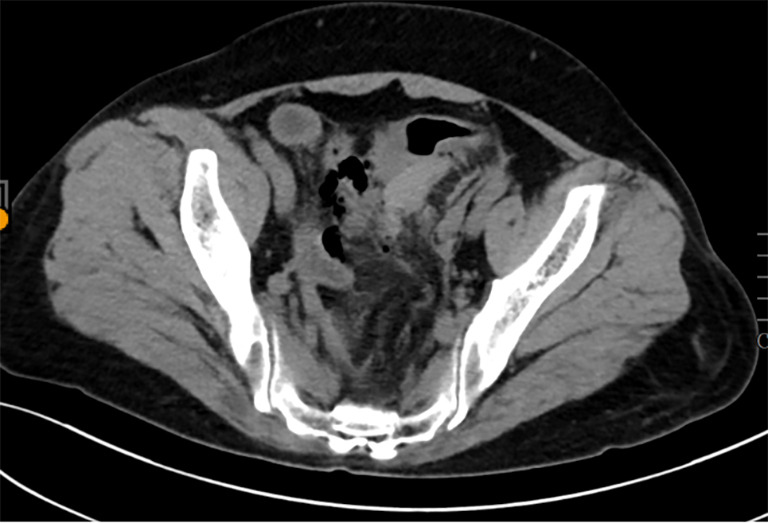
A 58-year-old female patient with previous history of "hypertension and cerebral infarction" underwent "proctocolectomy" for "rectal prolapse" 11+ months ago and recovered well after the operation, but developed constipation. The patient was admitted to our hospital for anorectal manometry (ARM) for "constipation for 11+ months". 2+ hours after the examination, the patient developed blood in the stool and was hospitalized in the Department of Anorectal Surgery of our hospital. The anorectal manometry was performed 2+ hours after the patient developed blood in the stool. The patient was discharged after 30 days of hospitalization without any complications. During treatment, the patient suffered from rectal rupture and perforation. Following timely and aggressive surgery, the patient recovered and was discharged without any complications.
ARM with balloon, as a method for detecting anorectal function, should only be performed cautiously after rectal surgery, especially among patients with comorbidities. If patients suffer from anorectal bleeding and perforation during ARM, prompt and aggressive surgical intervention is necessary. At present, there is little literature on ARM teaching courses. To improve the operation level of ARM and reduce the incidence of complications, we should extend understandings of ARM, develop a systematic management plan, and continuously summarize ARM-related experiences.
肛肠测压法(ARM)主要用于评估肛肠感觉运动功能。ARM为便秘或大便失禁患者提供有关肛门括约肌和直肠感觉的全面信息。一般来说,ARM可应用于成人和儿童。本研究首次报告了1例无直肠癌病史的患者在直肠切除术后进行ARM检查时出现便秘并伴有直肠出血和穿孔的病例,旨在为直肠手术后接受ARM检查的患者提供治疗指导。
一名58岁女性患者,既往有“高血压和脑梗死”病史,11个多月前因“直肠脱垂”接受了“直肠结肠切除术”,术后恢复良好,但出现了便秘。患者因“便秘11个多月”入住我院接受肛肠测压法(ARM)检查。检查后2个多小时,患者出现便血,并入住我院肛肠外科。患者便血后2个多小时进行了肛肠测压。患者住院30天后出院,无任何并发症。在治疗期间,患者发生了直肠破裂和穿孔。经过及时积极的手术治疗,患者康复出院,无任何并发症。
作为一种检测肛肠功能的方法,带气囊的ARM在直肠手术后应谨慎进行,尤其是在有合并症的患者中。如果患者在ARM检查期间出现肛肠出血和穿孔,及时积极的手术干预是必要的。目前,关于ARM教学课程的文献很少。为了提高ARM的操作水平并降低并发症的发生率,我们应该加深对ARM的理解,制定系统的管理计划,并不断总结与ARM相关的经验。