The Pain Clinic in Copenhagen, Horsted Institute, Copenhagen, Denmark.
Centre for Clinic Research, North Denmark Regional Hospital, Denmark.
Eur J Pain. 2023 Feb;27(2):234-247. doi: 10.1002/ejp.2054. Epub 2022 Dec 15.
Cannabinoids are considered a therapeutic option to patients suffering from treatment refractory chronic pain (TRCP) insufficiently relieved by conventional analgesics or experiencing intolerable adverse events (AEs) from those. This study aimed to explore safety and effectiveness of oral cannabinoids among patients with TRCP.
A retrospective study was conducted among Danish patients with TRCP being prescribed oral cannabinoids. Data on AEs and changes in pain intensity by numeric rating scale (NRS) before and after initiation of oral cannabinoid therapy were analysed.
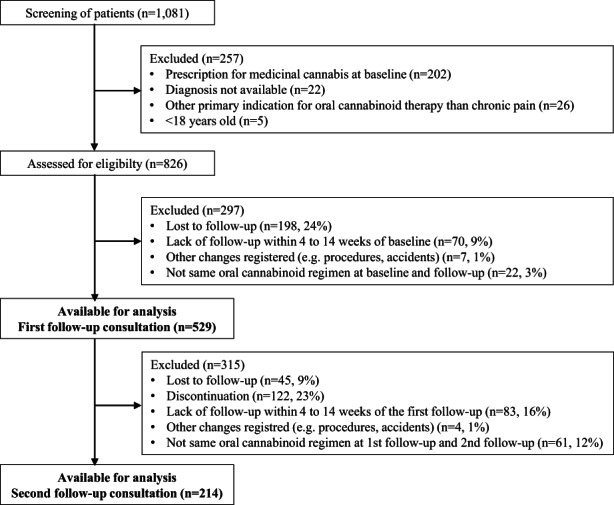
Among 826 eligible patients ≥18 years old, 529 (64%) were included for data analysis at first follow-up (F/U1) (median 56 days from baseline) and 214 (26%) for second follow-up (F/U2) (median 126 days from F/U1). Mean age was 60 ± 15.9 years and 70% were females. AEs were in general reported mild to moderate by 42% of patients at F/U1 and 34% at F/U2. AEs were mainly related to gastrointestinal (F/U1: 17% and F/U2: 13%) and nervous system disorders (F/U1: 14% and F/U2: 11%). Reduction in NRS was significantly different at both follow-up consultations compared with baseline (<0.0001). Clinically relevant pain reduction (NRS ≥30%) was reported by 17% at F/U1 and 10% of patients at F/U2 in intention-to-treat analysis whereas the figures were 32% and 45% respectively, in per-protocol analysis.
Oral cannabinoid therapy seems to be safe and mildly effective in patients with TRCP. Randomized controlled trials with focus on comparable pain characteristics in diagnostical homogenous patient subgroups are needed for further improvement of evidence level for relief of chronic pain using oral cannabinoids.
The findings in this retrospective study conducted in a real-world clinical setting suggest a favourable safety profile of cannabinoids. Moreover, one-sixth (intention-to-treat) and one-third (per-protocol) of patients with chronic pain refractory to conventional analgesics, or experiencing intolerable adverse effects, benefited significantly from therapy with oral cannabinoid regimens. Combination of THC and CBD seems overall more effective than cannabinoid monotherapy. Conduction of randomized controlled trials investigating safety and efficacy of cannabinoid therapy to diagnosis specific patient subgroups with comparable clinical and pathophysiological chronic pain characteristics is warranted, hence contributing further to the process of clinical evidence clarification currently in progress.
大麻素被认为是一种治疗选择,可用于治疗常规镇痛药物治疗无效的慢性难治性疼痛(TRCP)患者,或经历这些药物无法耐受的不良反应(AE)的患者。本研究旨在探讨口服大麻素在 TRCP 患者中的安全性和有效性。
对接受口服大麻素治疗的丹麦 TRCP 患者进行回顾性研究。分析 AE 数据和治疗开始前后数字评分量表(NRS)的疼痛强度变化。
在 826 名符合条件的≥18 岁患者中,有 529 名(64%)在第一次随访(F/U1)(从基线中位数 56 天)和 214 名(26%)在第二次随访(F/U2)(从 F/U1 中位数 126 天)进行数据分析。平均年龄为 60±15.9 岁,70%为女性。42%的患者在 F/U1 和 34%的患者在 F/U2 时报告 AE 为轻度至中度。AE 主要与胃肠道(F/U1:17%和 F/U2:13%)和神经系统疾病(F/U1:14%和 F/U2:11%)有关。与基线相比,两次随访时 NRS 均显著降低(<0.0001)。在意向治疗分析中,17%的患者在 F/U1 和 10%的患者在 F/U2 报告有临床相关的疼痛缓解(NRS≥30%),而在方案分析中,这一数字分别为 32%和 45%。
口服大麻素治疗 TRCP 患者似乎安全且轻度有效。需要进行聚焦于诊断同质性患者亚组中可比疼痛特征的随机对照试验,以进一步提高口服大麻素缓解慢性疼痛的证据水平。
这项在真实临床环境中进行的回顾性研究的结果表明,大麻素具有良好的安全性。此外,六分之一(意向治疗)和三分之一(方案治疗)的慢性疼痛患者对常规镇痛药物治疗无效,或经历无法耐受的不良反应,从口服大麻素方案治疗中显著获益。THC 和 CBD 的联合治疗总体上比大麻素单药治疗更有效。有必要进行随机对照试验,调查针对具有可比临床和病理生理慢性疼痛特征的特定诊断患者亚组的大麻素治疗的安全性和有效性,从而进一步推动目前正在进行的临床证据澄清过程。