School of Pharmacy, University of Eastern Finland, P.O. Box 1627, Kuopio FI-70211, Finland.
Mol Pharm. 2023 Jan 2;20(1):206-218. doi: 10.1021/acs.molpharmaceut.2c00594. Epub 2022 Nov 17.
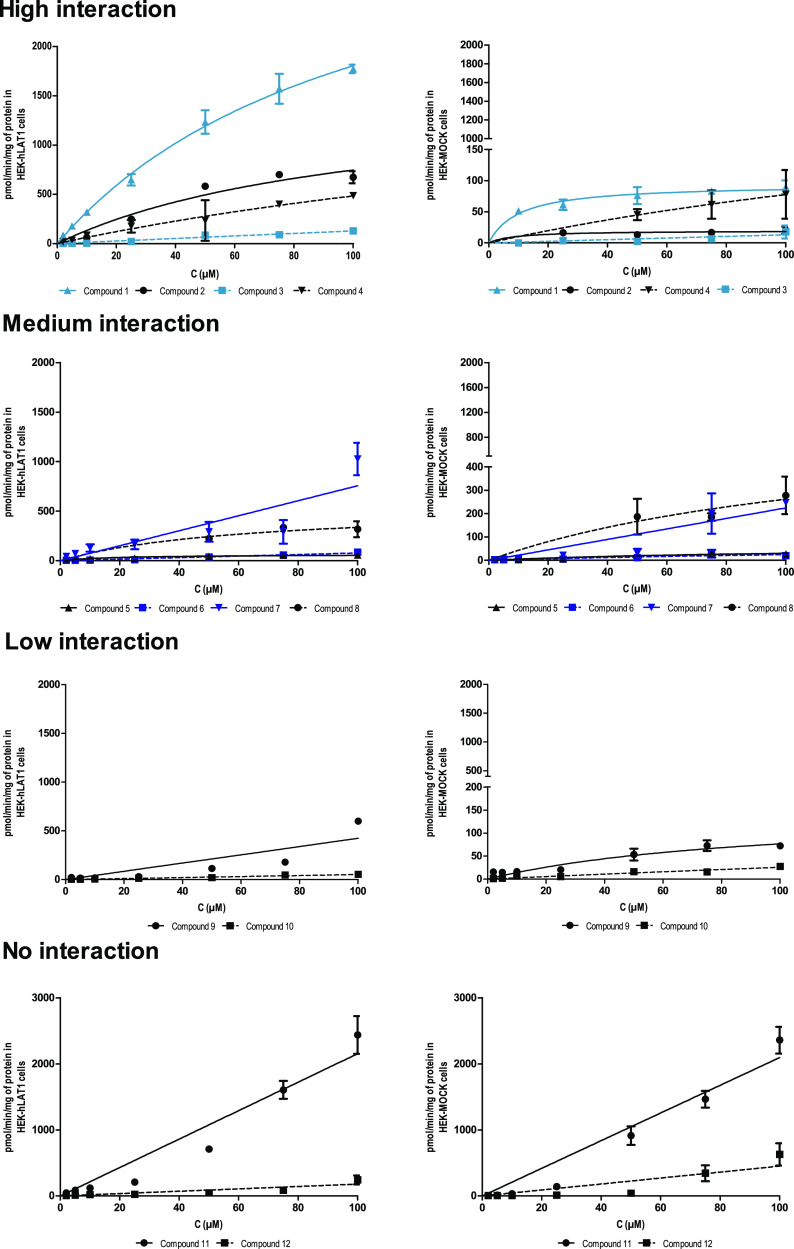
L-type amino acid transporter 1 (LAT1) transfers essential amino acids across cell membranes. Owing to its predominant expression in the blood-brain barrier and tumor cells, LAT1 has been exploited for drug delivery and targeting to the central nervous system (CNS) and various cancers. Although the interactions of amino acids and their mimicking compounds with LAT1 have been extensively investigated, the specific structural features for an optimal drug scaffold have not yet been determined. Here, we evaluated a series of LAT1-targeted drug-phenylalanine conjugates (ligands) by determining their uptake rates by in vitro studies and investigating their interaction with LAT1 via induced-fit docking. Combining the experimental and computational data, we concluded that although LAT1 can accommodate various types of structures, smaller compounds are preferred. As the ligand size increased, its flexibility became more crucial in determining the compound's transportability and interactions. Compounds with linear or planar structures exhibited reduced uptake; those with rigid lipophilic structures lacked interactions and likely utilized other transport mechanisms for cellular entry. Introducing polar groups between aromatic structures enhanced interactions. Interestingly, compounds with a carbamate bond in the aromatic ring's para-position displayed very good transport efficiencies for the larger compounds. Compared to the ester bond, the corresponding amide bond had superior hydrogen bond acceptor properties and increased interactions. A reverse amide bond was less favorable than a direct amide bond for interactions with LAT1. The present information can be applied broadly to design appropriate CNS or antineoplastic drug candidates with a prodrug strategy and to discover novel LAT1 inhibitors used either as direct or adjuvant cancer therapy.
L 型氨基酸转运蛋白 1(LAT1)将必需氨基酸转运穿过细胞膜。由于其在血脑屏障和肿瘤细胞中的主要表达,LAT1 已被用于药物输送和靶向中枢神经系统(CNS)和各种癌症。尽管已经广泛研究了氨基酸及其模拟化合物与 LAT1 的相互作用,但尚未确定最佳药物支架的特定结构特征。在这里,我们通过体外研究确定了一系列 LAT1 靶向药物-苯丙氨酸缀合物(配体)的摄取率,并通过诱导拟合对接研究了它们与 LAT1 的相互作用。结合实验和计算数据,我们得出结论,尽管 LAT1 可以容纳各种类型的结构,但较小的化合物更受欢迎。随着配体尺寸的增加,其柔性在确定化合物的可运输性和相互作用方面变得更加关键。具有线性或平面结构的化合物摄取减少;那些具有刚性疏水性结构的化合物缺乏相互作用,可能利用其他运输机制进入细胞。在芳构结构之间引入极性基团增强了相互作用。有趣的是,在芳环对位带有氨基甲酸酯键的化合物对较大化合物表现出非常好的转运效率。与酯键相比,相应的酰胺键具有更好的氢键受体性质并增加了相互作用。反向酰胺键与 LAT1 的相互作用不如直接酰胺键有利。目前的信息可以广泛应用于设计合适的 CNS 或抗肿瘤药物候选物的前药策略,并发现新型 LAT1 抑制剂,用作直接或辅助癌症治疗。