School of Health & Life Sciences, Teesside University, Middlesbrough, TS1 3BX, UK.
National Horizons Centre, Teesside University, 38 John Dixon Ln, Darlington, DL1 1HG, UK.
Sci Rep. 2022 Nov 18;12(1):19868. doi: 10.1038/s41598-022-24099-4.
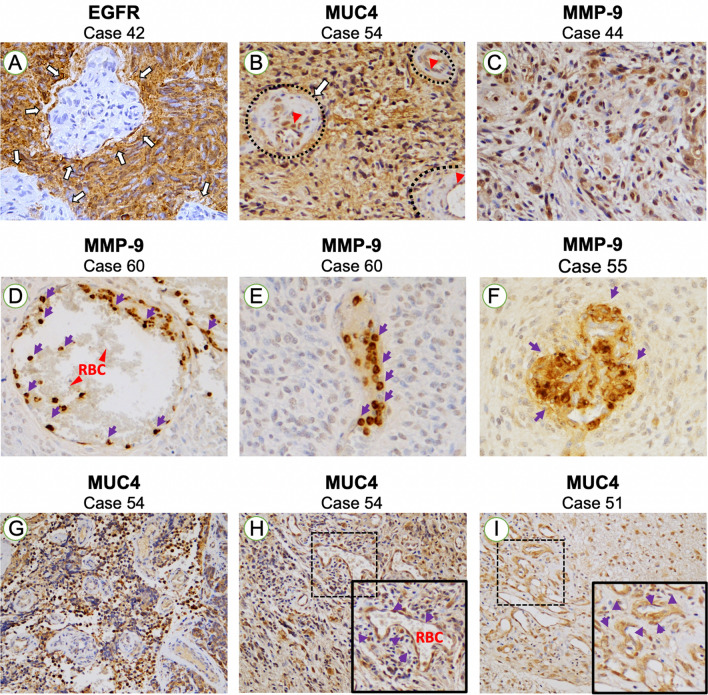
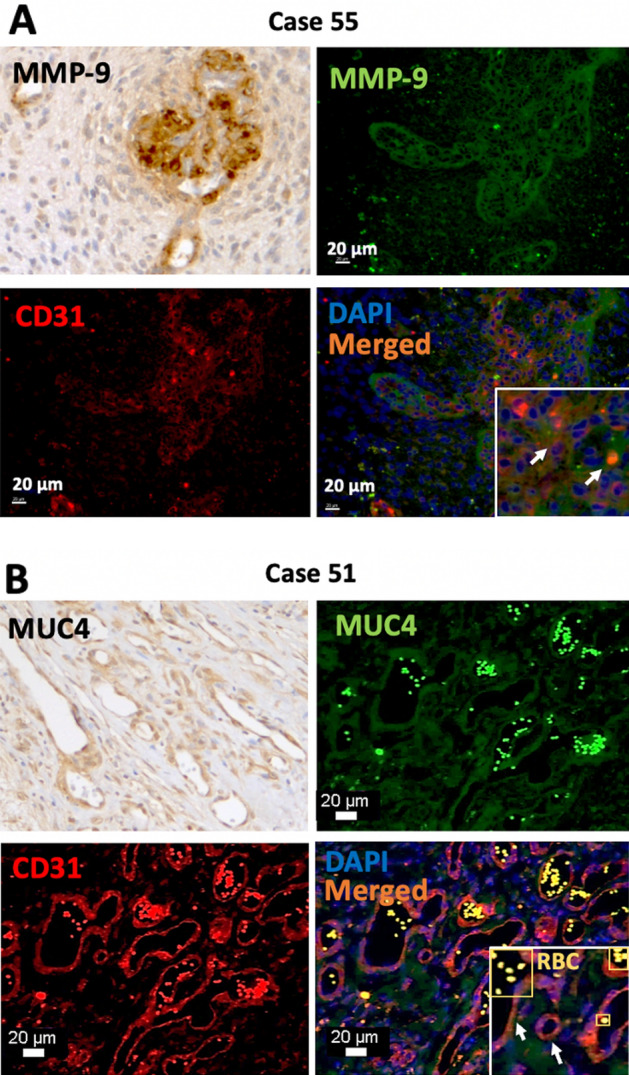
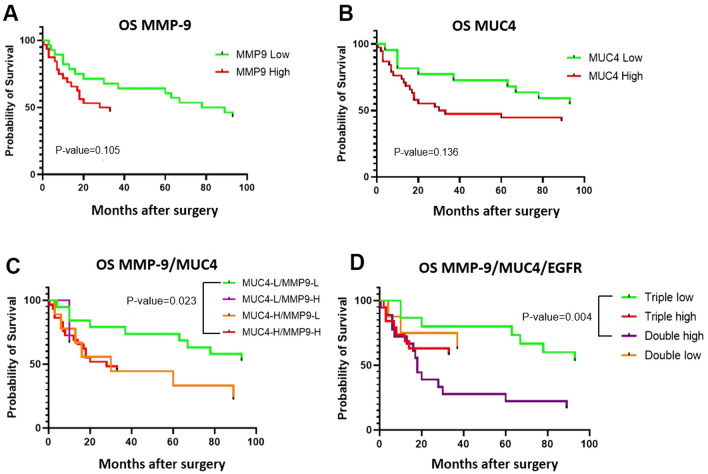
Glioblastoma is the most aggressive form of brain cancer, presenting poor prognosis despite current advances in treatment. There is therefore an urgent need for novel biomarkers and therapeutic targets. Interactions between mucin 4 (MUC4) and the epidermal growth factor receptor (EGFR) are involved in carcinogenesis, and may lead to matrix metalloproteinase-9 (MMP9) overexpression, exacerbating cancer cell invasiveness. In this study, the role of MUC4, MMP9, and EGFR in the progression and clinical outcome of glioma patients was investigated. Immunohistochemistry (IHC) and immunofluorescence (IF) in fixed tissue samples of glioma patients were used to evaluate the expression and localization of EGFR, MMP9, and MUC4. Kaplan-Meier survival analysis was also performed to test the prognostic utility of the proteins for glioma patients. The protein levels were assessed with enzyme-linked immunosorbent assay (ELISA) in serum of glioma patients, to further investigate their potential as non-invasive serum biomarkers. We demonstrated that MUC4 and MMP9 are both significantly upregulated during glioma progression. Moreover, MUC4 is co-expressed with MMP9 and EGFR in the proliferative microvasculature of glioblastoma, suggesting a potential role for MUC4 in microvascular proliferation and angiogenesis. The combined high expression of MUC4/MMP9, and MUC4/MMP9/EGFR was associated with poor overall survival (OS). Finally, MMP9 mean protein level was significantly higher in the serum of glioblastoma compared with grade III glioma patients, whereas MUC4 mean protein level was minimally elevated in higher glioma grades (III and IV) compared with control. Our results suggest that MUC4, along with MMP9, might account for glioblastoma progression, representing potential therapeutic targets, and suggesting the 'MUC4/MMP9/EGFR axis' may play a vital role in glioblastoma diagnostics.
胶质母细胞瘤是最具侵袭性的脑癌,尽管目前在治疗方面取得了进展,但预后仍然不佳。因此,迫切需要新的生物标志物和治疗靶点。黏蛋白 4(MUC4)与表皮生长因子受体(EGFR)之间的相互作用参与了癌症的发生,并可能导致基质金属蛋白酶 9(MMP9)的过度表达,从而加剧癌细胞的侵袭性。在这项研究中,研究了 MUC4、MMP9 和 EGFR 在胶质瘤患者进展和临床结局中的作用。使用免疫组化(IHC)和固定组织样本的免疫荧光(IF)来评估 EGFR、MMP9 和 MUC4 的表达和定位。还进行了 Kaplan-Meier 生存分析,以测试这些蛋白质对胶质瘤患者的预后效用。通过酶联免疫吸附试验(ELISA)评估了胶质瘤患者血清中的蛋白质水平,以进一步研究它们作为非侵入性血清生物标志物的潜力。我们证明 MUC4 和 MMP9 在胶质瘤进展过程中均显著上调。此外,MUC4 在胶质母细胞瘤的增殖性微血管中与 MMP9 和 EGFR 共表达,表明 MUC4 在微血管增殖和血管生成中可能发挥作用。MUC4/MMP9 和 MUC4/MMP9/EGFR 的高表达与总生存期(OS)不良相关。最后,与 III 级胶质瘤患者相比,胶质母细胞瘤患者的 MMP9 平均蛋白水平显著升高,而与对照组相比,较高的胶质瘤分级(III 级和 IV 级)中 MUC4 平均蛋白水平略有升高。我们的研究结果表明,MUC4 与 MMP9 一起可能导致胶质母细胞瘤的进展,代表潜在的治疗靶点,并表明“MUC4/MMP9/EGFR 轴”可能在胶质母细胞瘤的诊断中发挥重要作用。