Department of nephropathy rheumatology and immunology, Wenzhou hospital of traditional Chinese medicine affiliated to Zhejiang Chinese medicine university, Wenzhou City, China.
Department of nephropathy rheumatology and immunology, Wenzhou hospital of traditional Chinese medicine affiliated to Zhejiang Chinese medicine university, No. 9, Liuhongqiao Road, Lucheng District, Wenzhou City, 325000, China.
BMC Endocr Disord. 2022 Nov 18;22(1):286. doi: 10.1186/s12902-022-01192-3.
This study aims to explore the association between dietary acid load and hyperuricemia in Chinese adults.
A case-control study was conducted. Adult participants with hyperuricemia were recruited as the cases and those without hyperuricemia were as the controls. Food consumption was evaluated by food frequency questionnaire (FFQ). Dietary acid load was assessed by potential renal acid load (PRAL) and net endogenous acid production (NEAP). Dietary acid load was divided into four levels: the first quartile (Q1), the second quartile (Q2), the third quartile (Q3) and the fourth quartile (Q4). Logistic regression model was applied for exploring the association between dietary acid load (PRAL and NEAP) and hyperuricemia. Odds ratio (OR) and its correspondence confidence interval (CI) were computed.
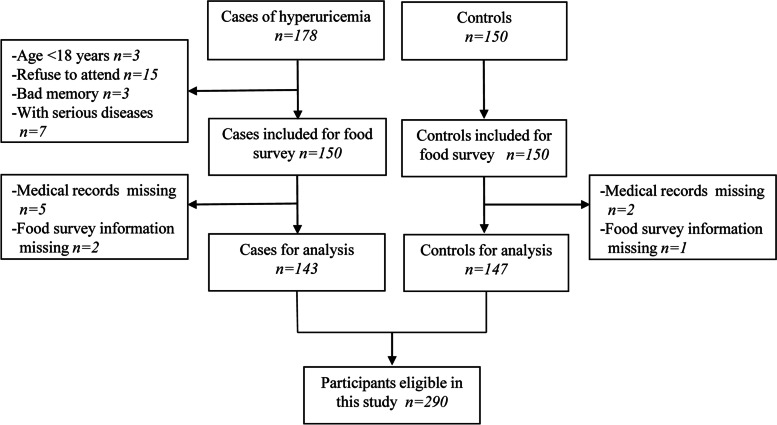
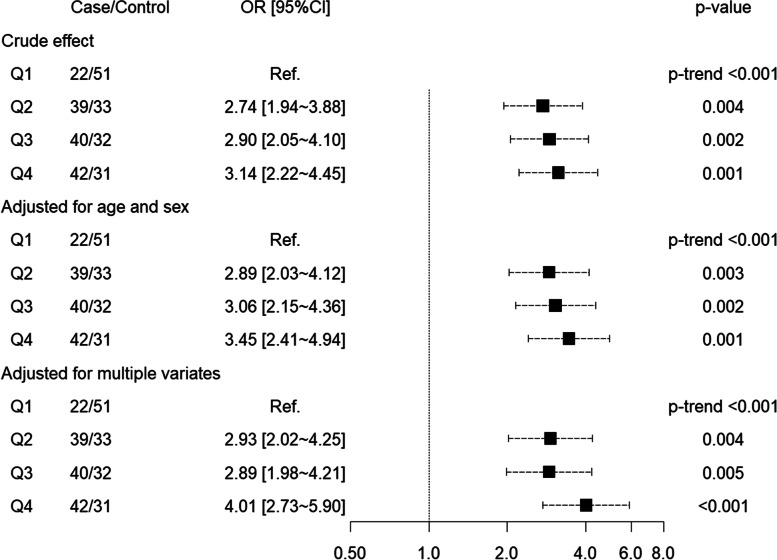
A total of 290 participants were eligible in this study, in which there were 143 individuals in case group and 147 in control group. A higher level of PRAL was found to be associated with odds of hyperuricemia. ORs of hyperuricemia for Q2, Q3 and Q4 of PRAL were 2.74 (95%CI: 1.94 ~ 3.88, p-value: 0.004), 2.90 (95%CI: 2.05 ~ 4.10, p-value: 0.002) and 3.14 (95%CI: 2.22 ~ 4.45, p-value: 0.001), respectively. There was a positive association between elevated NEAP and hyperuricemia. OR of hyperuricemia for Q2 was not material significance (OR:1.54, 95%CI: 0.93 ~ 2.53, p-value: 0.210), however, ORs of hyperuricemia for Q3 (OR: 2.40, 95%CI: 1.70 ~ 3.38, p-value: 0.011) and Q4 (OR: 3.27, 95%CI: 2.31 ~ 4.62, p-value: 0.001) were statistically significant.
Higher level of dietary acid load was found to be associated with hyperuricemia in Chinese adults, indicative of advocation of a well-balanced diet in this population.
本研究旨在探讨中国成年人饮食酸负荷与高尿酸血症之间的关系。
采用病例对照研究。招募高尿酸血症患者作为病例组,无高尿酸血症患者作为对照组。通过食物频率问卷(FFQ)评估食物摄入情况。采用潜在肾酸负荷(PRAL)和净内源性酸生成(NEAP)评估饮食酸负荷。饮食酸负荷分为四个水平:第一四分位数(Q1)、第二四分位数(Q2)、第三四分位数(Q3)和第四四分位数(Q4)。应用 logistic 回归模型探讨饮食酸负荷(PRAL 和 NEAP)与高尿酸血症的关系。计算比值比(OR)及其对应置信区间(CI)。
本研究共纳入 290 名参与者,其中病例组 143 人,对照组 147 人。较高的 PRAL 水平与高尿酸血症的发生风险相关。PRAL 的 Q2、Q3 和 Q4 水平与高尿酸血症的 OR 值分别为 2.74(95%CI:1.943.88,p 值:0.004)、2.90(95%CI:2.054.10,p 值:0.002)和 3.14(95%CI:2.224.45,p 值:0.001)。升高的 NEAP 与高尿酸血症呈正相关。Q2 水平的高尿酸血症 OR 值无统计学意义(OR:1.54,95%CI:0.932.53,p 值:0.210),而 Q3(OR:2.40,95%CI:1.703.38,p 值:0.011)和 Q4(OR:3.27,95%CI:2.314.62,p 值:0.001)水平的高尿酸血症 OR 值具有统计学意义。
中国成年人饮食酸负荷水平较高与高尿酸血症相关,提示该人群应提倡均衡饮食。