First Department of Cardiology, First Affiliated Hospital, School of Medicine, Shihezi University, Shihezi, Xinjiang, People's Republic of China.
The Clinical Laboratory Medical Center, The First Affiliated Hospital of Xinjiang Medical University, Urumqi, Xinjiang, People's Republic of China.
BMC Cardiovasc Disord. 2022 Nov 20;22(1):494. doi: 10.1186/s12872-022-02940-y.
In patients with heart failure, anxiety disorder is common and associated with adverse prognosis. This study intended to find more confounding factors of Chinese heart failure patients.
We enrolled 284 hospitalized heart failure patients, whose New York Heart Association (NYHA) classed as II-IV and left ventricular ejection fraction (LVEF) ≤ 45%. All the patients were scaled in Hamilton Rating Scale for Anxiety (14-items) (HAM-A14). Ordinal logistic regression analysis was performed to examine the association of correlated factors with anxiety disorder.
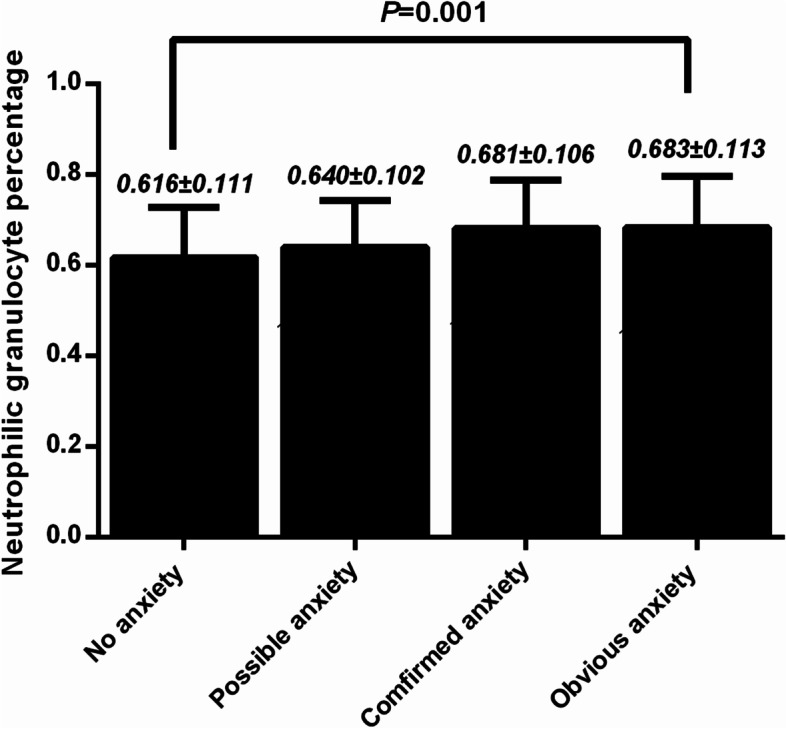
There were 184 patients had anxiety accounting for 64.8% of all 284 hospitalized heart failure patients. The neutrophilic granulocyte percentage, urea nitrogen, total bilirubin and brain natriuretic peptide were positively associated with HAM-A14 score, meanwhile, the hemoglobin, red blood cells counts, albumin and LVEF were negatively associated with HAM-A14 score (All P < 0.05). After the adjustments of sex, hemoglobin, urea nitrogen, total bilirubin, albumin and brain natriuretic peptide, the neutrophilic granulocyte percentage was significantly associated with anxiety (OR = 43.265, P = 0.012). The neutrophilic granulocyte percentage was 0.616 ± 0.111, 0.640 ± 0.102, 0.681 ± 0.106 and 0.683 ± 0.113 in heart failure patients with no anxiety, possible anxiety, confirmed anxiety and obvious anxiety, respectively.
Neutrophilic granulocyte percentage as well as the traditional risk factors such as sex, urea nitrogen and brain natriuretic peptide is associated with anxiety in hospitalized heart failure patients.
在心力衰竭患者中,焦虑障碍很常见,且与不良预后相关。本研究旨在寻找更多中国心力衰竭患者的混杂因素。
我们纳入了 284 例因心力衰竭住院的患者,纽约心脏病协会(NYHA)心功能分级为 II-IV 级,左心室射血分数(LVEF)≤45%。所有患者均进行汉密尔顿焦虑量表(14 项)(HAM-A14)评分。采用有序逻辑回归分析探讨相关因素与焦虑障碍的关系。
共有 184 例患者存在焦虑,占 284 例心力衰竭住院患者的 64.8%。中性粒细胞百分比、尿素氮、总胆红素和脑钠肽与 HAM-A14 评分呈正相关,而血红蛋白、红细胞计数、白蛋白和 LVEF 与 HAM-A14 评分呈负相关(均 P<0.05)。在校正性别、血红蛋白、尿素氮、总胆红素、白蛋白和脑钠肽后,中性粒细胞百分比与焦虑显著相关(OR=43.265,P=0.012)。无焦虑、可能焦虑、确诊焦虑和明显焦虑的心力衰竭患者中性粒细胞百分比分别为 0.616±0.111、0.640±0.102、0.681±0.106 和 0.683±0.113。
中性粒细胞百分比与性别、尿素氮和脑钠肽等传统危险因素与住院心力衰竭患者的焦虑相关。