Kakinuma Toshiyuki, Kakinuma Kaoru, Matsuda Yoshio, Ohwada Michitaka, Yanagida Kaoru
Department of Obstetrics and Gynecology, International University of Health and Welfare Hospital, Nasushiobara-City 329-2763, Tochigi, Japan.
World J Clin Cases. 2022 Nov 16;10(32):11949-11954. doi: 10.12998/wjcc.v10.i32.11949.
Asherman's syndrome is characterized by reduced menstrual volume and adhesions within the uterine cavity and cervix, resulting in inability to carry a pregnancy to term, placental malformation, or infertility. We present the case of a 40-year-old woman diagnosed with Asherman's syndrome who successfully gave birth to a live full-term neonate after hysteroscopic adhesiolysis under laparoscopic observation, intrauterine device insertion, and Kaufmann therapy.
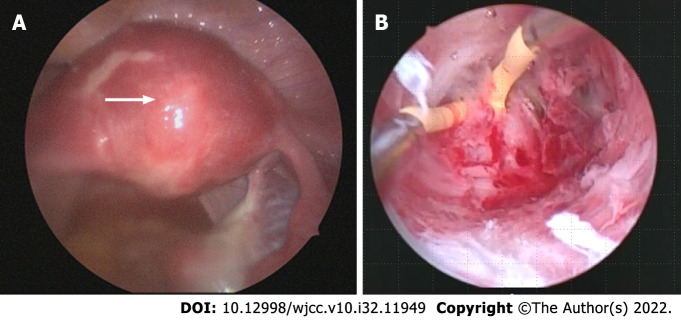
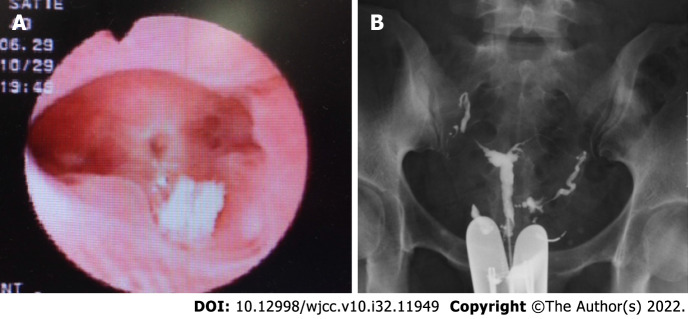
A 40-year-old woman (Gravida 3, Para 0) arrived at our hospital for specialist care to carry her pregnancy to term. She had previously undergone six sessions of dilation and curettage owing to a hydatidiform mole and persistent trophoblastic disease, followed by chemotherapy. She subsequently became pregnant twice, but both pregnancies resulted in spontaneous miscarriages during the first trimester. Her menstrual periods were very light and of short duration. Hysteroscopic adhesiolysis with concurrent laparoscopy was performed, and Asherman's syndrome was diagnosed. The uterine adhesions covered the area from the internal cervical os to the uterine fundus. Postoperative Kaufmann therapy was administered, and endometrial regeneration was confirmed using hysteroscopy. She became pregnant 9 mo postoperatively and delivered through elective cesarean section at 37 wk of gestation. The postpartum course was uneventful, and she was discharged on postoperative day 7.
Hysteroscopic adhesiolysis with concurrent laparoscopy enables identification and resection of the affected area and safe and accurate surgery, without complications.
阿谢曼综合征的特征是月经量减少以及子宫腔和宫颈内粘连,导致无法足月妊娠、胎盘畸形或不孕。我们报告一例40岁被诊断为阿谢曼综合征的女性病例,该患者在腹腔镜观察下进行宫腔镜粘连松解术、宫内节育器置入及考夫曼疗法后成功产下一名足月活产新生儿。
一名40岁女性(孕3产0)因希望足月妊娠前来我院寻求专科治疗。她曾因葡萄胎和持续性滋养细胞疾病接受了6次刮宫术,随后进行了化疗。她随后怀孕两次,但均在孕早期自然流产。她的月经量非常少且持续时间短。进行了宫腔镜粘连松解术并同时进行腹腔镜检查,诊断为阿谢曼综合征。子宫粘连覆盖了从宫颈内口到子宫底部的区域。术后给予考夫曼疗法,并通过宫腔镜确认子宫内膜再生。她术后9个月怀孕,并在妊娠37周时通过择期剖宫产分娩。产后过程顺利,术后第7天出院。
宫腔镜粘连松解术并同时进行腹腔镜检查能够识别并切除受影响区域,实现安全、准确的手术,且无并发症。