Huang Yiyao, Driedonks Tom A P, Cheng Lesley, Rajapaksha Harinda, Turchinovich Andrey, Routenberg David A, Nagaraj Rajini, Redding-Ochoa Javier, Arab Tanina, Powell Bonita H, Pletnikova Olga, Troncoso Juan C, Zheng Lei, Hill Andrew F, Mahairaki Vasiliki, Witwer Kenneth W
Department of Molecular and Comparative Pathobiology (Y.H., T.A.P.D., T.A., B.H.P., K.W.W.), Johns Hopkins University School of Medicine, Baltimore, MD; Department of Biochemistry and Chemistry (L.C., H.R., A.F.H.), La Trobe Institute for Molecular Science, La Trobe University, Bundoora, Australia; Molecular Epidemiology (A.T.), German Cancer Research Center DKFZ, Heidelberg, Germany; SciBerg e.Kfm (A.T.), Mannheim, Germany; Meso Scale Diagnostics (D.A.R., R.N.), LLC, Rockville, MD; Department of Pathology (J.R.-O., O.P., J.C.T.), Johns Hopkins University School of Medicine, Baltimore, MD; Department of Pathology and Anatomical Sciences (O.P.), Jacobs School of Medicine and Biomedical Sciences, University at Buffalo, Buffalo, NY; Department of Neurology (J.C.T., K.W.W.), Johns Hopkins University School of Medicine, Baltimore, MD; Department of Laboratory Medicine (L.Z.), Institute of Health and Sport (A.F.H.), Victoria University, Melbourne, Australia; Nanfang Hospital, Southern Medical University, Guangzhou, Guangdong, China; Department of Genetic Medicine (V.M.); and Richman Family Precision Medicine Center of Excellence in Alzheimer's Disease (V.M., K.W.W.), Johns Hopkins University School of Medicine, Baltimore, MD.
Neurol Genet. 2022 Oct 26;8(6):e200026. doi: 10.1212/NXG.0000000000200026. eCollection 2022 Dec.
Variants of the apolipoprotein E gene are the greatest known risk factors for sporadic Alzheimer disease (AD). Three major isoform alleles, , and , encode and produce proteins that differ by only 1-2 amino acids but have different binding partner interactions. Whereas is protective against AD relative to is associated with an increased risk for AD development. However, the role of in gene regulation in AD pathogenesis has remained largely undetermined. Extracellular vesicles (EVs) are lipid bilayer-delimited particles released by cells to dispose of unwanted materials and mediate intercellular communication, and they are implicated in AD pathophysiology. Brain-derived EVs (bdEVs) could act locally in the tissue and reflect cellular changes. To reveal whether genotype affects EV components in AD brains, bdEVs were separated from patients with AD with different genotypes for parallel small RNA and protein profile.
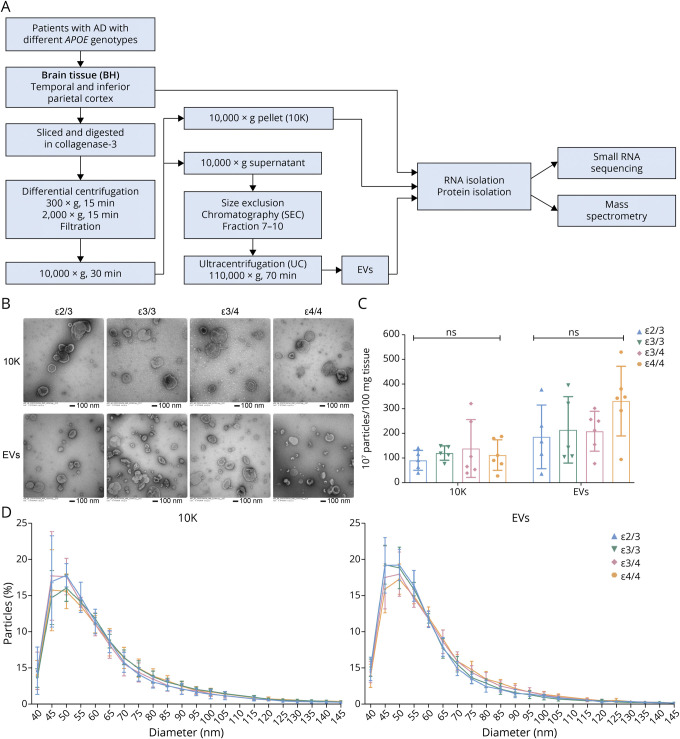
bdEVs from late-stage AD brains (BRAAK stages 5-6) from patients with genotypes (n = 5), (n = 5), (n = 6), and (n = 6) were separated using our published protocol into a 10,000 pelleted extracellular fraction (10K) and a further purified EV fraction. Counting, sizing, and multiomic characterization by small RNA sequencing and proteomic analysis were performed for 10K, EVs, and source tissue.
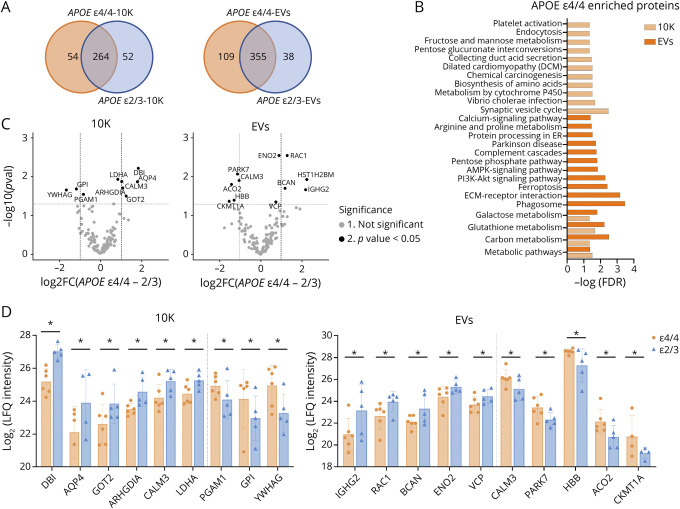
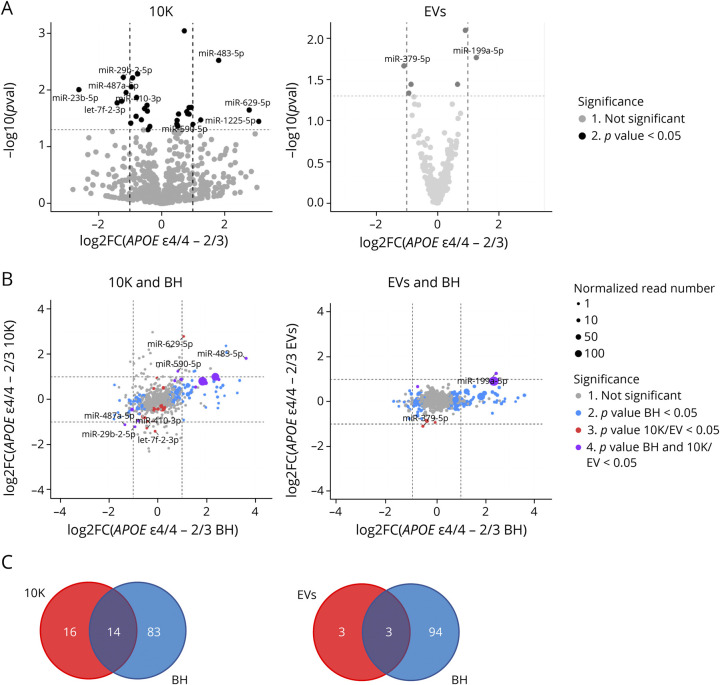
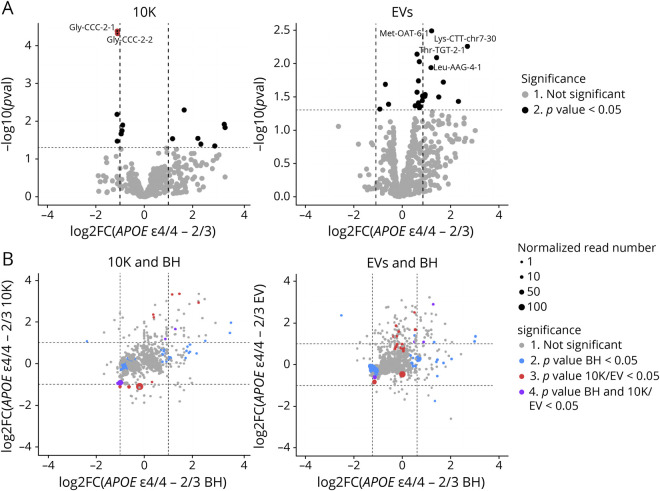
Comparing genotypes, no significant differences in bdEV total particle concentration or morphology were observed. Overall small RNA and protein profiles of 10K, EVs, and source tissue also did not differ substantially between different genotypes. However, several differences in individual RNAs (including miRNAs and tRNAs) and proteins in 10K and EVs were observed when comparing the highest and lowest risk groups and . Bioinformatic analysis and previous publications indicate a potential regulatory role of these molecules in AD.
For patients with late-stage AD in this study, only a few moderate differences were observed for small RNA and protein profiles between genotypes. Among these, several newly identified 10K and EV-associated molecules may play roles in AD progression. Possibly, larger genotype-related differences exist and are more apparent in or before earlier disease stages.
载脂蛋白E基因变体是散发性阿尔茨海默病(AD)已知的最大风险因素。三种主要的异构体等位基因ε2、ε3和ε4,编码并产生仅相差1 - 2个氨基酸但具有不同结合伴侣相互作用的蛋白质。相对于ε4,ε2对AD具有保护作用,而ε4与AD发病风险增加相关。然而,ε4在AD发病机制中的基因调控作用在很大程度上仍未确定。细胞外囊泡(EVs)是细胞释放的脂质双分子层界定的颗粒,用于处理不需要的物质并介导细胞间通讯,它们与AD病理生理学有关。脑源性EVs(bdEVs)可在组织局部发挥作用并反映细胞变化。为了揭示ε4基因型是否影响AD大脑中的EV成分,将来自不同ε4基因型的AD患者的bdEVs分离出来,用于平行的小RNA和蛋白质谱分析。
使用我们已发表的方案,将来自基因型为ε2(n = 5)、ε3(n = 5)、ε4(n = 6)和ε4/ε4(n = 6)的晚期AD大脑(Braak分期5 - 6期)的bdEVs分离成10,000×g沉淀的细胞外部分(10K)和进一步纯化的EV部分。对10K、EVs和来源组织进行计数、大小测定以及通过小RNA测序和蛋白质组分析进行多组学表征。
比较ε4基因型,未观察到bdEV总颗粒浓度或形态有显著差异。不同ε4基因型之间,10K、EVs和来源组织的总体小RNA和蛋白质谱也没有实质性差异。然而,在比较最高和最低风险组ε2/ε2和ε4/ε4时,观察到10K和EVs中个别RNA(包括miRNA和tRNA)和蛋白质存在一些差异。生物信息学分析和先前的出版物表明这些分子在AD中具有潜在的调控作用。
在本研究的晚期AD患者中,ε4基因型之间的小RNA和蛋白质谱仅观察到一些适度差异。其中,一些新鉴定的与10K和EV相关分子可能在AD进展中起作用。可能在疾病早期或之前就存在更大的与基因型相关的差异且更为明显。