Honorato Fernando Sousa, de Deus Lysleine Alves, Reis Andrea Lucena, Neves Rodrigo Vanerson Passos, Corrêa Hugo de Luca, Medeiros Ana Paola Brasil, Haberland Débora Fernanda, Medeiros Radamés Maciel Vitor, Prestes Jonato, Ferreira Carlos Ernesto Santos, Rosa Thiago Santos
Graduate Program in Physical Education, Catholic University of Brasília-DF, Brasília, Brazil.
Aerospace Medicine Institute-Brazil, Rio de Janeiro, Brazil.
Front Physiol. 2022 Nov 3;13:1005016. doi: 10.3389/fphys.2022.1005016. eCollection 2022.
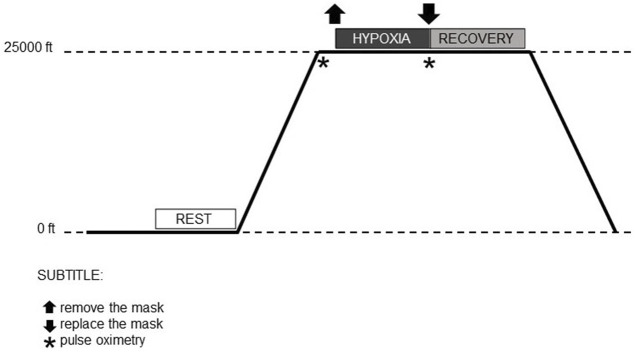
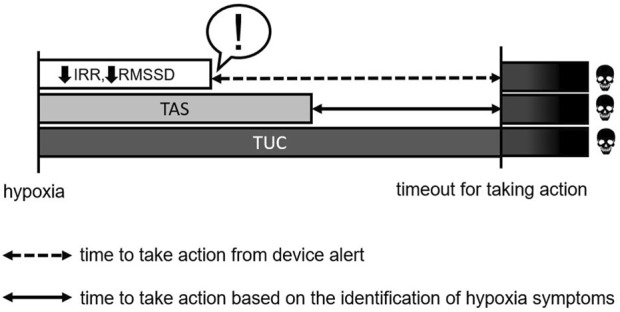
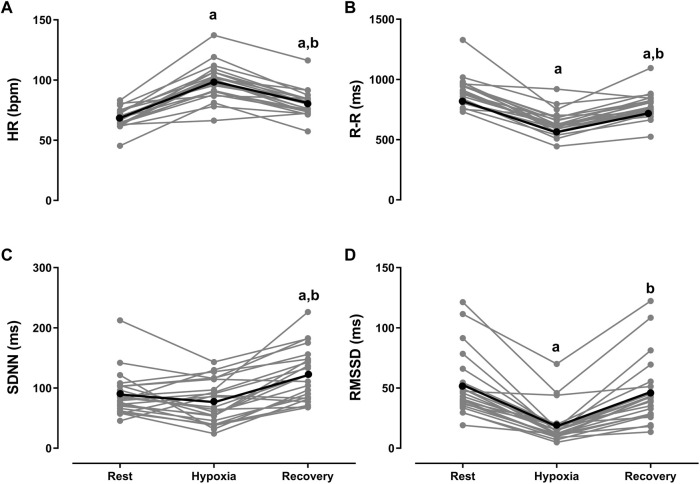
Hypobaric hypoxia during a flight can cause accidents, resulting in deaths. Heart rate variability may be more sensitive than self-reported hypoxia symptoms to the effects of HH. The level of physical fitness can contribute to efficient cardiac autonomic modulation. However, no studies have examined the association between fitness, heart rate variability, and the time of onset of hypobaric hypoxia symptoms. To analyze the influence of hypobaric hypoxia on cardiac autonomic function at the time of onset of the first symptoms and its association with physical fitness. Male airmen trained and belonging to the staff of the Brazilian Air Force ( = 23; 30 ± 6.7 years) participated in a flight simulation in a 25.000 ft hypobaric chamber. Heart rate variability was recorded with a Polar cardiac monitor. Data were analyzed in the time-domain method using Kubios software. We evaluated pulse oximetry with the Mindray PM-60 oximeter. Physical fitness assessment test results were collected from the archive. At moments rest vs. hypoxia revealed a decrease in heart rate variability indices iRR and RMSSD ( < 0.001). The individual analysis of hypoxia-rest variation showed that 100% of the airmen had a negative delta for both iRR and RMSSD indices. The time of onset of hypoxia symptoms was not associated with body composition, physical fitness, oxygen saturation, and HRV indices. Also, we suggest that cardiac autonomic modulation seems to be more sensitive to the effects of hypobaric hypoxia at 25.000 ft than the self-reported subjective perception of symptoms. Further devices that alert to a hypoxic condition during a flight should consider heart rate variability allowing more time and security to reestablish control of the flight.
飞行过程中的低压缺氧可能导致事故,造成人员死亡。心率变异性可能比自我报告的缺氧症状对低压缺氧的影响更敏感。身体素质水平有助于实现有效的心脏自主神经调节。然而,尚无研究探讨身体素质、心率变异性与低压缺氧症状发作时间之间的关联。为分析低压缺氧在首次症状发作时对心脏自主神经功能的影响及其与身体素质的关系。巴西空军的男性飞行员(n = 23;30±6.7岁)参与了在25000英尺低压舱内的飞行模拟。使用 Polar 心脏监测仪记录心率变异性。使用 Kubios 软件通过时域法分析数据。我们使用迈瑞 PM - 60 血氧仪评估脉搏血氧饱和度。从档案中收集身体素质评估测试结果。在静息与缺氧状态下,心率变异性指标 iRR 和 RMSSD 降低(P < 0.001)。对缺氧 - 静息变化的个体分析表明,100%的飞行员 iRR 和 RMSSD 指标的变化量均为负值。缺氧症状的发作时间与身体成分、身体素质、血氧饱和度和心率变异性指标无关。此外,我们认为在25000英尺高度时,心脏自主神经调节似乎比自我报告的主观症状感知对低压缺氧的影响更敏感。飞行过程中用于提醒缺氧状况的进一步设备应考虑心率变异性,以便有更多时间和安全性来重新建立飞行控制。