Kennedy Chris J, Marwaha Jayson S, Beaulieu-Jones Brendin R, Scalise P Nina, Robinson Kortney A, Booth Brandon, Fleishman Aaron, Nathanson Larry A, Brat Gabriel A
Department of Surgery, Beth Israel Deaconess Medical Center, 110 Francis Street, Suite 2G, Boston, MA 02215, USA.
Center for Precision Psychiatry, Massachusetts General Hospital, Boston, MA, USA.
Surg Pract Sci. 2022 Sep;10. doi: 10.1016/j.sipas.2022.100098. Epub 2022 Jun 10.
Post-discharge opioid consumption is a crucial patient-reported outcome informing opioid prescribing guidelines, but its collection is resource-intensive and vulnerable to inaccuracy due to nonresponse bias.
We developed a post-discharge text message-to-web survey system for efficient collection of patient-reported pain outcomes. We prospectively recruited surgical patients at Beth Israel Deaconess Medical Center in Boston, Massachusetts from March 2019 through October 2020, sending an SMS link to a secure web survey to quantify opioids consumed after discharge from hospitalization. Patient factors extracted from the electronic health record were tested for nonresponse bias and observable confounding. Following targeted learning-based nonresponse adjustment, procedure-specific opioid consumption quantiles (medians and 75th percentiles) were estimated and compared to a previous telephone-based reference survey.
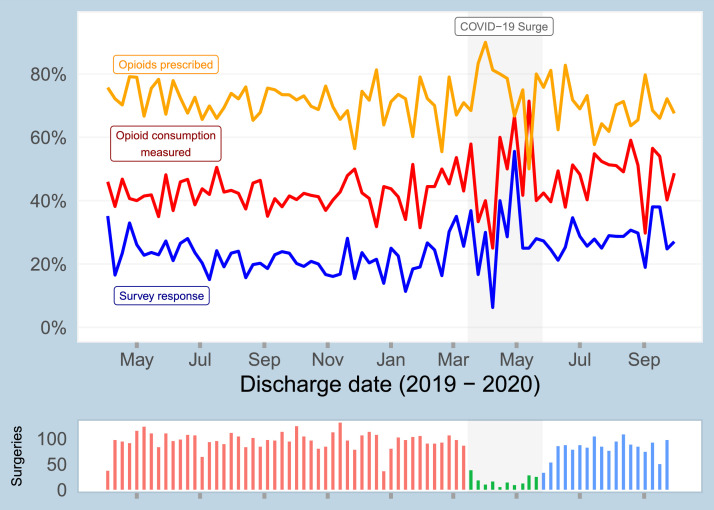
6553 patients were included. Opioid consumption was measured in 44% of patients (2868), including 21% (1342) through survey response. Characteristics associated with inability to measure opioid consumption included age, tobacco use, and prescribed opioid dose. Among the 10 most common procedures, median consumption was only 36% of the median prescription size; 64% of prescribed opioids were not consumed. Among those procedures, nonresponse adjustment corrected the median opioid consumption by an average of 37% (IQR: 7, 65%) compared to unadjusted estimates, and corrected the 75th percentile by an average of 5% (IQR: 0, 12%). This brought median estimates for 5/10 procedures closer to telephone survey-based consumption estimates, and 75th percentile estimates for 2/10 procedures closer to telephone survey-based estimates.
SMS-recruited online surveying can generate reliable opioid consumption estimates after nonresponse adjustment using patient factors recorded in the electronic health record, protecting patients from the risk of inaccurate prescription guidelines.
出院后阿片类药物的使用情况是患者报告的一项关键结果,可为阿片类药物处方指南提供依据,但收集该信息资源密集,且因无应答偏倚而容易出现不准确的情况。
我们开发了一种出院后短信转网络调查系统,用于高效收集患者报告的疼痛结果。2019年3月至2020年10月,我们在马萨诸塞州波士顿的贝斯以色列女执事医疗中心前瞻性招募手术患者,发送短信链接至安全的网络调查问卷,以量化出院后使用的阿片类药物。从电子健康记录中提取患者因素,检测无应答偏倚和可观察到的混杂因素。在基于目标学习的无应答调整之后,估计特定手术的阿片类药物使用量分位数(中位数和第75百分位数),并与之前基于电话的参考调查进行比较。
纳入6553例患者。44%的患者(2868例)测量了阿片类药物使用量,其中21%(1342例)通过调查应答得出。与无法测量阿片类药物使用量相关的特征包括年龄、吸烟情况和开具的阿片类药物剂量。在10种最常见的手术中,使用量中位数仅为处方量中位数的36%;64%的开具阿片类药物未被使用。在这些手术中,与未调整的估计值相比,无应答调整使阿片类药物使用量中位数平均校正了37%(四分位间距:7,65%),使第75百分位数平均校正了5%(四分位间距:0,12%)。这使得10种手术中的5种手术的中位数估计值更接近基于电话调查的使用量估计值,10种手术中的2种手术的第75百分位数估计值更接近基于电话调查的估计值。
通过短信招募的在线调查在使用电子健康记录中记录的患者因素进行无应答调整后,可以得出可靠的阿片类药物使用量估计值,保护患者免受不准确处方指南的风险。