Malik Preeti, Pillai Shreejith, Agarwal Kriti, Abdelwahed Salwa, Bhandari Renu, Singh Abhishek, Chidharla Anusha, Patel Kajal, Singh Priyanka, Manaktala Pritika, Rabbani Rizwan, Koritala Thoyaja, Gupta Sachin
Department of Pathology, Montefiore Medical Center, Bronx, NY, USA.
Preeti Malik and Shreejith Pillai contributed equally to this article as first authors.
Gastroenterology Res. 2022 Oct;15(5):232-239. doi: 10.14740/gr1557. Epub 2022 Oct 19.
Ultrasound-based transient elastography (TE) is a non-invasive alternative to liver biopsy for the staging of hepatic fibrosis due to various chronic liver diseases. This meta-analysis aims to assess the diagnostic accuracy of TE for detecting liver cirrhosis (F4) and severe fibrosis (F3) in patients with chronic liver diseases, in comparison to the gold standard liver biopsy.
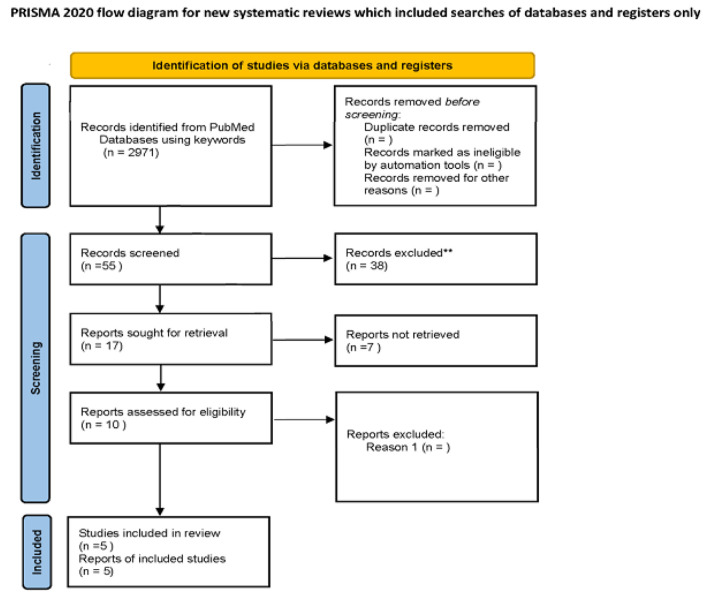
A systematic search was performed using PubMed search engine following Preferred Reporting Items for Systematic reviews and Meta-Analysis (PRISMA) guidelines from inception to May 2021. The meta-analysis studies evaluating the diagnostic accuracy of TE for severe fibrosis and cirrhosis were identified. We conducted a meta-meta-analysis to generate pooled estimates of the sensitivity, specificity, and diagnostic odds ratios (ORs) for F3 and F4 fibrosis stage.
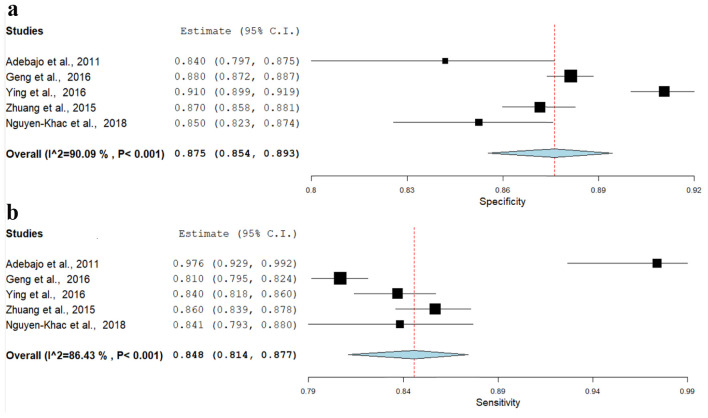
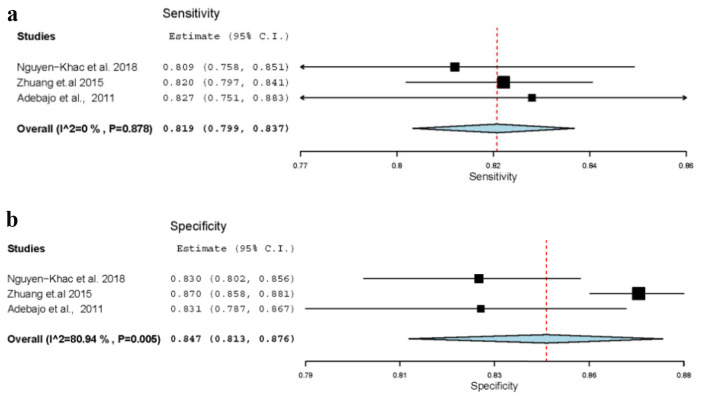
We included five studies with a total of 124 sub-studies and 20,341 patients in our analysis. Three studies have reported the diagnostic accuracy of TE in detecting F3/severe fibrosis stage and found 81.9% pooled sensitivity (95% confidence interval (CI): 79.9-83.7%; P < 0.001) (I = 0%), 84.7% pooled specificity (95% CI: 81.3-87.6%) (I = 81%; P = 0.02). All five studies reported the diagnostic accuracy of TE in detecting F4/liver cirrhosis stage. We found 84.8% pooled sensitivity (95% CI: 81.4-87.7%) (I = 86.4%; P < 0.001), 87.5% pooled specificity (95% CI: 85.4-89.3%) (I = 90%; P < 0.001) and pooled diagnostic OR (41.8; 95% CI: 3.9 - 56.5) (I = 87%; P < 0.001).
Ultrasound-based TE has excellent diagnostic accuracy for identifying cirrhosis and liver fibrosis stages 3. Future studies should focus on estimating the diagnostic accuracy of other fibrosis stages in chronic liver disease patients. This will eventually decrease the risk associated with invasive liver biopsy.
基于超声的瞬时弹性成像(TE)是一种用于各种慢性肝病所致肝纤维化分期的非侵入性肝活检替代方法。本荟萃分析旨在评估与金标准肝活检相比,TE检测慢性肝病患者肝硬化(F4)和重度纤维化(F3)的诊断准确性。
按照系统评价与荟萃分析的首选报告项目(PRISMA)指南,使用PubMed搜索引擎从创刊至2021年5月进行系统检索。确定评估TE对重度纤维化和肝硬化诊断准确性的荟萃分析研究。我们进行了一项荟萃-荟萃分析,以得出F3和F4纤维化分期的敏感性、特异性和诊断比值比(OR)的合并估计值。
我们的分析纳入了5项研究,共124项子研究和20341例患者。3项研究报告了TE检测F3/重度纤维化分期的诊断准确性,发现合并敏感性为81.9%(95%置信区间(CI):79.9 - 83.7%;P < 0.001)(I² = 0%),合并特异性为84.7%(95% CI:81.3 - 87.6%)(I² = 81%;P = 0.02)。所有5项研究均报告了TE检测F4/肝硬化分期的诊断准确性。我们发现合并敏感性为84.8%(95% CI:81.4 - 87.7%)(I² = 86.4%;P < 0.001),合并特异性为87.5%(95% CI:85.4 - 89.3%)(I² = 90%;P < 0.001),合并诊断OR为(41.8;95% CI:3.9 - 56.5)(I² = 87%;P < 0.001)。
基于超声的TE在识别肝硬化和3期肝纤维化方面具有出色的诊断准确性。未来的研究应侧重于评估慢性肝病患者其他纤维化分期的诊断准确性。这最终将降低与侵入性肝活检相关的风险。