Department of Sociology, Center for Community Research and Evaluation, University of Memphis, Memphis, TN, United States.
Department of Politics, Justice, Law, and Philosophy, University of North Alabama, Florence, AL, United States.
Front Public Health. 2022 Nov 3;10:1029196. doi: 10.3389/fpubh.2022.1029196. eCollection 2022.
In the U.S., inequality is widespread and still growing at nearly every level conceivable. This is vividly illustrated in the long-standing, well-documented inequalities in outcomes between rural and urban places in the U.S.; namely, the of disproportionately higher mortality rates in these areas. But what does the concept of "rural" capture and conjure? How we explain these geographic differences has spanned modes of place measurement and definitions. We employ three county-level rural-urban definitions to (1) analyze how spatially specific and robust rural disparities in mortality are and (2) identify whether mortality outcomes are dependent on different definitions.
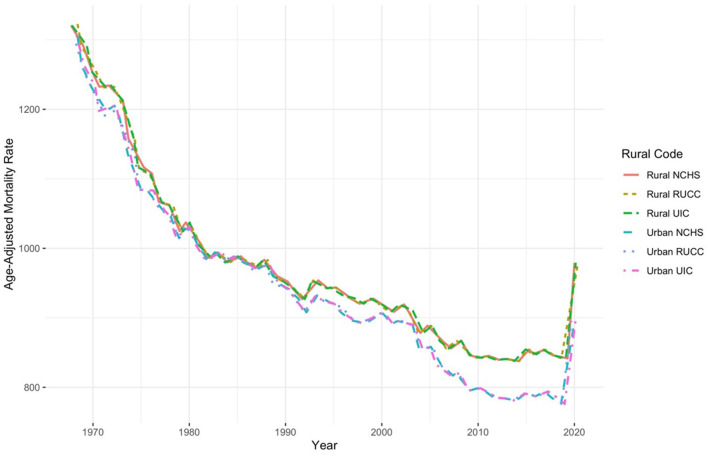
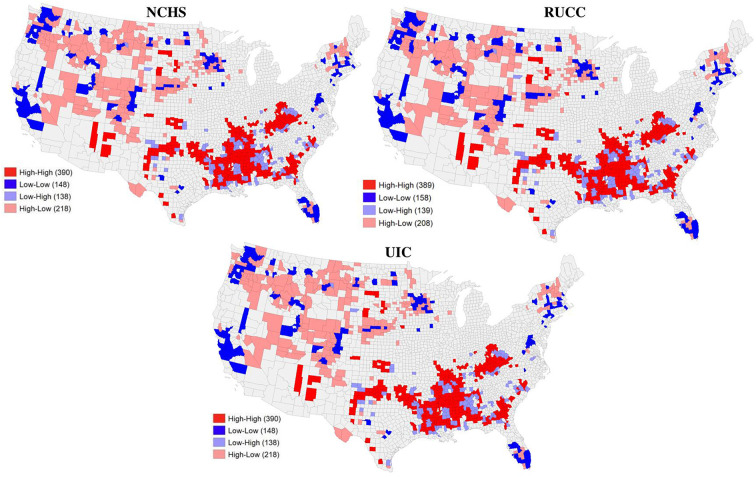
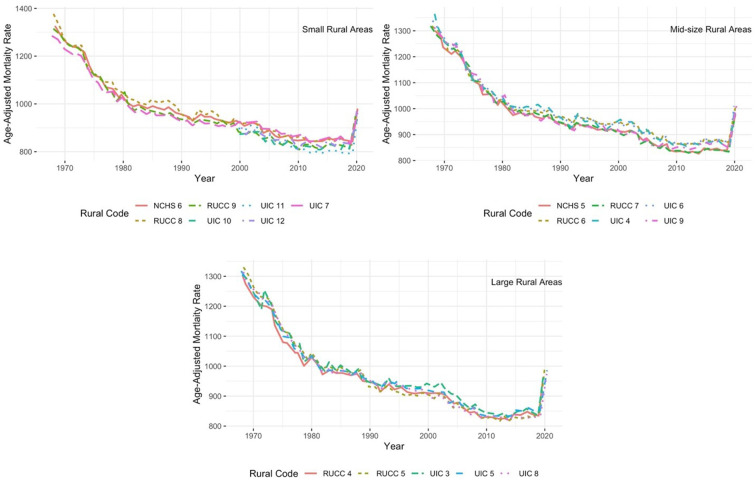
We compare place-based all-cause mortality rates using three typologies of "rural" from the literature to assess robustness of mortality rates across these rural and urban distinctions. Results show longitudinal all-cause mortality rate trends from 1968 to 2020 for various categories of urban and rural areas. We then apply this data to rural and urban geography to analyze the similarity in the distribution of spatial clusters and outliers in mortality using spatial autocorrelation methodologies.
The rural disadvantage in mortality is remarkably consistent regardless of which rural-urban classification scheme is utilized, suggesting the overall pattern of rural disadvantage is robust to any definition. Further, the spatial association between rurality and high rates of mortality is statistically significant.
Different definitions yielding strongly similar results suggests robustness of rurality and consequential insights for actionable policy development and implementation.
在美国,不平等现象普遍存在,而且在几乎所有可以想象的层面上都在不断加剧。这在美国农村和城市地区之间长期存在、有充分记录的结果不平等中得到了生动的体现;即这些地区的死亡率不成比例地更高。但是,“农村”这个概念捕捉到了什么,又能引起什么联想呢?我们解释这些地理差异的方式跨越了地方测量和定义的模式。我们采用三种县级农村-城市定义来(1)分析死亡率的农村差异在空间上的具体程度和稳健性,以及(2)确定死亡率结果是否取决于不同的定义。
我们使用文献中的三种“农村”类型学来比较基于地点的全因死亡率,以评估死亡率在这些农村和城市差异中的稳健性。结果显示了 1968 年至 2020 年各种农村和城市地区的全因死亡率趋势。然后,我们将这些数据应用于农村和城市地理,使用空间自相关方法分析死亡率分布中空间聚类和离群值的相似性。
无论使用哪种农村-城市分类方案,农村地区的死亡率都明显较低,这表明农村劣势的总体模式对任何定义都是稳健的。此外,农村和高死亡率之间的空间关联具有统计学意义。
不同的定义产生了非常相似的结果,这表明农村的稳健性和由此产生的对可操作政策制定和实施的见解。