Yu Danny J, Yu Angus P, Li Shirley X, Chan Rachel N Y, Fong Daniel Y, Chan Derwin K C, Hui Stanley S, Chung Ka Fai, Woo Jean, Wang Chenchen, Irwin Michael R, Siu Parco M
Division of Kinesiology, School of Public Health, Li Ka Shing Faculty of Medicine, The University of Hong Kong, Hong Kong, China.
Department of Psychology, Faculty of Social Sciences, The University of Hong Kong, Hong Kong, China.
J Exerc Sci Fit. 2023 Jan;21(1):67-73. doi: 10.1016/j.jesf.2022.10.012. Epub 2022 Nov 4.
Insomnia is a prevailing health problem among older adults. Tai Chi, a popular mind-body exercise practiced by older people in various oriental communities, has been shown to improve sleep. However, Tai Chi has not been directly compared to cognitive behavioral therapy for insomnia (CBT-I), which is the first-line non-pharmacological treatment for insomnia in older adults. This study aims to examine whether Tai Chi is non-inferior to CBT-I as a treatment for insomnia in older adults.
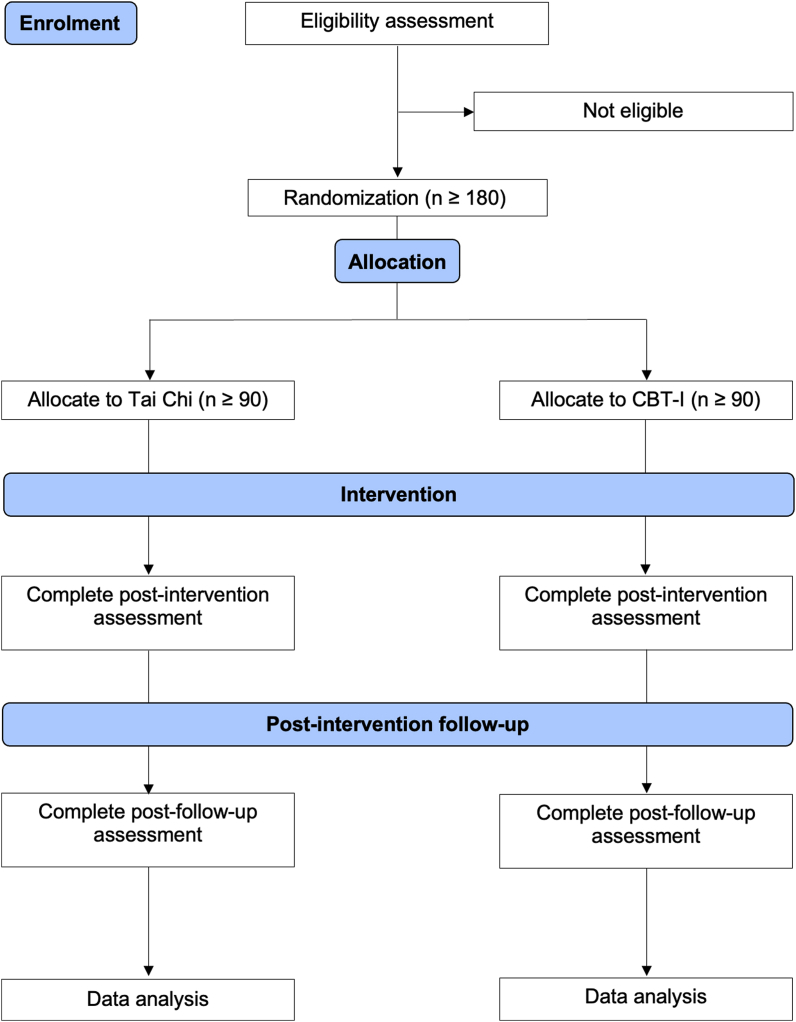
This is a single-center, assessor-blinded, non-inferiority randomized controlled trial comparing Tai Chi and CBT-I in 180 older adults aged ≥50 years with chronic insomnia according to the Diagnostic and Statistical Manual of Mental Disorders, Fifth Edition. Participants will be randomly assigned to either the Tai Chi or CBT-I group. Interventions will last for 3 months with a 12-month follow-up. The primary outcome is self-perceived insomnia severity measured by Insomnia Severity Index (ISI) at 3 months and at 15 months. The secondary outcomes include the remission rate of chronic insomnia, insomnia treatment response, subjective sleep quantity and quality, 7-day actigraphy, 7-day sleep diary, sleep medication, health-related quality of life, mental health, body balance and lower extremity function, adverse events, habitual physical activity, and dietary intake. Measurements will be conducted at baseline, 3 months, and 15 months by outcome assessors who are blinded to the group allocation.
This will be the first non-inferiority randomized controlled trial to compare the efficacy and long-term outcomes of Tai Chi versus CBT-I for treating insomnia in older adults. This study will be of clinical importance as it supports the use of Tai Chi as an alternative non-pharmacological approach for insomnia treatment and sustainable management.
失眠是老年人中普遍存在的健康问题。太极拳是一种在各个东方社区中老年人广泛练习的身心锻炼方式,已被证明可以改善睡眠。然而,太极拳尚未与失眠认知行为疗法(CBT-I)进行直接比较,而CBT-I是老年人失眠的一线非药物治疗方法。本研究旨在探讨太极拳作为老年人失眠治疗方法是否不劣于CBT-I。
这是一项单中心、评估者盲法、非劣效性随机对照试验,根据《精神疾病诊断与统计手册》第五版,比较太极拳和CBT-I对180名年龄≥50岁的慢性失眠老年人的疗效。参与者将被随机分配到太极拳组或CBT-I组。干预为期3个月,并进行12个月的随访。主要结局是在3个月和15个月时通过失眠严重程度指数(ISI)测量的自我感知失眠严重程度。次要结局包括慢性失眠的缓解率、失眠治疗反应、主观睡眠量和质量、7天活动记录仪、7天睡眠日记、睡眠药物使用、健康相关生活质量、心理健康、身体平衡和下肢功能、不良事件、习惯性身体活动和饮食摄入。测量将由对分组情况不知情的结局评估者在基线、3个月和15个月时进行。
这将是第一项比较太极拳与CBT-I治疗老年人失眠的疗效和长期结局的非劣效性随机对照试验。本研究具有临床重要性,因为它支持将太极拳作为失眠治疗和可持续管理的替代非药物方法。