Department of Medical Psychology, Hospital Gelderse Vallei, Ede, The Netherlands.
Department of Medical Psychology, Amsterdam University Medical Centers, University of Amsterdam, Amsterdam Public Health Research Institute, Amsterdam, The Netherlands.
Trials. 2021 Dec 11;22(1):904. doi: 10.1186/s13063-021-05868-4.
Insomnia is common in people with long-term medical conditions and is related to increased mortality and morbidity. Cognitive behavioral therapy for insomnia (CBT-I) is first choice treatment and effective for people with insomnia and comorbid long-term medical conditions. However, CBT-I has some limitations as it might not always be available or appeal to patients with medical conditions. Furthermore, a small proportion of patients do not respond to CBT-I. Preliminary evidence and clinical experience suggest that low-dose amitriptyline (AM) might be an effective alternative to treat insomnia in patients with medical comorbidity. In this randomized controlled trial, we will determine whether AM is non-inferior to the first choice treatment for insomnia, CBT-I.
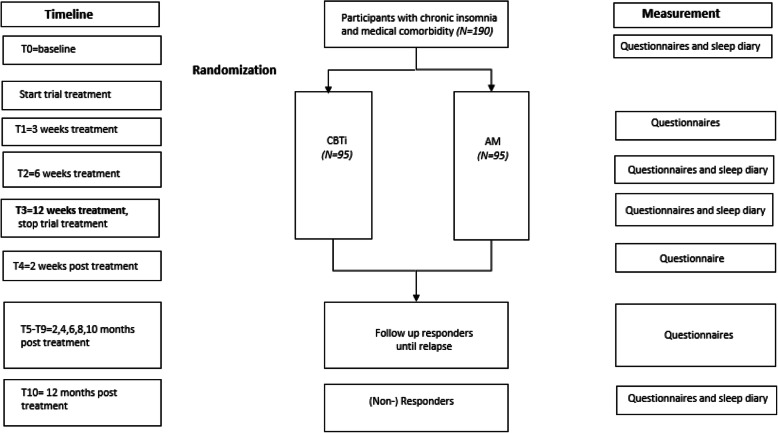
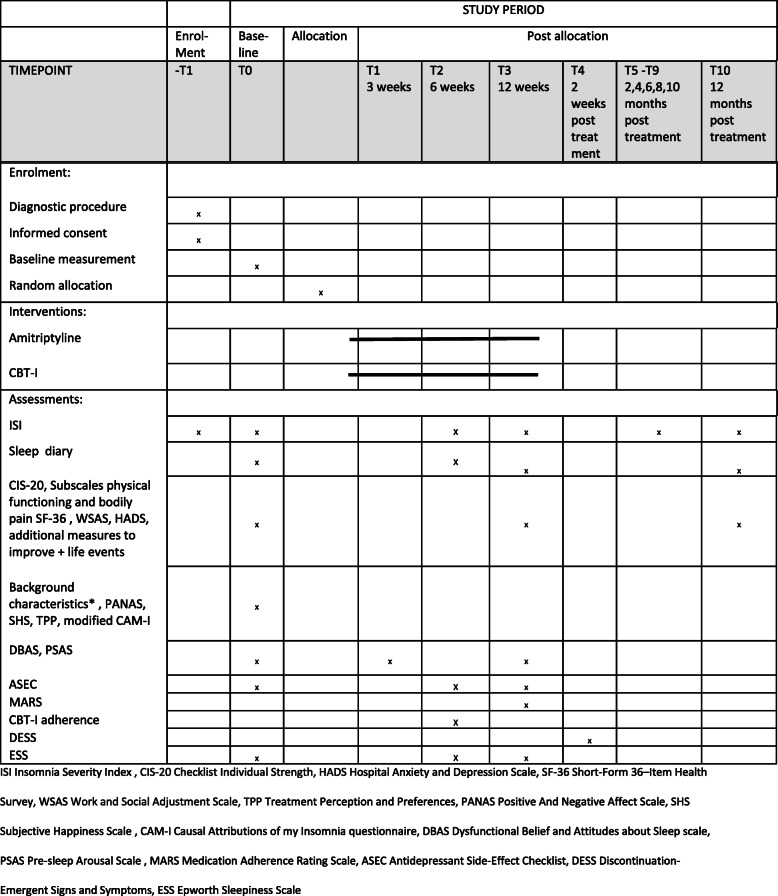
METHODS/DESIGN: This study will test if treatment with low-dose amitriptyline for insomnia in patients with medical comorbidity is non-inferior to CBT-I in a multicenter randomized controlled non-inferiority trial. Participants will be 190 adults with a long-term medical condition and insomnia. Participants will be randomly allocated to one of two intervention arms: 12 weeks AM (starting with 10 mg per day, and if ineffective at 3 weeks, doubling this dose) or 12 weeks of CBT-I consisting of 6 weekly sessions and a follow-up session 6 weeks later. The primary outcome is subjective insomnia severity, measured with the Insomnia Severity Index (ISI). The primary endpoint is at 12 weeks. Secondary outcomes include sleep quality (e.g., sleep efficiency), questionnaires on daytime functioning (physical functioning and impairment of functioning), and symptoms (e.g., fatigue, pain, anxiety) at 12 weeks and 12 months post treatment and relapse of insomnia until 12 months after treatment.
Irrespective of the outcome, this study will be a much-needed contribution to evidence based clinical guidelines on the treatment of insomnia in patients with medical comorbidity.
Dutch Trial Register NTR NL7971 . Registered on 18 August 2019.
失眠在患有长期疾病的人群中很常见,与死亡率和发病率增加有关。失眠的认知行为疗法(CBT-I)是首选治疗方法,对患有失眠和合并长期疾病的患者有效。然而,CBT-I 有一些局限性,因为它可能并不总是适用于或吸引患有疾病的患者。此外,一小部分患者对 CBT-I 没有反应。初步证据和临床经验表明,低剂量阿米替林(AM)可能是治疗合并症患者失眠的有效替代方法。在这项随机对照试验中,我们将确定 AM 是否对患有合并症的失眠患者的治疗不劣于首选治疗失眠的方法,即 CBT-I。
方法/设计:这项研究将在一项多中心随机对照非劣效性试验中,测试治疗患有合并症的失眠患者的低剂量 AM 是否不劣于 CBT-I。参与者将是 190 名患有长期疾病和失眠的成年人。参与者将被随机分配到两个干预组之一:12 周 AM(起始剂量为每天 10 毫克,如果 3 周后无效,则将剂量加倍)或 12 周 CBT-I,包括 6 次每周的治疗和 6 周后的随访。主要结局是使用失眠严重程度指数(ISI)测量的主观失眠严重程度。主要终点是在 12 周时。次要结局包括睡眠质量(例如,睡眠效率)、白天功能(身体功能和功能障碍)和症状(例如,疲劳、疼痛、焦虑)的问卷,在 12 周和 12 个月治疗后以及治疗后 12 个月内失眠复发。
无论结果如何,这项研究都将是对有合并症的失眠患者治疗的循证临床指南的急需贡献。
荷兰试验注册处 NTR NL7971。于 2019 年 8 月 18 日注册。