Yang Huan, Yang Xiao, Rong Kewei, Liang Jiarong, Wang Zhengting, Zhao Jie, Zhang Pu, Li Yijie, Wang Lihuan, Ma Hui, Ye Bin
Shanghai Key Laboratory of Orthopedic Implants, Shanghai Ninth People's Hospital, Shanghai, China.
Second Clinical Medical College, Yunnan University of Traditional Chinese Medicine, Kunming, Yunnan, China.
Front Pharmacol. 2022 Nov 3;13:940475. doi: 10.3389/fphar.2022.940475. eCollection 2022.
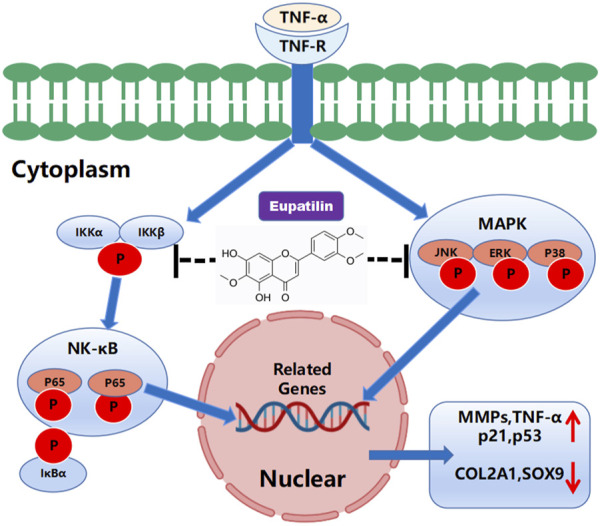
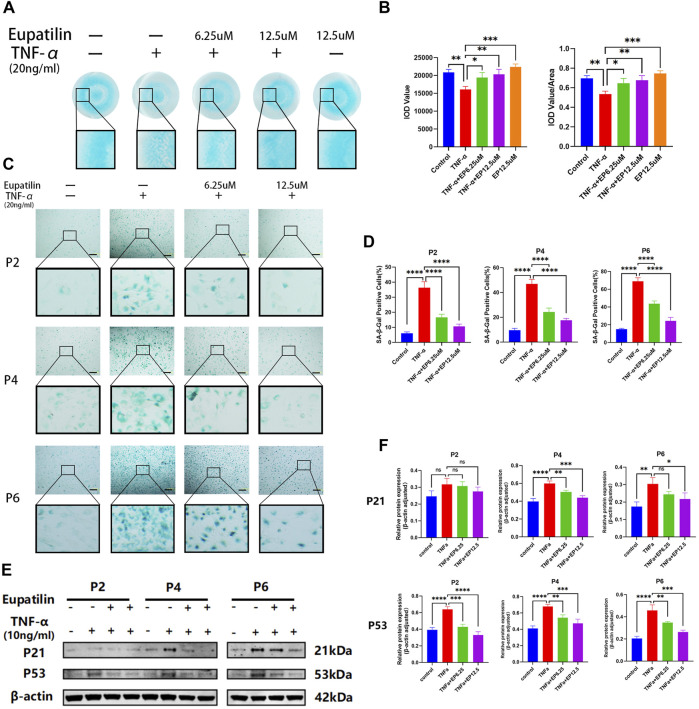
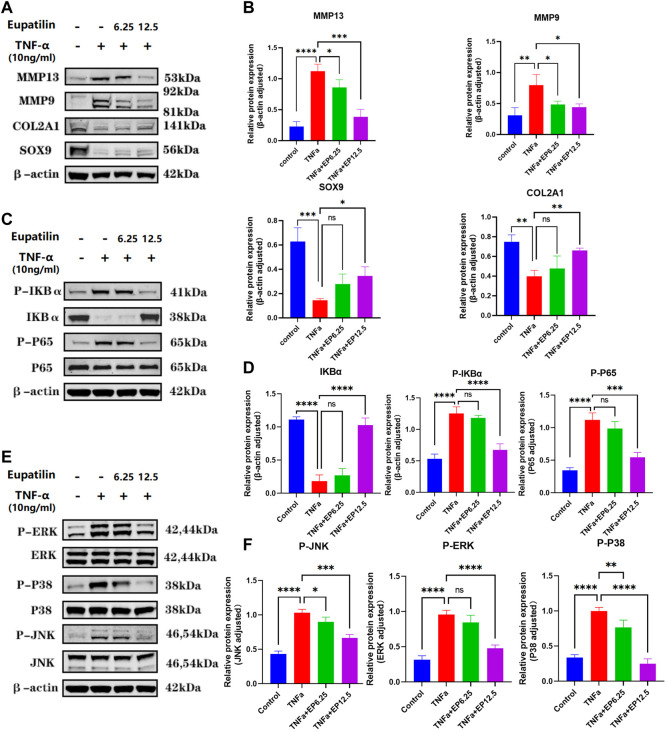
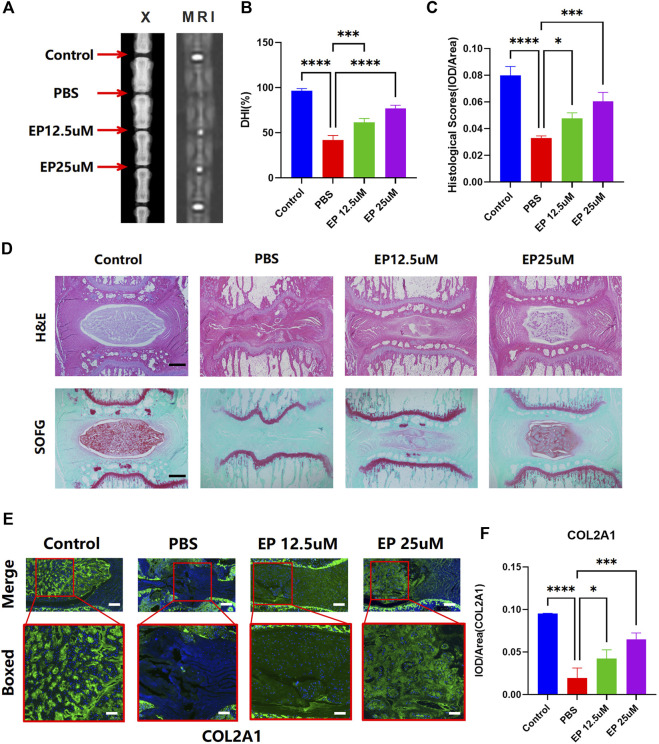
Intervertebral disc degeneration (IDD) is the main cause of low back pain. An increasing number of studies have suggested that inflammatory response or the senescence of nucleus pulposus (NP) cells is strongly associated with the progress of IDD. Eupatilin, the main flavonoid extracted from , was reported to be associated with the inhibition of the intracellular inflammatory response and the senescence of cells. However, the relationship between eupatilin and IDD is still unknown. In this study, we explored the role of eupatilin in tumor necrosis factor-α (TNF-α)-induced activation of inflammatory signaling pathways and NP cell senescence, in the anabolism and catabolism of NP cell extracellular matrix (ECM) and in the effect of the puncture-induced model of caudal IDD in the rat. , eupatilin significantly inhibited TNF-α-induced ECM degradation, downregulated the expression of related markers of NP cells (MMP3, MMP9, and MMP13), and upregulated the expression of and . Furthermore, eupatilin reduced TNF-α-induced cell senescence by inhibiting the expression of the senescence of NP cell-related markers (p21 and p53). Mechanistically, ECM degradation and cell senescence were reduced by eupatilin, which inhibited the activation of MAPK/NF-κB signaling pathways. Consistent with the data, eupatilin administration ameliorated the puncture-induced model of caudal IDD in the rat. In conclusion, eupatilin can inhibit the inflammatory response and the senescence of NP cells, which may be a novel treatment strategy for IDD.
椎间盘退变(IDD)是腰痛的主要原因。越来越多的研究表明,炎症反应或髓核(NP)细胞的衰老与IDD的进展密切相关。据报道,从[植物名称未给出]中提取的主要黄酮类化合物灯盏乙素与抑制细胞内炎症反应和细胞衰老有关。然而,灯盏乙素与IDD之间的关系仍不清楚。在本研究中,我们探讨了灯盏乙素在肿瘤坏死因子-α(TNF-α)诱导的炎症信号通路激活和NP细胞衰老、NP细胞细胞外基质(ECM)合成代谢和分解代谢中的作用,以及在大鼠尾椎IDD穿刺诱导模型中的作用。结果表明,灯盏乙素显著抑制TNF-α诱导的ECM降解,下调NP细胞相关标志物(MMP3、MMP9和MMP13)的表达,并上调[具体基因未给出]和[具体基因未给出]的表达。此外,灯盏乙素通过抑制NP细胞衰老相关标志物(p21和p53)的表达来减少TNF-α诱导的细胞衰老。机制上,灯盏乙素通过抑制MAPK/NF-κB信号通路的激活来减少ECM降解和细胞衰老。与体外实验数据一致,给予灯盏乙素可改善大鼠尾椎IDD穿刺诱导模型。总之,灯盏乙素可以抑制NP细胞的炎症反应和衰老,这可能是一种治疗IDD的新策略。