Department of Cell and Molecular Biology, Biomedical Centre, Uppsala Universitygrid.8993.b, Uppsala, Sweden.
Department of Microbiology, Centre for Molecular Microbiology and Infection, Imperial College London, London, United Kingdom.
mBio. 2022 Dec 20;13(6):e0289122. doi: 10.1128/mbio.02891-22. Epub 2022 Nov 21.
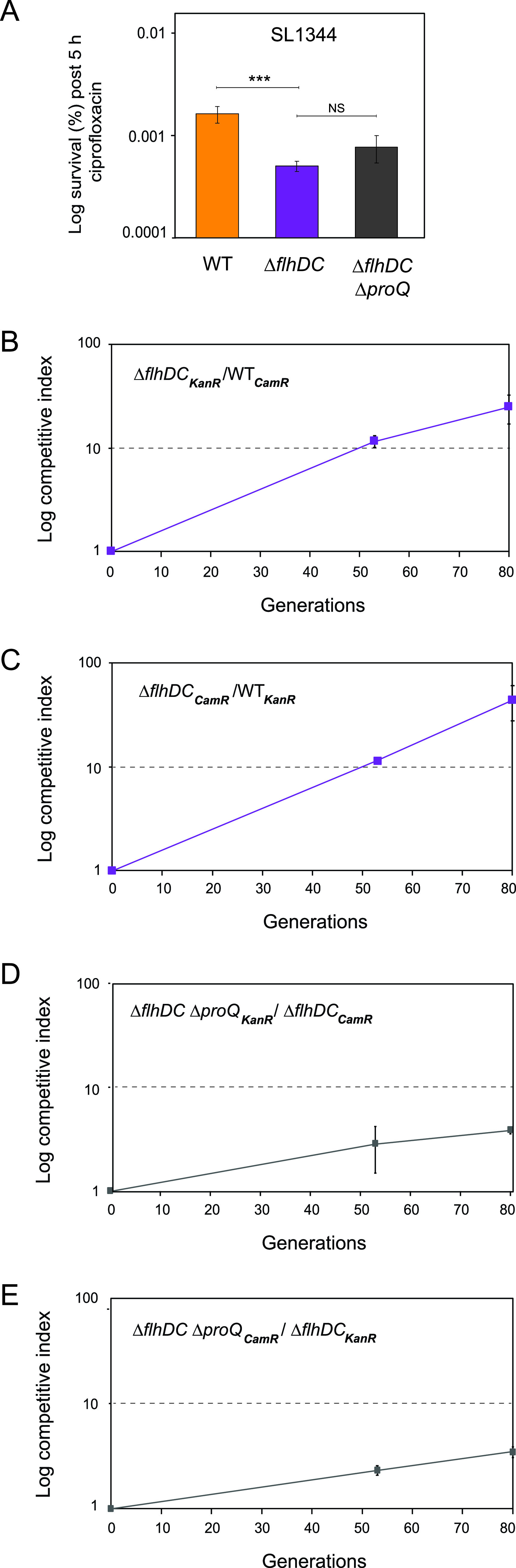
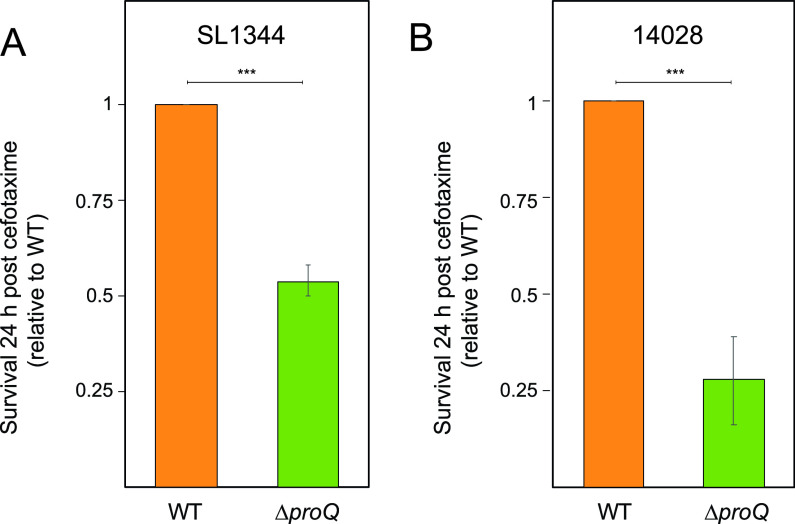
Bacterial populations can survive exposure to antibiotics through transient phenotypic and gene expression changes. These changes can be attributed to a small subpopulation of bacteria, giving rise to antibiotic persistence. Although this phenomenon has been known for decades, much remains to be learned about the mechanisms that drive persister formation. The RNA-binding protein ProQ has recently emerged as a global regulator of gene expression. Here, we show that ProQ impacts persister formation in Salmonella. , ProQ contributes to growth arrest in a subset of cells that are able to survive treatment at high concentrations of different antibiotics. The underlying mechanism for ProQ-dependent persister formation involves the activation of metabolically costly processes, including the flagellar pathway and the type III protein secretion system encoded on Salmonella pathogenicity island 2. Importantly, we show that the ProQ-dependent phenotype is relevant during macrophage infection and allows Salmonella to survive the combined action of host immune defenses and antibiotics. Together, our data highlight the importance of ProQ in Salmonella persistence and pathogenesis. Bacteria can avoid eradication by antibiotics through a phenomenon known as persistence. Persister cells arise through phenotypic heterogeneity and constitute a small fraction of dormant cells within a population of actively growing bacteria, which is susceptible to antibiotic killing. In this study, we show that ProQ, an RNA-binding protein and global regulator of gene expression, promotes persisters in the human pathogen Salmonella enterica serovar Typhimurium. Bacteria lacking the gene outcompete wild-type bacteria under laboratory conditions, are less prone to enter growth dormancy, and form fewer persister cells. The basis for these phenotypes lies in ProQ's ability to activate energy-consuming cellular processes, including flagellar motility and protein secretion. Importantly, we show that ProQ contributes to the persister phenotype during Salmonella infection of macrophages, indicating an important role of this global regulator in Salmonella pathogenesis.
细菌种群可以通过短暂的表型和基因表达变化来应对抗生素的暴露。这些变化可以归因于一小部分细菌,导致抗生素持续存在。尽管这种现象已经存在了几十年,但对于驱动持久形成的机制仍有很多需要了解。RNA 结合蛋白 ProQ 最近已成为基因表达的全局调节剂。在这里,我们表明 ProQ 会影响沙门氏菌中的持久形成。ProQ 有助于在能够在高浓度不同抗生素下存活的细胞亚群中发生生长停滞。ProQ 依赖性持久形成的潜在机制涉及代谢成本高昂的过程的激活,包括鞭毛途径和沙门氏菌致病性岛 2 上编码的 III 型蛋白分泌系统。重要的是,我们表明 ProQ 依赖性表型在巨噬细胞感染期间是相关的,并使沙门氏菌能够抵抗宿主免疫防御和抗生素的联合作用。总之,我们的数据强调了 ProQ 在沙门氏菌持续存在和发病机制中的重要性。
细菌可以通过一种称为持久性的现象来避免被抗生素消灭。持久细胞通过表型异质性产生,构成活跃生长细菌群体中休眠细胞的一小部分,容易被抗生素杀死。在这项研究中,我们表明 RNA 结合蛋白和基因表达的全局调节剂 ProQ 促进了人类病原体鼠伤寒沙门氏菌中的持久细胞形成。缺乏基因的细菌在实验室条件下比野生型细菌更具竞争力,不易进入生长休眠期,形成的持久细胞也更少。这些表型的基础在于 ProQ 激活耗能细胞过程的能力,包括鞭毛运动和蛋白分泌。重要的是,我们表明 ProQ 在沙门氏菌感染巨噬细胞期间有助于持久表型的形成,表明该全局调节剂在沙门氏菌发病机制中起着重要作用。