National Taiwan University Hospital, Department of Emergency Medicine, Taipei, Taiwan.
National Taiwan University Hospital Hsin-Chu Branch, Department of Emergency Medicine, Hsinchu, Taiwan.
West J Emerg Med. 2022 Oct 18;23(6):832-840. doi: 10.5811/westjem.2022.7.57028.
Although factors related to a return visit to the emergency department (ED) have been reported, only a few studies have examined "high-risk" ED revisits with serious adverse outcomes. In this study we aimed to describe the incidence and trend of high-risk ED revisits in United States EDs and to investigate factors associated with these revisits.
We obtained data from the National Hospital Ambulatory Medical Care Survey (NHAMCS), 2010-2018. Adult ED revisits within 72 hours of a previous discharge were identified using a mark on the patient record form. We defined high-risk revisits as revisits with serious adverse outcomes, including intensive care unit admissions, emergency surgery, cardiac catheterization, or cardiopulmonary resuscitation (CPR) during the return visit. We performed analyses using descriptive statistics and multivariable logistic regression, accounting for NHAMCS's complex survey design.
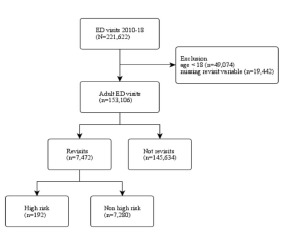
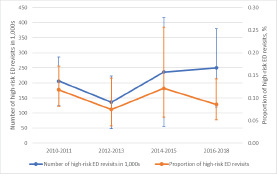
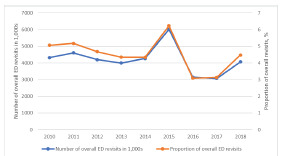
Over the nine-year study period, there were an estimated 37,700,000 revisits, and the proportion of revisits in the entire ED population decreased slightly from 5.1% in 2010 to 4.5% in 2018 (P for trend = 0.02). By contrast, there were an estimated 827,000 high-risk ED revisits, and the proportion of high-risk revisits in the entire ED population remained stable at approximately 0.1%. The mean age of these high-risk revisit patients was 57 years, and 43% were men. Approximately 6% of the patients were intubated, and 13% received CPR. Most of them were hospitalized, and 2% died in the ED. Multivariable analysis showed that older age (65+ years), Hispanic ethnicity, daytime visits, and arrival by ambulance during the revisit were independent predictors of high-risk revisits.
High-risk revisits accounted for a relatively small fraction (0.1%) of ED visits. Over the period of the NHAMCS survey between 2010-2018, this fraction remained stable. We identified factors during the return visit that could be used to label high-risk revisits for timely intervention.
尽管已有研究报道了与急诊科(ED)复诊相关的因素,但仅有少数研究探讨了存在严重不良结局的“高危”ED 复诊。本研究旨在描述美国 ED 高危复诊的发生率和趋势,并探讨与这些复诊相关的因素。
我们从 2010 年至 2018 年的国家医院门诊医疗调查(NHAMCS)中获取数据。通过患者记录表单上的标记识别 72 小时内从前一次出院后再次到 ED 的复诊患者。我们将高危复诊定义为在复诊期间有入住重症监护病房、紧急手术、心导管检查或心肺复苏(CPR)等严重不良结局的复诊。我们使用描述性统计和多变量逻辑回归进行分析,同时考虑了 NHAMCS 的复杂调查设计。
在 9 年的研究期间,估计有 3770 万次复诊,复诊在整个 ED 就诊人群中的比例从 2010 年的 5.1%略有下降至 2018 年的 4.5%(趋势 P 值=0.02)。相比之下,估计有 82.7 万次高危 ED 复诊,复诊在整个 ED 就诊人群中的比例保持稳定,约为 0.1%。这些高危复诊患者的平均年龄为 57 岁,其中 43%为男性。大约 6%的患者需要插管,13%接受了 CPR。他们中的大多数人住院治疗,有 2%在 ED 死亡。多变量分析显示,年龄较大(65 岁以上)、西班牙裔、白天就诊以及在复诊时乘坐救护车到达是高危复诊的独立预测因素。
高危复诊占 ED 就诊的比例相对较小(0.1%)。在 NHAMCS 调查期间(2010-2018 年),这一比例保持稳定。我们确定了复诊期间的一些因素,可以用来标记高危复诊,以便及时干预。