Dipartimento Di Chimica Industriale "Toso Montanari", Università Di Bologna, Viale del Risorgimento 4, 40136, Bologna, Italy.
Analytical Chemistry - Center for Electrochemical Sciences (CES), Faculty of Chemistry and Biochemistry, Ruhr University Bochum, Universitätsstraße 150, 44780, Bochum, Germany.
Mikrochim Acta. 2022 Nov 22;189(12):459. doi: 10.1007/s00604-022-05548-3.
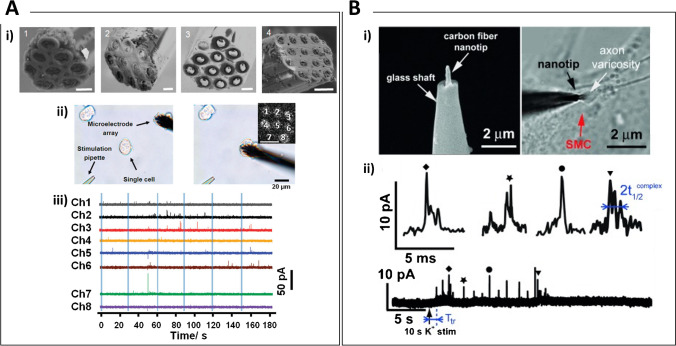
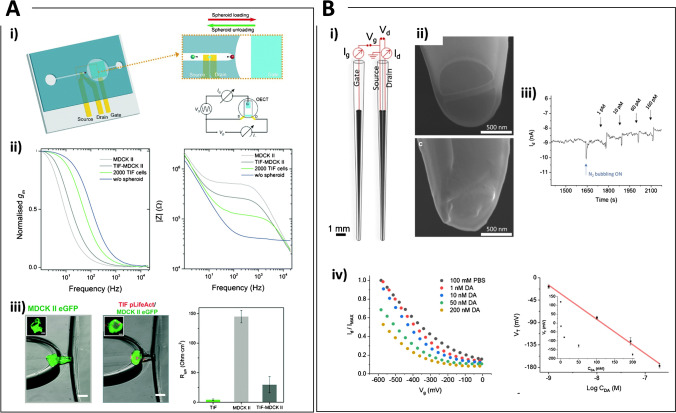
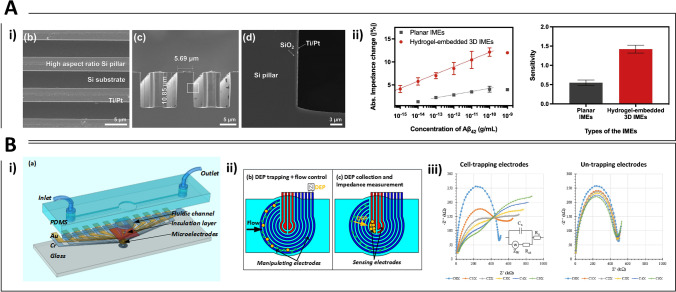
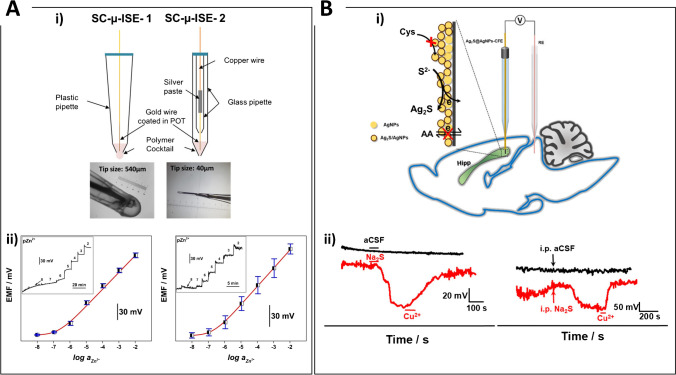
Electrode miniaturization has profoundly revolutionized the field of electrochemical sensing, opening up unprecedented opportunities for probing biological events with a high spatial and temporal resolution, integrating electrochemical systems with microfluidics, and designing arrays for multiplexed sensing. Several technological issues posed by the desire for downsizing have been addressed so far, leading to micrometric and nanometric sensing systems with different degrees of maturity. However, there is still an endless margin for researchers to improve current strategies and cope with demanding sensing fields, such as lab-on-a-chip devices and multi-array sensors, brain chemistry, and cell monitoring. In this review, we present current trends in the design of micro-/nano-electrochemical sensors and cutting-edge applications reported in the last 10 years. Micro- and nanosensors are divided into four categories depending on the transduction mechanism, e.g., amperometric, impedimetric, potentiometric, and transistor-based, to best guide the reader through the different detection strategies and highlight major advancements as well as still unaddressed demands in electrochemical sensing.
电极微型化极大地推动了电化学传感领域的发展,为高时空分辨率探测生物事件、将电化学系统与微流控技术集成以及设计用于多重传感的阵列提供了前所未有的机会。迄今为止,已经解决了许多由于小型化需求而产生的技术问题,从而形成了具有不同成熟度的微纳尺度传感系统。然而,研究人员仍然有无限的空间来改进当前的策略,并应对具有挑战性的传感领域,如芯片实验室设备和多阵列传感器、脑化学和细胞监测等。在这篇综述中,我们介绍了过去 10 年来微纳电化学传感器设计的最新趋势和前沿应用。根据传感器的转换机制,微纳传感器可分为四大类,例如安培、阻抗、电位和基于晶体管的传感器,以便能够最好地引导读者了解不同的检测策略,并突出电化学传感领域的主要进展和尚未解决的需求。