Lilien Thijs A, Gunjak Miša, Myti Despoina, Casado Francisco, van Woensel Job B M, Morty Rory E, Bem Reinout A
Pediatric Intensive Care Unit, Emma Children's Hospital, Amsterdam UMC Location University of Amsterdam, 1105 AZ Amsterdam, The Netherlands.
Department of Lung Development and Remodeling, Max Planck Institute for Heart and Lung Research, 61231 Bad Nauheim, Germany.
Pathogens. 2022 Nov 12;11(11):1334. doi: 10.3390/pathogens11111334.
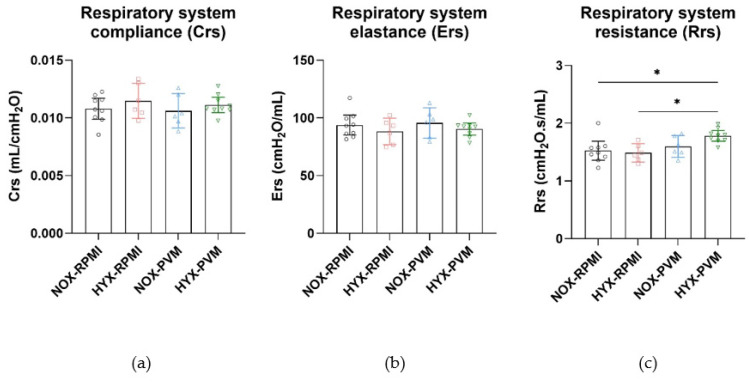
Viral-induced lower respiratory tract infection (LRTI), mainly by respiratory syncytial virus (RSV), causes a major health burden among young children and has been associated with long-term respiratory dysfunction. Children with severe viral LRTI are frequently treated with oxygen therapy, hypothetically posing an additional risk factor for pulmonary sequelae. The main goal of this study was to determine the effect of concurrent hyperoxia exposure during the acute phase of viral LRTI on long-term pulmonary outcome. As an experimental model for severe RSV LRTI in infants, C57Bl/6J mice received an intranasal inoculation with the pneumonia virus of mice J3666 strain at post-natal day 7, and were subsequently exposed to hyperoxia (85% O) or normoxia (21% O) from post-natal day 10 to 17 during the acute phase of disease. Long-term outcomes, including lung function and structural development, were assessed 3 weeks post-inoculation at post-natal day 28. Compared to normoxic conditions, hyperoxia exposure in PVM-inoculated mice induced a transient growth arrest without subsequent catchup growth, as well as a long-term increase in airway resistance. This hyperoxia-induced pulmonary dysfunction was not associated with developmental changes to the airway or lung structure. These findings suggest that hyperoxia exposure during viral LRTI at young age may aggravate subsequent long-term pulmonary sequelae. Further research is needed to investigate the specific mechanisms underlying this alteration to pulmonary function.
病毒引起的下呼吸道感染(LRTI),主要由呼吸道合胞病毒(RSV)引起,给幼儿带来了重大健康负担,并与长期呼吸功能障碍有关。患有严重病毒性LRTI的儿童经常接受氧疗,这可能会增加肺部后遗症的额外风险因素。本研究的主要目的是确定在病毒性LRTI急性期同时暴露于高氧对长期肺部结局的影响。作为婴儿严重RSV LRTI的实验模型,C57Bl/6J小鼠在出生后第7天经鼻接种小鼠肺炎病毒J3666株,随后在疾病急性期从出生后第10天至17天暴露于高氧(85% O)或常氧(21% O)。在接种后3周、出生后第28天评估包括肺功能和结构发育在内的长期结局。与常氧条件相比,接种PVM的小鼠暴露于高氧会导致短暂的生长停滞且无后续追赶生长,以及气道阻力长期增加。这种高氧诱导的肺功能障碍与气道或肺结构的发育变化无关。这些发现表明,幼年病毒性LRTI期间暴露于高氧可能会加重随后的长期肺部后遗症。需要进一步研究来调查这种肺功能改变的具体机制。