
基于人工智能的免疫分析可作为晚期肝细胞癌纳武单抗治疗的潜在预测生物标志物。
Artificial intelligence-based immunoprofiling serves as a potentially predictive biomarker of nivolumab treatment for advanced hepatocellular carcinoma.
作者信息
Lee Jan-Mou, Hung Yi-Ping, Chou Kai-Yuan, Lee Cheng-Yun, Lin Shian-Ren, Tsai Ya-Han, Lai Wan-Yu, Shao Yu-Yun, Hsu Chiun, Hsu Chih-Hung, Chao Yee
机构信息
FullHope Biomedical Co., Ltd., New Taipei City, Taiwan.
Department of Oncology, Taipei Veterans General Hospital, Taipei, Taiwan.
出版信息
Front Med (Lausanne). 2022 Nov 8;9:1008855. doi: 10.3389/fmed.2022.1008855. eCollection 2022.
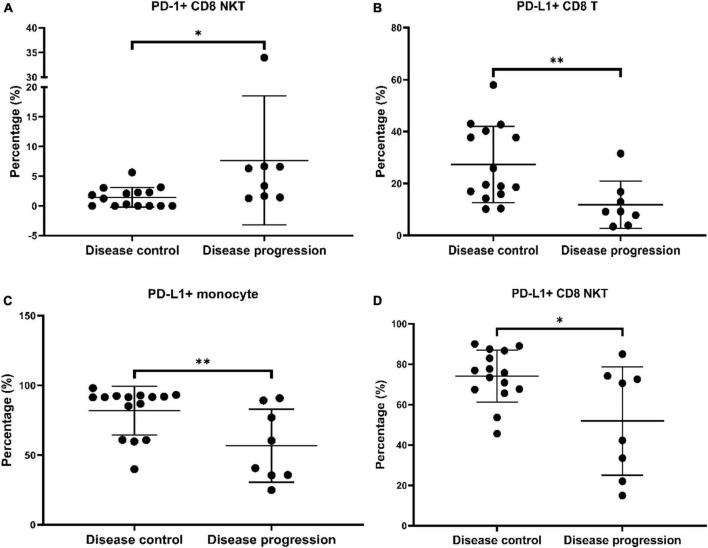
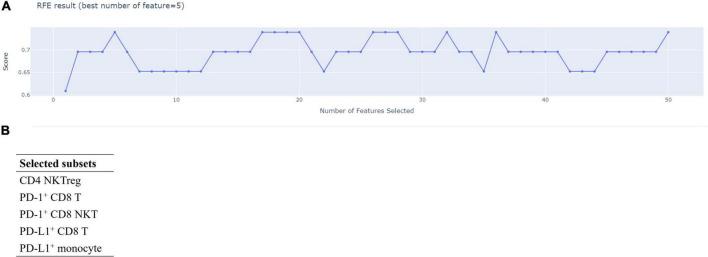
Immune checkpoint inhibitors (ICI) have been applied in treating advanced hepatocellular carcinoma (aHCC) patients, but few patients exhibit stable and lasting responses. Moreover, identifying aHCC patients suitable for ICI treatment is still challenged. This study aimed to evaluate whether dissecting peripheral immune cell subsets by Mann-Whitney U test and artificial intelligence (AI) algorithms could serve as predictive biomarkers of nivolumab treatment for aHCC. Disease control group carried significantly increased percentages of PD-L1 monocytes, PD-L1 CD8 T cells, PD-L1 CD8 NKT cells, and decreased percentages of PD-L1 CD8 NKT cells via Mann-Whitney U test. By recursive feature elimination method, five featured subsets (CD4 NKTreg, PD-1 CD8 T cells, PD-1 CD8 NKT cells, PD-L1 CD8 T cells and PD-L1 monocytes) were selected for AI training. The featured subsets were highly overlapping with ones identified via Mann-Whitney U test. Trained AI algorithms committed valuable AUC from 0.8417 to 0.875 to significantly separate disease control group from disease progression group, and SHAP value ranking also revealed PD-L1 monocytes and PD-L1 CD8 T cells exclusively and significantly contributed to this discrimination. In summary, the current study demonstrated that integrally analyzing immune cell profiling with AI algorithms could serve as predictive biomarkers of ICI treatment.
免疫检查点抑制剂(ICI)已被应用于治疗晚期肝细胞癌(aHCC)患者,但很少有患者表现出稳定且持久的反应。此外,识别适合ICI治疗的aHCC患者仍然具有挑战性。本研究旨在评估通过曼-惠特尼U检验和人工智能(AI)算法剖析外周免疫细胞亚群是否可作为aHCC患者纳武单抗治疗的预测生物标志物。通过曼-惠特尼U检验,疾病控制组的PD-L1单核细胞、PD-L1 CD8 T细胞、PD-L1 CD8 NKT细胞百分比显著增加,而PD-L1 CD8 NKT细胞百分比降低。通过递归特征消除方法,选择了五个特征亚群(CD4 NKTreg、PD-1 CD8 T细胞、PD-1 CD8 NKT细胞、PD-L1 CD8 T细胞和PD-L1单核细胞)进行AI训练。这些特征亚群与通过曼-惠特尼U检验确定的亚群高度重叠。经过训练的AI算法的AUC值在0.8417至0.875之间,能够显著区分疾病控制组和疾病进展组,SHAP值排名也显示PD-L1单核细胞和PD-L1 CD8 T细胞对这种区分有独特且显著的贡献。总之,当前研究表明,用AI算法整体分析免疫细胞图谱可作为ICI治疗的预测生物标志物。


 Zotero 插件