Casano Anna Beatrice, Barile Vittoria Lucia, Menchetti Laura, Guelfi Gabriella, Brecchia Gabriele, Agradi Stella, De Matteis Giovanna, Scatà Maria Carmela, Grandoni Francesco, Barbato Olimpia
Department of Veterinary Medicine, University of Perugia, Via San Costanzo, 06126 Perugia, Italy.
Research Centre for Animal Production and Aquaculture, Consiglio per la Ricerca in Agricoltura e l'Analisi dell'Economia Agraria (CREA), Via Salaria 31, 00015 Monterotondo (Roma), Italy.
Animals (Basel). 2022 Nov 8;12(22):3068. doi: 10.3390/ani12223068.
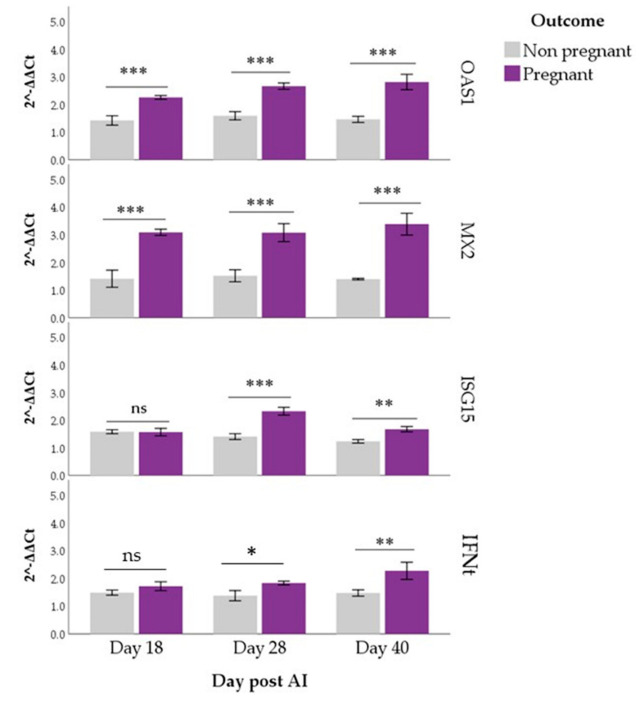
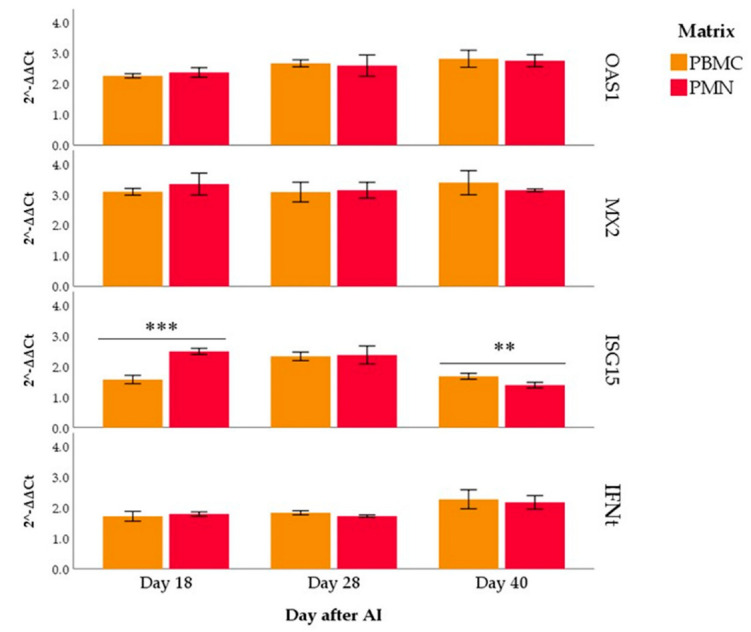
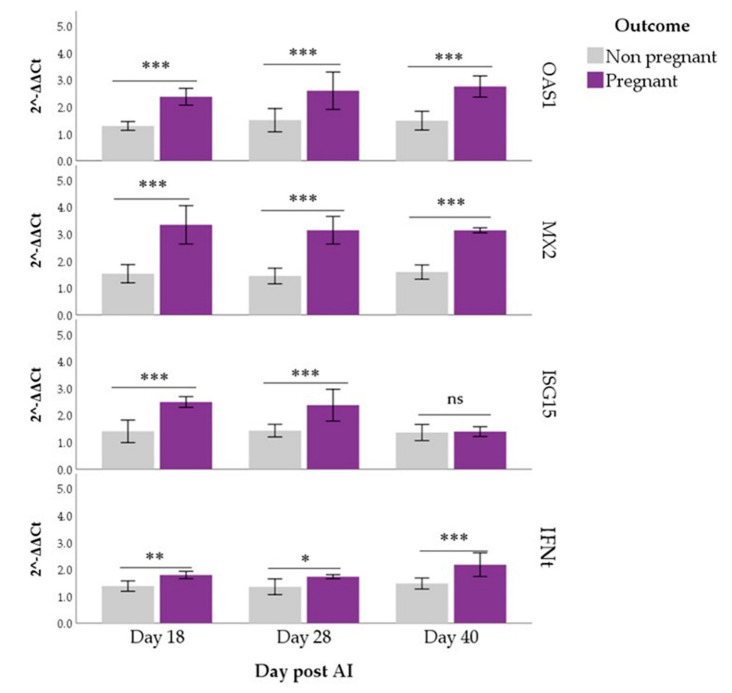
The objective of this study was to analyze interferon-stimulated genes (ISGs) and interferon tau (IFNt) gene expression in peripheral blood leukocytes during the peri-implantation period and until 40 days of pregnancy in buffalo cows. Relationships were also examined between the expression of ISGs and IFNt and pregnancy-associated glycoproteins (PAGs) peripheral plasma concentration. Buffalo cows were synchronized and artificially inseminated (d 0). Blood samples were collected on days 0, 18, 28 and 40 after artificial insemination (AI) for peripheral blood mononuclear cells (PBMCs) and polymorphonuclear leukocytes (PMNs) isolation and PAGs radioimmunoassay analysis. The study was carried out on 21 buffalo cows divided ex post into Pregnant (n = 12) and Non-pregnant (n = 9) groups. Steady state levels of OAS1, MX2, ISG15 and IFNt mRNA were measured by RT-qPCR and their estimated marginal means (p < 0.01 for all) were higher in pregnant than non-pregnant buffaloes, both in PBMCs and PMNs. In PBMCs, pairwise comparisons showed that OAS1 and MX2 expressions differed between pregnant and non-pregnant buffaloes on all the days of observation (p < 0.001), while significant differences in ISG15 and IFNt started from day 28 post-AI (p < 0.05). In PMNs, ISG15 expression differed between groups only at days 18 and 28 (p < 0.001), while comparisons were always significant for IFNt (p < 0.05). The expression of all genes, except ISG15 as determined in PMNs, was positively associated with PAGs plasma concentrations (p < 0.05). This work showed a significant increase in ISGs and IFNt expressions in PBMCs and PMNs in buffalo during the peri-implantation period and early pregnancy, and their correlation with PAGs plasma concentration.
本研究的目的是分析水牛母牛在植入前期直至妊娠40天时外周血白细胞中干扰素刺激基因(ISGs)和干扰素τ(IFNt)基因的表达情况。同时还检测了ISGs和IFNt的表达与外周血浆中妊娠相关糖蛋白(PAGs)浓度之间的关系。对水牛母牛进行同期发情并人工授精(第0天)。在人工授精(AI)后的第0、18、28和40天采集血样,用于分离外周血单核细胞(PBMCs)和多形核白细胞(PMNs)以及进行PAGs放射免疫分析。该研究对21头水牛母牛进行,事后分为妊娠组(n = 12)和非妊娠组(n = 9)。通过RT-qPCR测定OAS1、MX2、ISG15和IFNt mRNA的稳态水平,其估计边际均值(所有p < 0.01)在妊娠水牛的PBMCs和PMNs中均高于非妊娠水牛。在PBMCs中,两两比较显示,在所有观察日,妊娠和非妊娠水牛之间OAS1和MX2的表达均有差异(p < 0.001),而ISG15和IFNt的显著差异从AI后第28天开始(p < 0.05)。在PMNs中,ISG15的表达仅在第18天和第28天组间有差异(p < 0.001),而IFNt的比较始终具有显著性(p < 0.05)。除PMNs中测定的ISG15外,所有基因的表达均与PAGs血浆浓度呈正相关(p < 0.05)。这项研究表明,在水牛的植入前期和妊娠早期,PBMCs和PMNs中ISGs和IFNt的表达显著增加,且它们与PAGs血浆浓度相关。