Feltrin Isabella Rio, Melo Gabriela Dalmaso, Freitas Pedro Pisani, Morelli Karine Galhego, Binelli Mario, Membrive Claudia Maria Bertan, Pugliesi Guilherme
Department of Pharmacology and Biotechnology, São Paulo State University (UNESP), Botucatu, SP, Brazil.
Department of Animal Reproduction, University of São Paulo (USP), Avenida Duque de Caxias Norte 225, Jardim Elite, Pirassununga, SP, Brazil.
Sci Rep. 2025 May 20;15(1):17548. doi: 10.1038/s41598-025-01996-y.
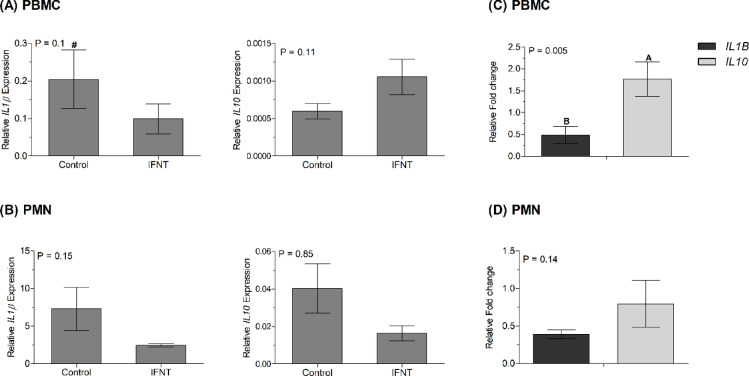
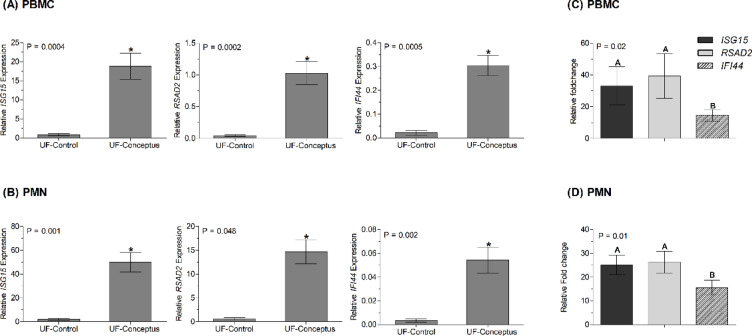
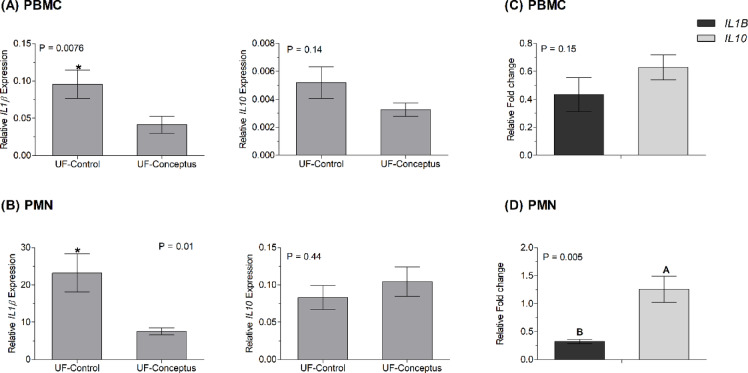
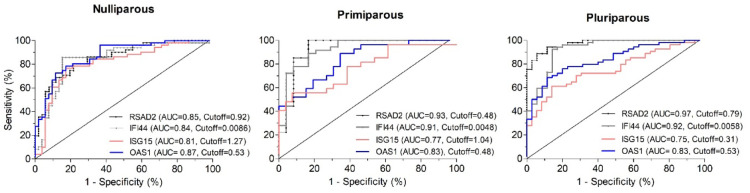
In beef cattle, estrous synchronization aiming a second artificial insemination (AI) requires a reliable estimation of the pregnancy status 20 days (D20) after the first AI. The hypothesis is that the expression of interferon-stimulated genes (ISGs; ISG15, OAS1, RSAD2, and IFI44) and cytokines (IL1β and IL10) in mononuclear (PBMC) and polymorphonuclear (PMN) cells is regulated by interferon-τ (IFN-τ) and predicts the pregnancy status. PBMC and PMN were isolated from non-pregnant beef cows (N = 9), 10-12 days post-ovulation (D0), and stimulated with 100 ng/mL recombinant ovine (ro) IFN-τ or with pooled uterine flush (UF) from D18 pregnant cows. Both roIFNT and UF stimulated the expression of ISG15, RSAD2, and IFI44 in PBMC and PMN. Expression of IL1β was reduced by UF in both PBMC and PMN. On another experiment, PMN were isolated, and luteal blood perfusion was measured on D20 post-timed-AI in beef females. The accuracy of ISG expression and luteal blood perfusion to predict the pregnancy outcome was determined by ROC curve analysis. All gene combinations were tested, and the best association for increased accuracy (92.7%) and reduction of false-negative results (0.9%, 2/233) was obtained through the combination of the four ISGs (ISG15, OAS1, RSAD2, and IFI44). The criterion was that if the expression levels of at least one of the four genes were greater than the predefined cutoffs, the animal would be considered pregnant. In conclusion, the expression of ISGs and IL1β was upregulated by roIFNT and UF from pregnancy cows. The combined PMN expression of classical (ISG15 and OAS1) and unusual (RSAD2 and IFI44) ISGs provided the greatest predictive accuracy of the pregnancy status on D20 in females with active CL by Doppler and is a potential tool to be used in reproductive programs for beef cattle.
在肉牛中,旨在进行第二次人工授精(AI)的发情同步需要对首次AI后20天(D20)的妊娠状态进行可靠估计。假设是单核细胞(PBMC)和多形核细胞(PMN)中干扰素刺激基因(ISG;ISG15、OAS1、RSAD2和IFI44)和细胞因子(IL1β和IL10)的表达受干扰素-τ(IFN-τ)调控,并可预测妊娠状态。从排卵后10 - 12天(D0)的未孕肉牛(N = 9)中分离出PBMC和PMN,并用100 ng/mL重组绵羊(ro)IFN-τ或来自D18妊娠母牛的混合子宫冲洗液(UF)进行刺激。roIFNT和UF均刺激了PBMC和PMN中ISG15、RSAD2和IFI44的表达。UF使PBMC和PMN中IL1β的表达降低。在另一项实验中,分离出PMN,并在定时AI后第20天测量肉牛黄体的血液灌注。通过ROC曲线分析确定ISG表达和黄体血液灌注预测妊娠结局的准确性。对所有基因组合进行了测试,通过四种ISG(ISG15、OAS1、RSAD2和IFI44)的组合获得了最高的准确性(92.7%)和最低的假阴性结果(0.9%,2/233)。标准是如果四个基因中至少有一个的表达水平高于预先设定的临界值,则该动物将被视为怀孕。总之,roIFNT和妊娠母牛的UF上调了ISG和IL1β的表达。经典(ISG15和OAS1)和非经典(RSAD2和IFI44)ISG的PMN联合表达在具有活跃黄体的雌性中对D20的妊娠状态提供了最高的预测准确性,并且是肉牛繁殖计划中潜在的可用工具。