
源自子宫内膜异位症病灶的白细胞介素-33通过诱导调节性T细胞产生促纤维化细胞因子促进纤维化形成。
Interleukin-33 Derived from Endometriotic Lesions Promotes Fibrogenesis through Inducing the Production of Profibrotic Cytokines by Regulatory T Cells.
作者信息
Xiao Fengyi, Liu Xishi, Guo Sun-Wei
机构信息
Gynecology Department, Shanghai Obstetrics and Gynecology Hospital, Fudan University, Shanghai 200011, China.
Shanghai Key Laboratory of Female Reproductive Endocrine-Related Diseases, Fudan University, Shanghai 200011, China.
出版信息
Biomedicines. 2022 Nov 11;10(11):2893. doi: 10.3390/biomedicines10112893.
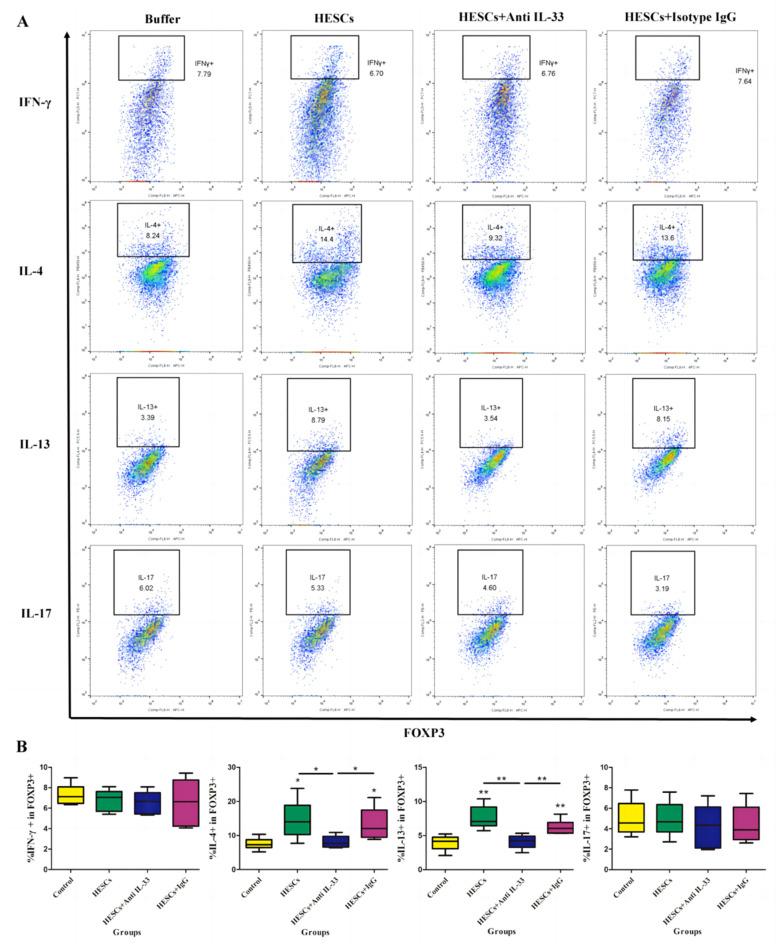
In endometriosis, it has been widely believed that the local immunological milieu is Th2-skewed. Regulatory T cells (Tregs) promote fibrogenesis of endometriosis through the transforming growth factor β1 (TGF-β1) and platelet-derived growth factor (PDGF) signaling pathways. We aimed to explore whether Tregs in endometriotic lesions acquire increased production of effector cytokines under the influence of lesion-derived interleukin (IL)-33. We extracted lymphocytes from normal endometrium and ovarian endometrioma to evaluate the expression of IL-4, IL-13, interferon-γ (IFN-γ), TGF-β1, and the IL-33 receptor (ST2) by Tregs from these tissues. Colocalization of IL-33 and FOXP3 in normal endometrium and ovarian endometrioma was evaluated by immunofluorescence. Tregs and endometriotic stromal cells were co-cultured and treated with anti-IL-33 antibody, and the cytokines produced by Tregs were analyzed by flow cytometry and enzyme-linked immunosorbent assay (ELISA). Tregs in ovarian endometrioma produced significant amounts of IL-4, IL-13, TGF-β1, and ST2. Colocalization of IL-33 and FOXP3 was detected in ovarian endometrioma. IL-33 from endometriotic stromal cells caused the differentiation of lesional Tregs into type 2 T helper (Th2)-like cells, along with increased production of TGF-β1 by Tregs. Thus, Tregs and endometriotic lesions engage active crosstalk through IL-33 to promote fibrogenesis in endometriosis, and, as such, this finding opens up new avenues to identify novel therapeutic targets for endometriosis.
在子宫内膜异位症中,人们普遍认为局部免疫环境呈Th2型偏向。调节性T细胞(Tregs)通过转化生长因子β1(TGF-β1)和血小板衍生生长因子(PDGF)信号通路促进子宫内膜异位症的纤维生成。我们旨在探讨子宫内膜异位症病灶中的Tregs在病灶来源的白细胞介素(IL)-33影响下是否会增加效应细胞因子的产生。我们从正常子宫内膜和卵巢子宫内膜异位囊肿中提取淋巴细胞,以评估这些组织中的Tregs对IL-4、IL-13、干扰素-γ(IFN-γ)、TGF-β1和IL-33受体(ST2)的表达。通过免疫荧光评估正常子宫内膜和卵巢子宫内膜异位囊肿中IL-33和FOXP3的共定位。将Tregs与子宫内膜异位症基质细胞共培养并用抗IL-33抗体处理,通过流式细胞术和酶联免疫吸附测定(ELISA)分析Tregs产生的细胞因子。卵巢子宫内膜异位囊肿中的Tregs产生大量的IL-4、IL-13、TGF-β1和ST2。在卵巢子宫内膜异位囊肿中检测到IL-33和FOXP3的共定位。来自子宫内膜异位症基质细胞的IL-33导致病灶Tregs分化为2型辅助性T(Th2)样细胞,同时Tregs产生的TGF-β1增加。因此,Tregs与子宫内膜异位症病灶通过IL-33进行活跃的相互作用,以促进子宫内膜异位症的纤维生成,因此,这一发现为确定子宫内膜异位症的新治疗靶点开辟了新途径。



 Zotero 插件