Department of Medical Oncology, Ramon y Cajal University Hospital, 28034 Madrid, Spain.
Int J Mol Sci. 2022 Nov 9;23(22):13784. doi: 10.3390/ijms232213784.
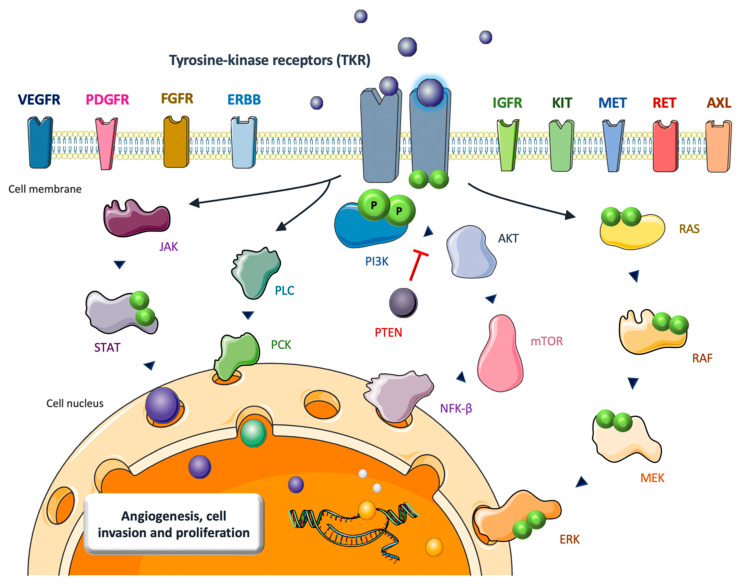
Bone sarcomas are a heterogeneous group of rare tumors with a predominance in the young population. Few options of systemic treatment are available once they become unresectable and resistant to conventional chemotherapy. A better knowledge of the key role that tyrosine kinase receptors (VEGFR, RET, MET, AXL, PDGFR, KIT, FGFR, IGF-1R) may play in the pathogenesis of these tumors has led to the development of multi-target inhibitors (TKIs) that are progressively being incorporated into our therapeutic arsenal. Osteosarcoma (OS) is the most frequent primary bone tumor and several TKIs have demonstrated clinical benefit in phase II clinical trials (cabozantinib, regorafenib, apatinib, sorafenib, and lenvatinib). Although the development of TKIs for other primary bone tumors is less advanced, preclinical data and early trials have begun to show their potential benefit in advanced Ewing sarcoma (ES) and rarer bone tumors (chondrosarcoma, chordoma, giant cell tumor of bone, and undifferentiated pleomorphic sarcoma). Previous reviews have mainly provided information on TKIs for OS and ES. We aim to summarize the existing knowledge regarding the use of TKIs in all bone sarcomas including the most recent studies as well as the potential synergistic effects of their combination with other systemic therapies.
骨肉瘤是一组罕见的异质性肿瘤,以年轻人群为主。一旦不可切除且对常规化疗耐药,系统治疗的选择就非常有限。对酪氨酸激酶受体(VEGFR、RET、MET、AXL、PDGFR、KIT、FGFR、IGF-1R)在这些肿瘤发病机制中可能发挥的关键作用有了更好的了解,促使开发了多靶点抑制剂(TKIs),这些抑制剂逐渐被纳入我们的治疗方案中。骨肉瘤(OS)是最常见的原发性骨肿瘤,几种 TKI 在 II 期临床试验中已证明具有临床获益(卡博替尼、瑞戈非尼、阿帕替尼、索拉非尼和仑伐替尼)。尽管针对其他原发性骨肿瘤的 TKI 开发进展较慢,但临床前数据和早期试验已开始显示它们在晚期尤文肉瘤(ES)和更罕见的骨肿瘤(软骨肉瘤、 chordoma、骨巨细胞瘤和未分化多形性肉瘤)中的潜在获益。以前的综述主要提供了关于 OS 和 ES 中 TKI 的信息。我们旨在总结目前关于所有骨肉瘤中 TKI 使用的相关知识,包括最新研究以及它们与其他系统治疗联合应用的潜在协同作用。