Wu Jia, Li Haoliang, Hu Fei, Luo Peng
Key Laboratory for Laboratory Medicine, Ministry of Education, Zhejiang Provincial Key Laboratory of Medical Genetics, School of Laboratory Medicine and Life Science, WenzhouMedical University, Wenzhou, Zhejiang, 325035, China.
Department of Orthopaedics, The Second Affiliated Hospital and Yuying Children's Hospital of Wenzhou Medical University, 109 Xue Yuan Xi Road, Wenzhou, Zhejiang, 325000, China.
J Orthop Translat. 2022 Nov 15;38:190-202. doi: 10.1016/j.jot.2022.05.005. eCollection 2023 Jan.
Osteoarthritis (OA) is a chronic disease that may cause articular cartilage degeneration, and synovial inflammation, resulting in considerable pain, poor quality of life, and functional limitations. Previous research has shown that ECM degradation and inflammation are involved in the progression of OA. Stevioside (STE), a naturally diterpenoid glycoside, is isolated from the (Bertoni), which has been exerted a variety of pharmacological activities, involving anti-inflammatory, anti-oxidative, and neuroprotective effects. However, STE's effects on OA and its mechanism still need further research.
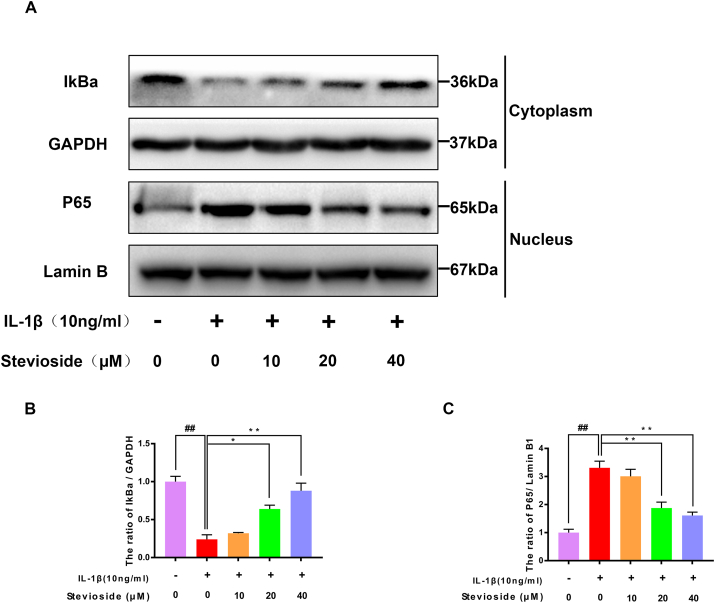
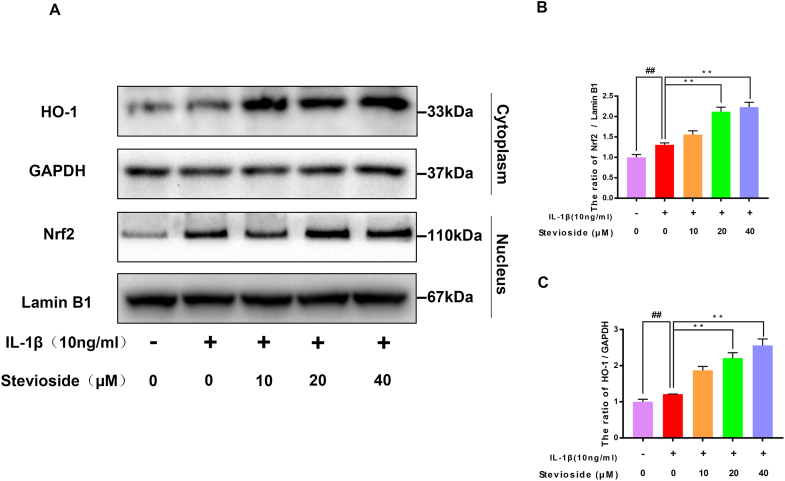
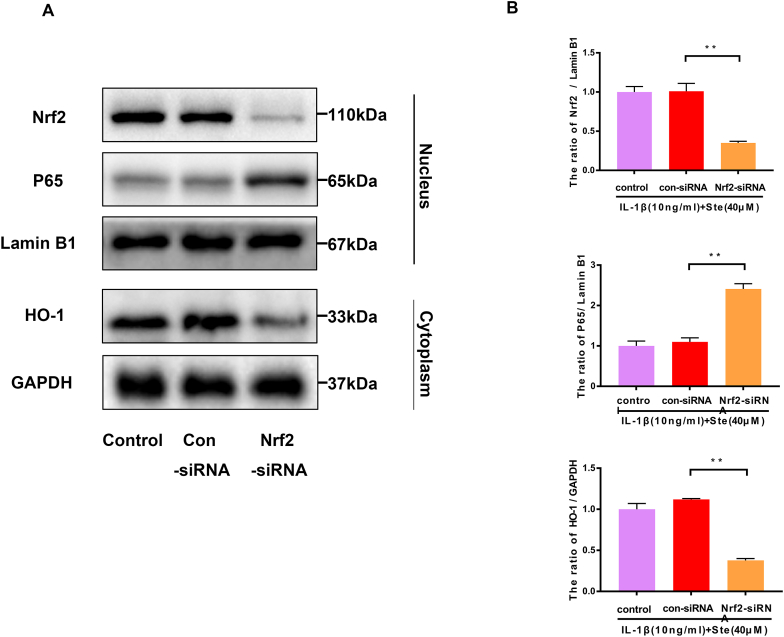
In the present study, we examined the anti-inflammatory effects of STE (STE) in both mouse chondrocytes and OA model induced by destabilization of the medial meniscus (DMM). , the mouse chondrocytes were treated with STE (0, 10, 20, 40 M, 24 h) after stimulated with IL-1β (10 ng/mL, 24 h). The expression of ant-inflammation-relative mediators iNOS and Cox-2 were detected by Western blot and RT-PCR. The catabolic factors (MMP-13, ADAMTS-4) and cartilage matrix constituent (Aggrecan, Collagen II) were measured by Western blot and Immunofluorescence staining. The Nrf2/HO-1/NF-κB signaling molecules were detected by Western blot. , histological analysis was used to evaluate the severity of mouse OA models.
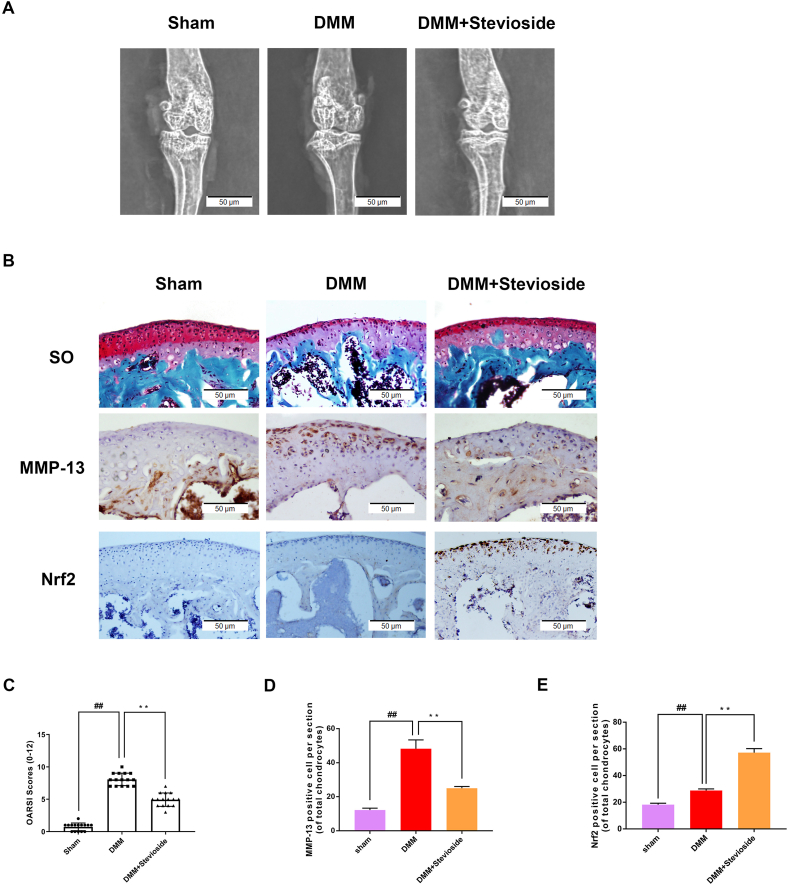
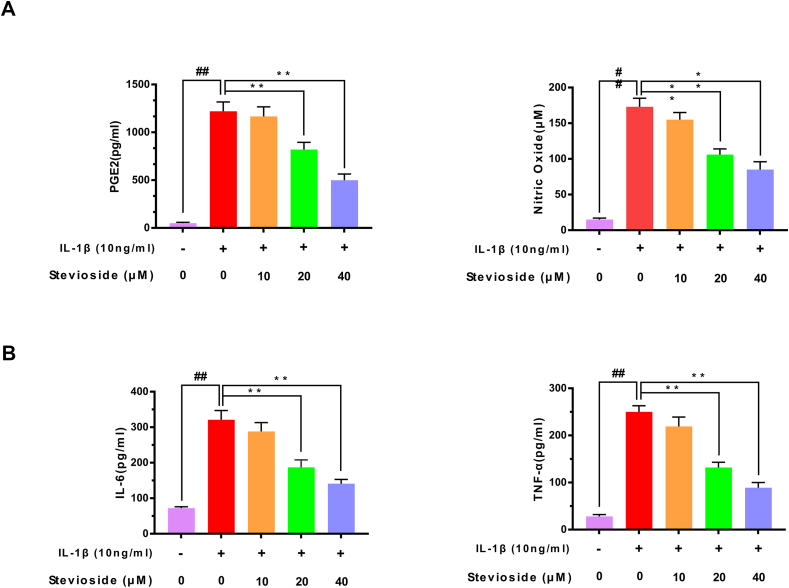
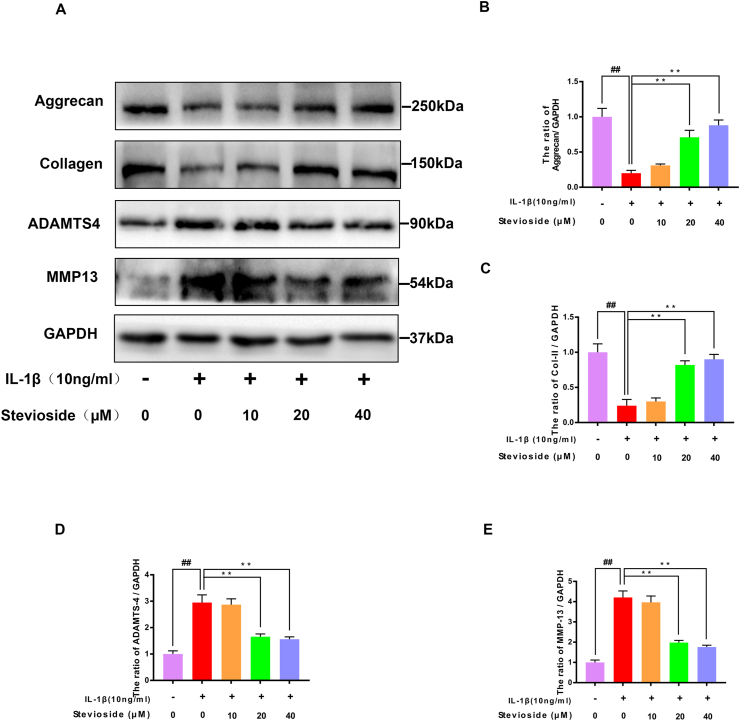
STE remarkably inhibited the IL-1β-induced expression of iNOS and Cox-2, generation of MMP-13, ADAMTS-4 and degradation of Aggrecan and Collagen II. Furthermore, we found that the chondroprotective effect of STE via Nrf2/HO-1/NF-κB signaling pathway. In vivo, the cartilage treated with STE displayed attenuated degeneration, low OARIS scores compared with DMM group. In conclusion, we considered that STE might be a promising therapeutic agent for the treatment of OA in future.
Our findings indicated that STE can ameliorate the development of OA via inhibiting the inflammation. The underlying mechanism may be related to the Nrf2/HO-1/NF-κB signaling pathway. Moreover, the treatment of STE significantly relieves the progression in the mouse DMM model. All of the results demonstrated the therapeutic of STE in OA treatment.
This study demonstrates a more efficient and safe application of STE in treating osteoarthritis, provide a new concept for the cartilage targeted application of natural compounds.
骨关节炎(OA)是一种慢性疾病,可导致关节软骨退变和滑膜炎症,引起严重疼痛、生活质量下降及功能受限。既往研究表明,细胞外基质(ECM)降解和炎症参与OA的进展。甜菊糖苷(STE)是一种天然二萜糖苷,从甜叶菊(Bertoni)中分离得到,具有多种药理活性,包括抗炎、抗氧化和神经保护作用。然而,STE对OA的作用及其机制仍需进一步研究。
在本研究中,我们检测了STE在小鼠软骨细胞和内侧半月板不稳定(DMM)诱导的OA模型中的抗炎作用。首先,用白细胞介素-1β(IL-1β,10 ng/mL,24小时)刺激小鼠软骨细胞后,用STE(0、10、20、40 μM,24小时)处理。通过蛋白质免疫印迹法(Western blot)和逆转录-聚合酶链反应(RT-PCR)检测抗炎相关介质诱导型一氧化氮合酶(iNOS)和环氧化酶-2(Cox-2)的表达。通过蛋白质免疫印迹法和免疫荧光染色检测分解代谢因子(基质金属蛋白酶-13,MMP-13;含血小板反应蛋白基序的解聚蛋白样金属蛋白酶-4,ADAMTS-4)和软骨基质成分(聚集蛋白聚糖、胶原蛋白II)。通过蛋白质免疫印迹法检测核因子E2相关因子2(Nrf2)/血红素加氧酶-1(HO-1)/核因子κB(NF-κB)信号分子。其次,采用组织学分析评估小鼠OA模型的严重程度。
STE显著抑制IL-1β诱导的iNOS和Cox-2表达、MMP-13和ADAMTS-4的产生以及聚集蛋白聚糖和胶原蛋白II的降解。此外,我们发现STE通过Nrf2/HO-!NF-κB信号通路发挥软骨保护作用。在体内,与DMM组相比,STE处理的软骨退变减轻,骨关节炎研究学会国际分会(OARIS)评分较低。总之,我们认为STE可能是未来治疗OA的一种有前景的治疗药物。
我们的研究结果表明,STE可通过抑制炎症改善OA的发展。其潜在机制可能与Nrf2/HO-1/NF-κB信号通路有关。此外,STE治疗显著缓解了小鼠DMM模型中的疾病进展。所有结果均证明了STE在OA治疗中的疗效。
本研究证明了STE在治疗骨关节炎方面更高效、安全的应用,为天然化合物的软骨靶向应用提供了新的概念。