Department of Colorectal Surgery, Taichung Veterans General Hospital, Taichung, Taiwan.
School of Medicine, National Defense Medical University, Taipei, Taiwan.
Sci Rep. 2022 Nov 29;12(1):20566. doi: 10.1038/s41598-022-24665-w.
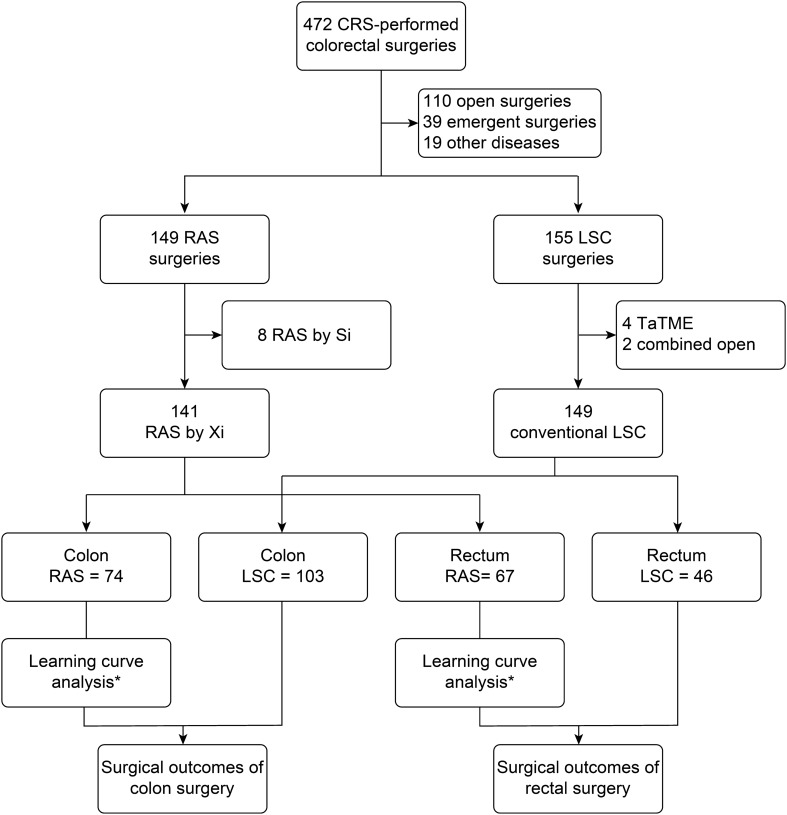
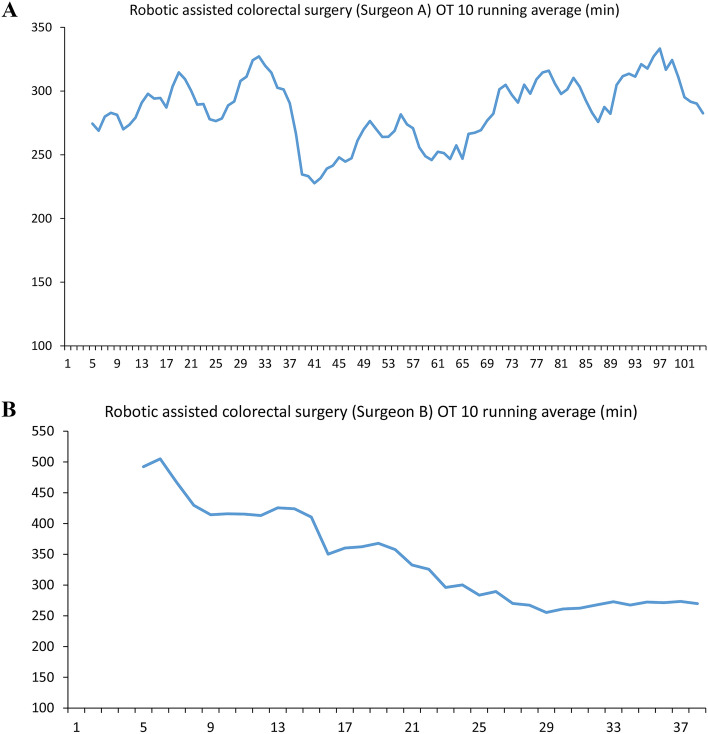
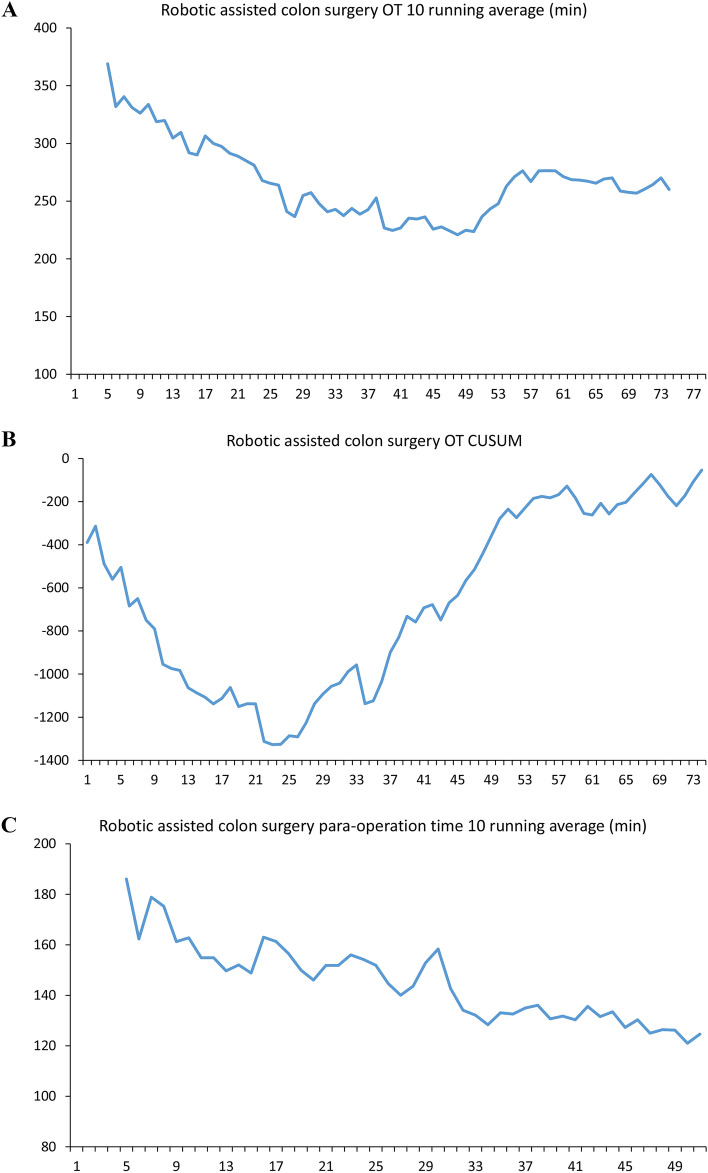
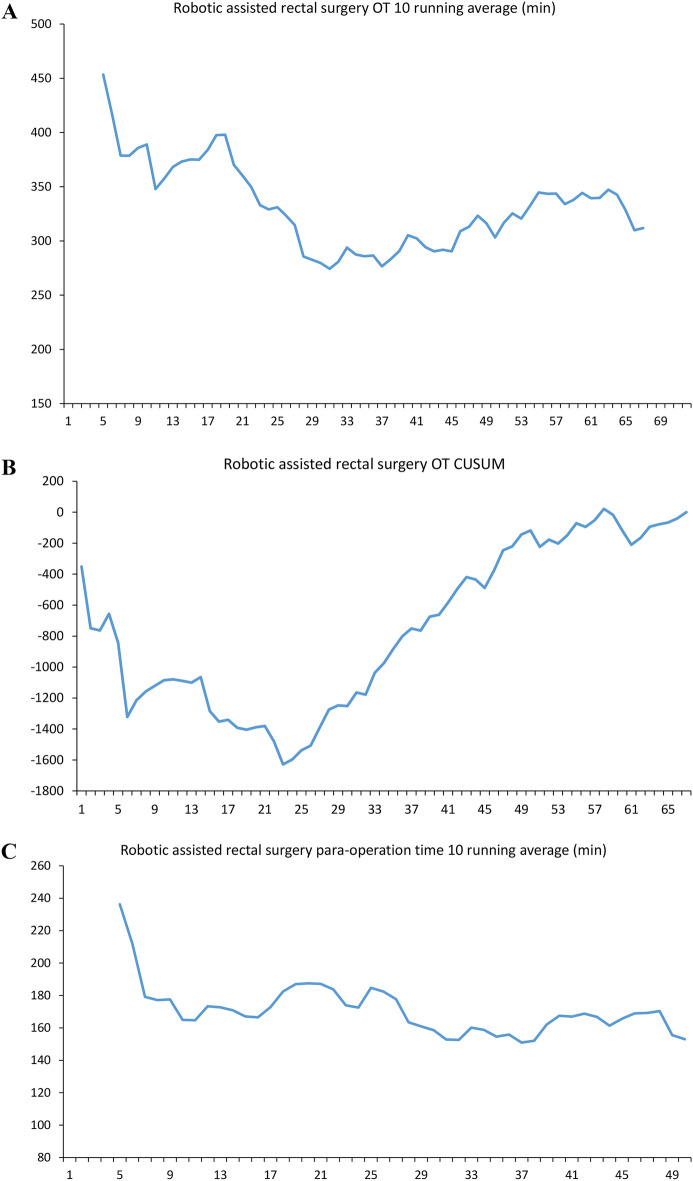
This study analyzed learning curve and the surgical outcome of robotic assisted colorectal surgery with ERAS program. The study results serve as a reference for future robotic colorectal surgeon who applied ERAS in clinical practice. This was a retrospective case-control study to analyze the learning curve of 141 robotic assisted colorectal surgery (RAS) by Da Vinci Xi (Xi) system and compare the surgical outcomes with 147 conventional laparoscopic (LSC) surgery in the same team. Evaluation for maturation was performed by operation time and the CUSUM plot. Patients were recruited from 1st February 2019 to 9th January 2022; follow-up was conducted at 30 days, and the final follow-up was conducted on 9th February 2022. It both took 31 cases for colon and rectal robotic surgeries to reach the maturation phase. Teamwork maturation was achieved after 60 cases. In the maturation stage, RAS required a longer operation time (mean: colon: 249.5 ± 46.5 vs. 190.3 ± 57.3 p < 0.001; rectum 314.9 ± 59.6 vs. 223.6 ± 63.5 p < 0.001). After propensity score matching, robotic surgery with ERAS program resulted in significant shorter length of hospital stay (mean: colon: 5.5 ± 4.5 vs. 10.0 ± 11.9, p < 0.001; rectum: 5.4 ± 3.5 vs. 10.1 ± 7.0, p < 0.001), lower minor complication rate (colon: 6.0% vs 20.0%, p = 0.074 ; rectum: 11.1% vs 33.3%, p = 0.102), and no significant different major complication rate (colon: 2.0% vs 6.0%, p = 0.617; rectum: 7.4% cs 7.4%, p = 1.0) to conventional LSC. Learning curve for robotic assisted colorectal surgery takes 31 cases. Robotic surgery with ERAS program brings significant faster recovery and fewer complication rate compared to laparoscopy in colorectal surgery.
本研究分析了机器人辅助结直肠手术(RAS)与加速康复外科(ERAS)方案的学习曲线和手术结果。研究结果为未来在临床实践中应用 ERAS 的机器人结直肠外科医生提供了参考。这是一项回顾性病例对照研究,分析了达芬奇 Xi(Xi)系统辅助的 141 例机器人结直肠手术(RAS)的学习曲线,并与同一团队的 147 例传统腹腔镜(LSC)手术的手术结果进行了比较。通过手术时间和 CUSUM 图评估成熟度。患者于 2019 年 2 月 1 日至 2022 年 1 月 9 日入组;在 30 天进行随访,最终随访于 2022 年 2 月 9 日进行。结肠和直肠机器人手术都需要 31 例才能达到成熟阶段。团队合作成熟度在 60 例后达到。在成熟阶段,RAS 的手术时间更长(平均:结肠:249.5±46.5 比 190.3±57.3,p<0.001;直肠:314.9±59.6 比 223.6±63.5,p<0.001)。在倾向评分匹配后,机器人手术与 ERAS 方案联合显著缩短了住院时间(平均:结肠:5.5±4.5 比 10.0±11.9,p<0.001;直肠:5.4±3.5 比 10.1±7.0,p<0.001),降低了小并发症发生率(结肠:6.0%比 20.0%,p=0.074;直肠:11.1%比 33.3%,p=0.102),而大并发症发生率无显著差异(结肠:2.0%比 6.0%,p=0.617;直肠:7.4%比 7.4%,p=1.0)。机器人辅助结直肠手术的学习曲线需要 31 例。与腹腔镜相比,机器人手术与 ERAS 方案联合在结直肠手术中能更快地恢复,并发症发生率更低。