Department of Pharmacy & Pharmacology, The Netherlands Cancer Institute, Amsterdam, The Netherlands.
Department of Nuclear Medicine, The Netherlands Cancer Institute, Amsterdam, The Netherlands.
Theranostics. 2022 Nov 14;12(18):7804-7820. doi: 10.7150/thno.77279. eCollection 2022.
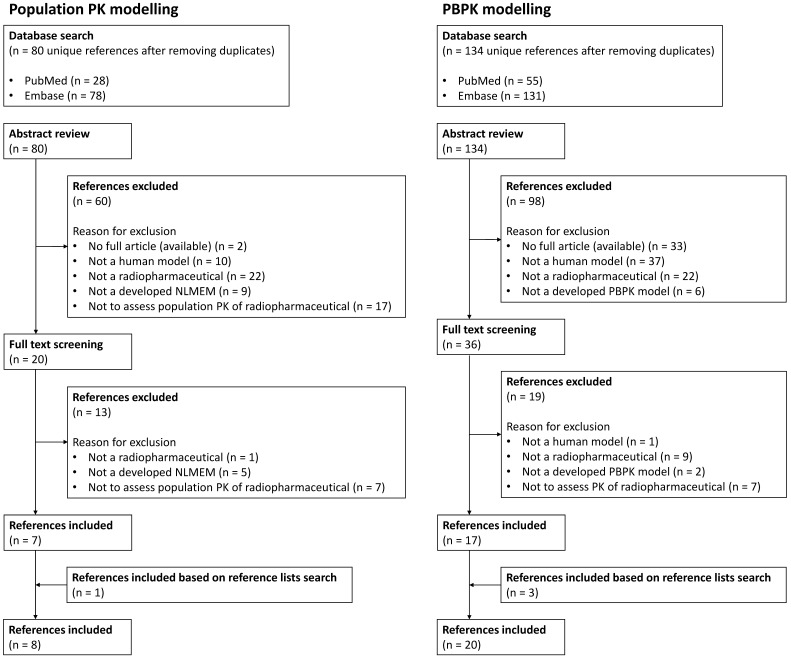
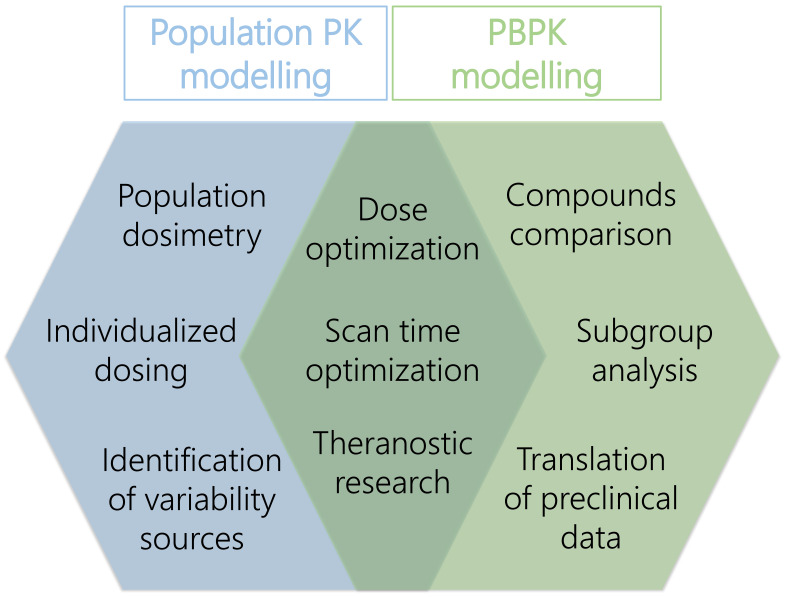
Physiologically based pharmacokinetic (PBPK) and population pharmacokinetic (PK) modelling approaches are widely accepted in non-radiopharmaceutical drug development and research, while there is no major role for these approaches in radiopharmaceutical development yet. In this review, a literature search was performed to specify different research purposes and questions that have previously been answered using both PBPK and population PK modelling for radiopharmaceuticals. The literature search was performed using the databases PubMed and Embase. Wide search terms included radiopharmaceutical, tracer, radioactivity, physiologically based pharmacokinetic model, PBPK, population pharmacokinetic model and nonlinear mixed-effects model. Eight articles and twenty articles were included for this review based on this literature search for population PK modelling and PBPK modelling, respectively. Included population PK analyses showed to have an added value to develop predictive models for a population and to describe individual variability sources. Main purposes of PBPK models appeared related to optimizing treatment (planning), or more specifically: to find the optimal combination of peptide amount and radioactivity, to optimize treatment planning by reducing the number of measurements, to individualize treatment, to get insights in differences between pre-therapeutic and therapeutic scans or to understand inter-patient differences. Other main research subjects were regarding radiopharmaceutical comparisons, selecting ligands based on their peptide characteristics and gaining a better understanding of drug-drug interactions. The use of PK modelling approaches in radiopharmaceutical research remains scarce, but can be expanded to obtain a better understanding of PK and whole-body distribution of radiopharmaceuticals in general. PK modelling of radiopharmaceuticals has great potential for the nearby future and could contribute to the evolving research of radiopharmaceuticals.
生理药代动力学(PBPK)和群体药代动力学(PK)建模方法在非放射性药物研发中得到广泛认可,而在放射性药物研发中尚未发挥主要作用。在本综述中,我们进行了文献检索,以确定之前使用 PBPK 和群体 PK 建模来回答放射性药物的不同研究目的和问题。文献检索使用了 PubMed 和 Embase 数据库。广泛的搜索词包括放射性药物、示踪剂、放射性、生理药代动力学模型、PBPK、群体药代动力学模型和非线性混合效应模型。根据本次文献检索,分别有 8 篇和 20 篇文章被纳入本综述,用于群体 PK 建模和 PBPK 建模。纳入的群体 PK 分析显示,对于开发人群预测模型和描述个体变异性来源具有附加价值。PBPK 模型的主要目的似乎与优化治疗(规划)有关,或者更具体地说:找到肽量和放射性的最佳组合,通过减少测量次数来优化治疗计划,实现个体化治疗,深入了解治疗前和治疗扫描之间的差异,或了解患者之间的差异。其他主要研究主题包括放射性药物比较、根据其肽特性选择配体以及更好地了解药物相互作用。PK 建模方法在放射性药物研究中的应用仍然很少,但可以扩展到更好地了解放射性药物的 PK 和全身分布。放射性药物的 PK 建模具有很大的潜力,并且可以为放射性药物的不断发展的研究做出贡献。