Singh Arjun, Kumar Murugan, Chakdar Hillol, Pandiyan Kuppusamy, Kumar Shiv Charan, Zeyad Mohammad Tarique, Singh Bansh Narayan, Ravikiran K T, Mahto Arunima, Srivastava Alok Kumar, Saxena Anil Kumar
ICAR-National Bureau of Agriculturally Important Microorganisms, Mau, India.
ICAR-Central Soil Salinity Research Institute, RRS, Lucknow, India.
Front Microbiol. 2022 Nov 14;13:1033158. doi: 10.3389/fmicb.2022.1033158. eCollection 2022.
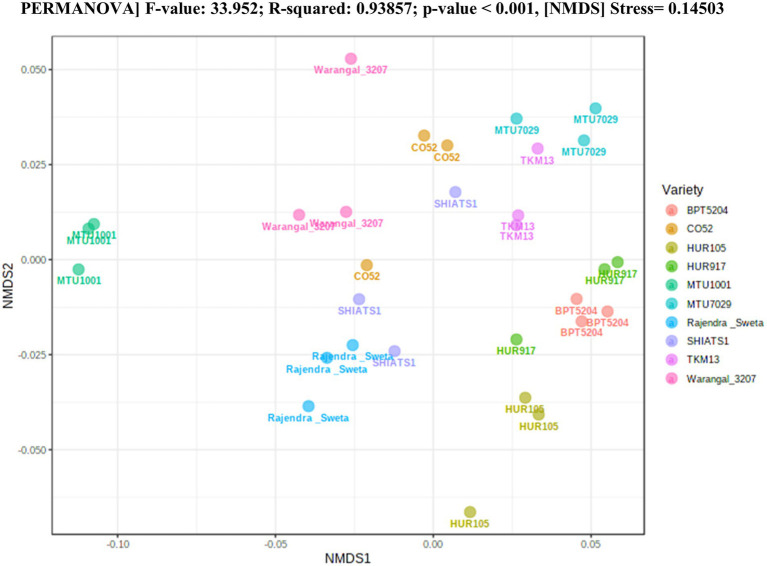
Rice plants display a unique root ecosystem comprising oxic-anoxic zones, harboring a plethora of metabolic interactions mediated by its root microbiome. Since agricultural land is limited, an increase in rice production will rely on novel methods of yield enhancement. The nascent concept of tailoring plant phenotype through the intervention of synthetic microbial communities (SynComs) is inspired by the genetics and ecology of core rhizobiome. In this direction, we have studied structural and functional variations in the root microbiome of 10 rice varieties. The studies on α and β-diversity indices of rhizospheric root microbiome with the host genotypes revealed variations in the structuring of root microbiome as well as a strong association with the host genotypes. Biomarker discovery, using machine learning, highlighted members of class , , and bacterial genera like , . , , etc. as the most important features of rice microbiota having a role in improving the plant's fitness. Metabolically, rice rhizobiomes showed an abundance of genes related to sulfur oxidation and reduction, biofilm production, nitrogen fixation, denitrification, and phosphorus metabolism. This comparative study of rhizobiomes has outlined the taxonomic composition and functional diversification of rice rhizobiome, laying the foundation for the development of next-generation microbiome-based technologies for yield enhancement in rice and other crops.
水稻植株展现出一个独特的根系生态系统,该系统由有氧-缺氧区域组成,其根系微生物群介导了大量的代谢相互作用。由于农业用地有限,水稻产量的提高将依赖于新的增产方法。通过合成微生物群落(SynComs)干预来定制植物表型这一新兴概念,受到核心根际微生物群的遗传学和生态学启发。在这个方向上,我们研究了10个水稻品种根系微生物群的结构和功能变化。对根际根系微生物群与宿主基因型的α和β多样性指数的研究揭示了根系微生物群结构的变化以及与宿主基因型的强关联。利用机器学习进行的生物标志物发现突出了 纲、 纲的成员以及诸如 属、 属、 属等细菌属,这些是水稻微生物群中对提高植物适应性起作用的最重要特征。在代谢方面,水稻根际微生物群显示出大量与硫氧化和还原、生物膜形成、固氮、反硝化和磷代谢相关的基因。这项对根际微生物群的比较研究概述了水稻根际微生物群的分类组成和功能多样化,为开发基于微生物群的下一代水稻及其他作物增产技术奠定了基础。