Department of Biochemistry, Institute of Biology, ELTE Eötvös Loránd University, Budapest, Hungary.
Protein Sci. 2023 Jan;32(1):e4522. doi: 10.1002/pro.4522.
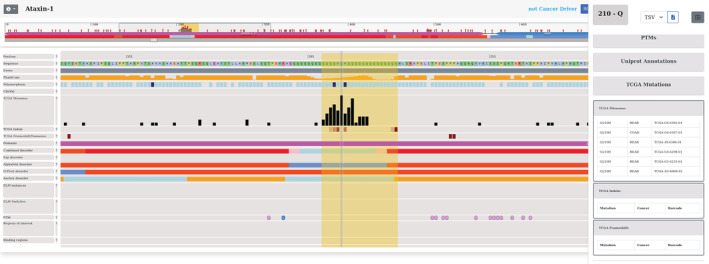
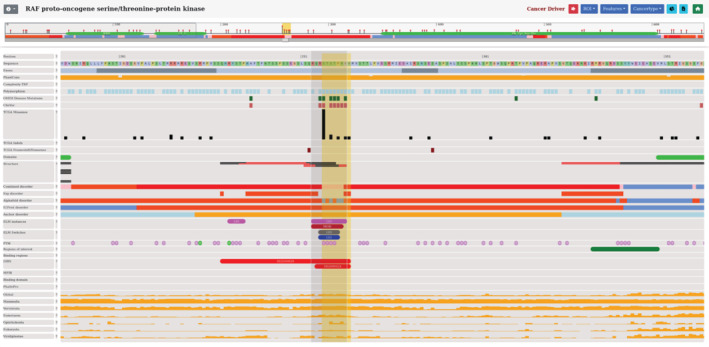
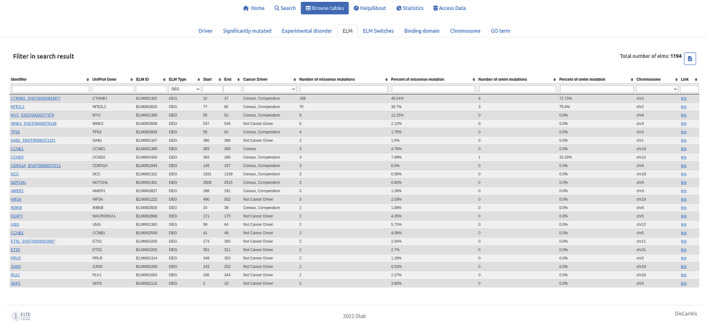
Intrinsically disordered proteins (IDPs) play important roles in a wide range of biological processes and have been associated with various diseases, including cancer. In the last few years, cancer genome projects have systematically collected genetic variations underlying multiple cancer types. In parallel, the number and different types of disordered proteins characterized by experimental methods have also significantly increased. Nevertheless, the role of IDPs in various types of cancer is still not well understood. In this work, we present DisCanVis, a novel visualization tool for cancer mutations with a special focus on IDPs. In order to aid the interpretation of observed mutations, genome level information is combined with information about the structural and functional properties of proteins. The web server enables users to inspect individual proteins, collect examples with existing annotations of protein disorder and associated function or to discover currently uncharacterized examples with likely disease relevance. Through a REST API interface and precompiled tables the analysis can be extended to a group of proteins.
无规卷曲蛋白质(IDPs)在广泛的生物过程中发挥着重要作用,并与各种疾病相关,包括癌症。在过去的几年中,癌症基因组项目已经系统地收集了多种癌症类型的遗传变异。与此同时,通过实验方法鉴定的无序蛋白质的数量和类型也显著增加。然而,IDPs 在各种类型癌症中的作用仍未被很好地理解。在这项工作中,我们提出了 DisCanVis,这是一种针对癌症突变的新型可视化工具,特别关注无规卷曲蛋白质。为了帮助解释观察到的突变,我们将基因组水平的信息与蛋白质结构和功能特性的信息相结合。该网络服务器允许用户检查单个蛋白质,收集具有现有蛋白质无序性和相关功能注释的示例,或者发现具有潜在疾病相关性但目前尚未表征的示例。通过 REST API 接口和预编译的表格,可以将分析扩展到一组蛋白质。