School of Medicine, Tsinghua University, Beijing, China.
Department of Orthopedic Surgery, Peking Union Medical College Hospital, Peking Union Medical College, Chinese Academy of Medical Sciences, Beijing, China.
Orthop Surg. 2023 Feb;15(2):460-470. doi: 10.1111/os.13603. Epub 2022 Dec 1.
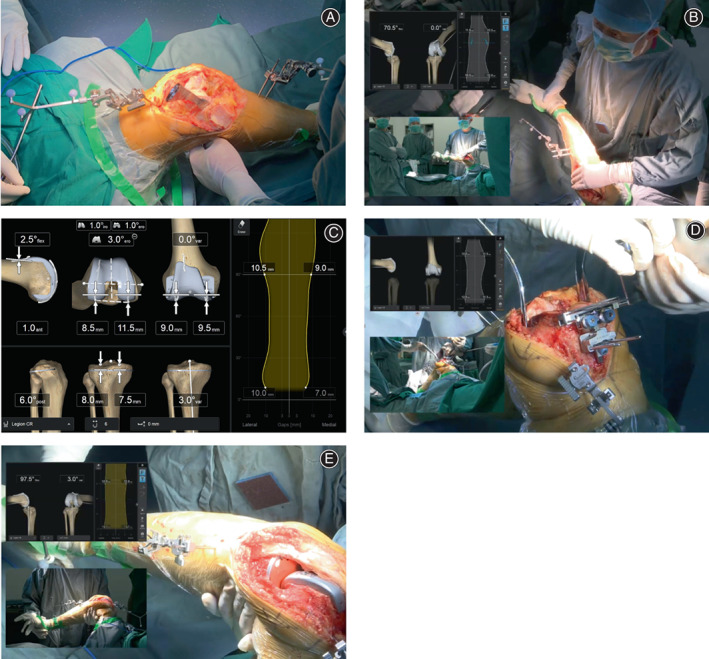
Mechanical alignment (MA)-total knee arthroplasty (TKA) has been challenged due to the excessive soft tissue release and the evidence of the clinical outcomes of computer assisted navigation is still limited. The aim of this ambispective cohort study was to: (i) investigate whether computer assisted navigation is capable to achieve restricted kinematic alignment (rKA)-TKA; and (ii) compare the short-term outcomes between rKA-TKA and MA-TKA.
We retrospectively included 41 patients diagnosed with osteoarthritis who received MA-TKA between April 2019 and January 2021 and 43 patients diagnosed with osteoarthritis who received rKA-TKA were included in the prospective cohort from January 2021 to September 2021. Demographical, peri-operative, and radiological data were collected and compared. Unpaired two-sample t-test for continuous variables and χ test for categorical variables were used to compare various measurements in two groups. The patient-reported outcome measures at baseline, 10 days (T1), and 6 months (T6) after surgery were statistically analyzed by generalized estimating equation (GEE) models.
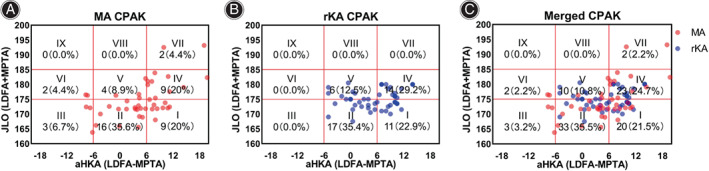
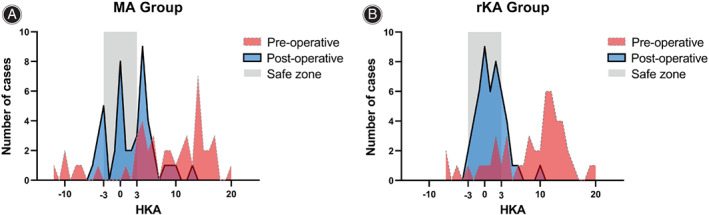
Fourty-one patients (45 knees) and 43 patients (48 knees) were included in the MA and the rKA group respectively. Three constitutional knee phenotypes (II, I, IV) were the commonest in our population. Navigation improved the surgical accuracy (1.5° vs 3.5°, p < 0.001) and precision (interquartile range 4.0 vs 2.0, p < 0.001) in the rKA group than the MA group. The changes in Knee Injury and Osteoarthritis Outcome Score 12 (KOOS12), EuroQol five-dimension questionnaire (EQ5D) from baseline to T1 and T6 for patients with on-target rKA were larger than on-target MA counterparts (26.053 vs 18.607, P < 0.001 , 0.457 vs 0.367 p < 0.001 ; 51.017 vs 46.896, P = 0.023 , 0.606 vs 0.565, P = 0.01 ). Patients with on-target rKA had better Forgotten Joint Score (FJS) at T1 (54.126 vs 40.965, P = 0.002) compared with on-target MA counterparts.
Computer assisted navigation achieved the level of accuracy required by rKA-TKA. rKA-TKA offered significantly better short-term outcomes than MA-TKA.
由于过度松解软组织,机械对线(MA)-全膝关节置换术(TKA)受到了挑战,计算机辅助导航的临床结果证据仍然有限。本前瞻性队列研究的目的是:(i)研究计算机辅助导航是否能够实现限制性运动学对线(rKA)-TKA;(ii)比较 rKA-TKA 和 MA-TKA 的短期结果。
我们回顾性纳入了 41 例 2019 年 4 月至 2021 年 1 月接受 MA-TKA 的骨关节炎患者和 43 例 2021 年 1 月至 2021 年 9 月接受 rKA-TKA 的骨关节炎患者。收集并比较了人口统计学、围手术期和影像学数据。采用独立样本 t 检验比较两组间连续变量,采用卡方检验比较分类变量。采用广义估计方程(GEE)模型对术后基线、术后 10 天(T1)和 6 个月(T6)的患者报告结局进行统计学分析。
MA 组和 rKA 组分别纳入 41 例(45 膝)和 43 例(48 膝)患者。我们人群中最常见的是三种膝关节形态学(II、I、IV)。导航提高了 rKA 组(1.5°比 3.5°,p<0.001)和 MA 组(4.0 比 2.0,p<0.001)的手术准确性和精度。rKA 组的膝关节损伤和骨关节炎结果评分 12(KOOS12)、欧洲五维健康量表(EQ5D)从基线到 T1 和 T6 的变化均大于目标 MA 组(26.053 比 18.607,p<0.001;0.457 比 0.367,p<0.001;51.017 比 46.896,p=0.023;0.606 比 0.565,p=0.01)。rKA 组目标对线的患者在 T1 时的遗忘关节评分(FJS)更好(54.126 比 40.965,p=0.002),与目标 MA 组相比。
计算机辅助导航实现了 rKA-TKA 所需的准确性水平。rKA-TKA 提供了明显更好的短期结果,优于 MA-TKA。