Division of General Internal Medicine and Health Services Research, David Geffen School of Medicine at the University of California, Los Angeles, Los Angeles.
Department of Health Policy and Management, Fielding School of Public Health at the University of California, Los Angeles, Los Angeles.
JAMA Netw Open. 2022 Dec 1;5(12):e2244486. doi: 10.1001/jamanetworkopen.2022.44486.
Long-term sequelae after symptomatic SARS-CoV-2 infection may impact well-being, yet existing data primarily focus on discrete symptoms and/or health care use.
To compare patient-reported outcomes of physical, mental, and social well-being among adults with symptomatic illness who received a positive vs negative test result for SARS-CoV-2 infection.
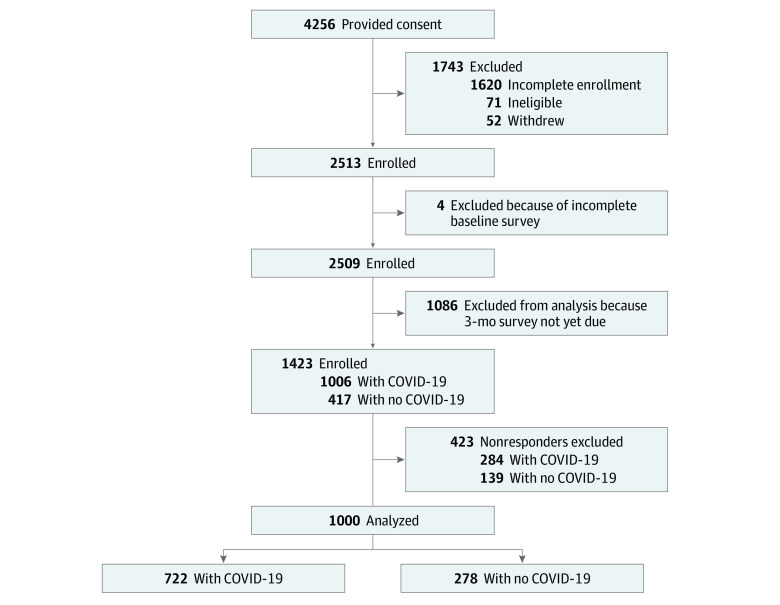
DESIGN, SETTING, AND PARTICIPANTS: This cohort study was a planned interim analysis of an ongoing multicenter prospective longitudinal registry study (the Innovative Support for Patients With SARS-CoV-2 Infections Registry [INSPIRE]). Participants were enrolled from December 11, 2020, to September 10, 2021, and comprised adults (aged ≥18 years) with acute symptoms suggestive of SARS-CoV-2 infection at the time of receipt of a SARS-CoV-2 test approved by the US Food and Drug Administration. The analysis included the first 1000 participants who completed baseline and 3-month follow-up surveys consisting of questions from the 29-item Patient-Reported Outcomes Measurement Information System (PROMIS-29; 7 subscales, including physical function, anxiety, depression, fatigue, social participation, sleep disturbance, and pain interference) and the PROMIS Short Form-Cognitive Function 8a scale, for which population-normed T scores were reported.
SARS-CoV-2 status (positive or negative test result) at enrollment.
Mean PROMIS scores for participants with positive COVID-19 tests vs negative COVID-19 tests were compared descriptively and using multivariable regression analysis.
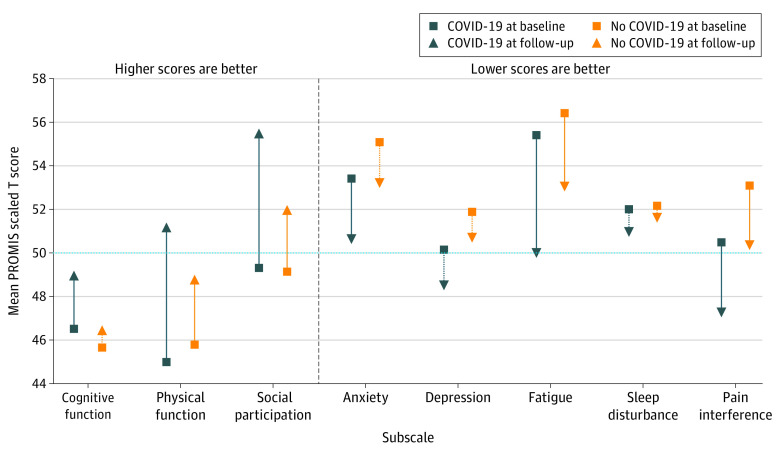
Among 1000 participants, 722 (72.2%) received a positive COVID-19 result and 278 (27.8%) received a negative result; 406 of 998 participants (40.7%) were aged 18 to 34 years, 644 of 972 (66.3%) were female, 833 of 984 (84.7%) were non-Hispanic, and 685 of 974 (70.3%) were White. A total of 282 of 712 participants (39.6%) in the COVID-19-positive group and 147 of 275 participants (53.5%) in the COVID-19-negative group reported persistently poor physical, mental, or social well-being at 3-month follow-up. After adjustment, improvements in well-being were statistically and clinically greater for participants in the COVID-19-positive group vs the COVID-19-negative group only for social participation (β = 3.32; 95% CI, 1.84-4.80; P < .001); changes in other well-being domains were not clinically different between groups. Improvements in well-being in the COVID-19-positive group were concentrated among participants aged 18 to 34 years (eg, social participation: β = 3.90; 95% CI, 1.75-6.05; P < .001) and those who presented for COVID-19 testing in an ambulatory setting (eg, social participation: β = 4.16; 95% CI, 2.12-6.20; P < .001).
In this study, participants in both the COVID-19-positive and COVID-19-negative groups reported persistently poor physical, mental, or social well-being at 3-month follow-up. Although some individuals had clinically meaningful improvements over time, many reported moderate to severe impairments in well-being 3 months later. These results highlight the importance of including a control group of participants with negative COVID-19 results for comparison when examining the sequelae of COVID-19.
新冠病毒感染后出现的长期后遗症可能会影响幸福感,但现有数据主要集中在离散症状和/或医疗保健使用上。
比较有症状的新冠病毒感染患者在接受新冠病毒检测呈阳性和阴性结果后,在身体、心理和社会福祉方面的患者报告结局。
设计、地点和参与者:这是一项正在进行的多中心前瞻性纵向登记研究(创新支持新冠病毒感染患者登记研究[INSPIRE])的计划中期分析。参与者于 2020 年 12 月 11 日至 2021 年 9 月 10 日入组,包括在接受美国食品和药物管理局批准的新冠病毒检测时出现急性疑似新冠病毒感染症状的成年人(年龄≥18 岁)。该分析包括前 1000 名参与者,他们完成了基线和 3 个月随访调查,调查包括 29 项患者报告结局测量信息系统(PROMIS-29;7 个分量表,包括身体功能、焦虑、抑郁、疲劳、社会参与、睡眠障碍和疼痛干扰)和 PROMIS 简短形式认知功能 8a 量表,其中报告了人群标准化 T 分数。
入组时的新冠病毒状态(阳性或阴性检测结果)。
比较接受新冠病毒阳性测试和阴性测试的参与者的平均 PROMIS 分数,进行描述性分析和多变量回归分析。
在 1000 名参与者中,722 名(72.2%)接受了新冠病毒阳性结果,278 名(27.8%)接受了新冠病毒阴性结果;998 名参与者中有 406 名(40.7%)年龄在 18 至 34 岁之间,972 名参与者中有 644 名(66.3%)为女性,984 名参与者中有 833 名(84.7%)为非西班牙裔,974 名参与者中有 685 名(70.3%)为白人。在新冠病毒阳性组的 712 名参与者中有 282 名(39.6%)和在新冠病毒阴性组的 275 名参与者中有 147 名(53.5%)报告在 3 个月随访时持续存在身体、心理或社会福祉不佳。调整后,新冠病毒阳性组的参与者在社会参与方面的健康状况改善在统计学和临床上均优于新冠病毒阴性组(β=3.32;95%置信区间,1.84-4.80;P<.001);两组间其他健康状况领域的变化在临床上没有差异。新冠病毒阳性组的健康状况改善主要集中在 18 至 34 岁的参与者中(例如,社会参与:β=3.90;95%置信区间,1.75-6.05;P<.001)和在门诊环境中接受新冠病毒检测的参与者中(例如,社会参与:β=4.16;95%置信区间,2.12-6.20;P<.001)。
在这项研究中,新冠病毒阳性和新冠病毒阴性组的参与者在 3 个月随访时均报告持续存在身体、心理或社会福祉不佳。虽然一些人随着时间的推移有了临床意义上的改善,但许多人在 3 个月后报告了中度至重度的健康受损。这些结果强调了在研究新冠病毒感染的后遗症时,将新冠病毒检测结果为阴性的参与者纳入对照组进行比较的重要性。