Faculty of Health and Sport Sciences, University of Tsukuba, Tsukuba, Japan.
Japan Society for the Promotion of Science, Tokyo, Japan.
PLoS One. 2022 Dec 1;17(12):e0278547. doi: 10.1371/journal.pone.0278547. eCollection 2022.
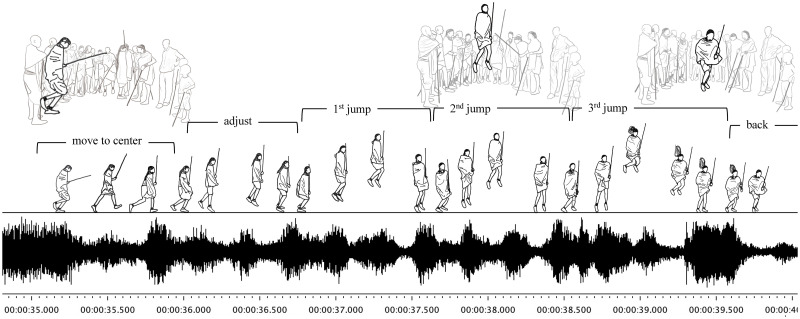
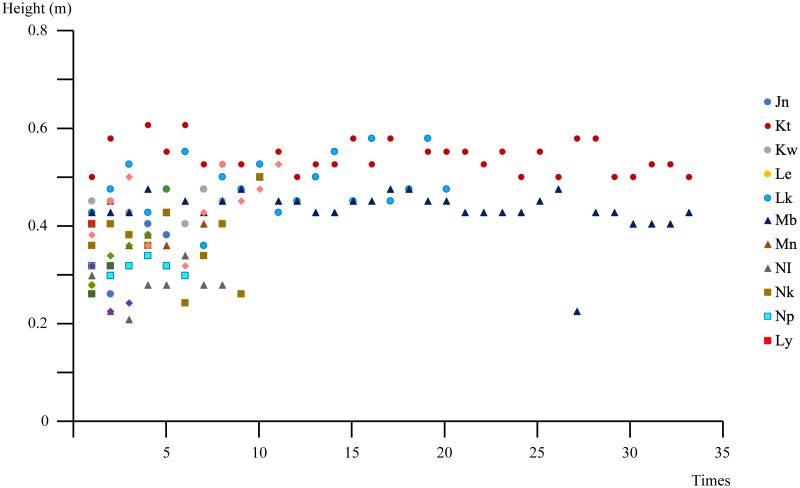
Studies focused on jumping performance in humans have so far investigated either its biological or sociocultural significance, with very little attentions paid to the inseparable relations of these two aspects in daily life of people. Integrating both ethnographic and biomechanical methods, this research investigated the biosocial features of the jump performance of Maasai youth in its most well observed context, the wedding ceremony. Ethnographic data were used to explain the social status of participants, the physical movements and singing tempo of performers, and their interactions. Biomechanical methods were applied to assess the heights and frequencies of identified repetitive double-legged vertical jumps (n = 160, from 15 male youths). All youth performers followed a certain posture pattern, paying specific attention to their final landing. Large variations exist in their jumping heights [coefficient of variation (CV) = 0.237]; however, the frequency in jump repetitions were maintained with the least variations (CV = 0.084). Cheering interactions were confirmed, but with no significant difference in height between the cheered and non-cheered groups. These results indicate that the Maasai youths did not compete for jump height during local ceremonies. Rather, they emphasized the rhythmical retention of jumps, corresponding to other youth mates who were singing alongside. In the broader context of human behaviors, the analysis addresses the diverse meanings of motor performances in different daily contexts that reject the generalized sports regime of "higher/faster-the-better".
目前,有关人类跳跃表现的研究主要集中在其生物学或社会文化意义上,很少关注到这两个方面在人们日常生活中的不可分割关系。本研究综合了民族志和生物力学方法,从最能观察到的角度——婚礼仪式——研究了马赛青年跳跃表现的生物社会特征。民族志数据用于解释参与者的社会地位、表演者的身体动作和歌唱节奏,以及他们的互动。生物力学方法则用于评估确定的重复双腿垂直跳跃的高度和频率(n = 160,来自 15 名男青年)。所有青年表演者都遵循一定的姿势模式,特别注意最后的落地。他们的跳跃高度存在很大差异(变异系数 [CV] = 0.237);然而,跳跃重复的频率保持最小的变化(CV = 0.084)。欢呼互动得到了证实,但欢呼组和非欢呼组之间的高度没有显著差异。这些结果表明,马赛青年在当地仪式上并不是为了争夺跳跃高度。相反,他们强调保持跳跃的节奏,与旁边唱歌的其他青年同伴保持一致。在人类行为的更广泛背景下,该分析探讨了不同日常环境中运动表现的多样化意义,拒绝了“越高/越快越好”的普遍体育模式。