Public Health and Integrated Toxicology Division, Center for Public Health and Environmental Assessment, U.S. Environmental Protection Agency, Research Triangle Park, NC, 27711, USA.
Center for Environmental Medicine, Asthma and Lung Biology, University of North Carolina, Chapel Hill, NC, 27599, USA.
Sci Rep. 2022 Dec 1;12(1):20722. doi: 10.1038/s41598-022-24856-5.
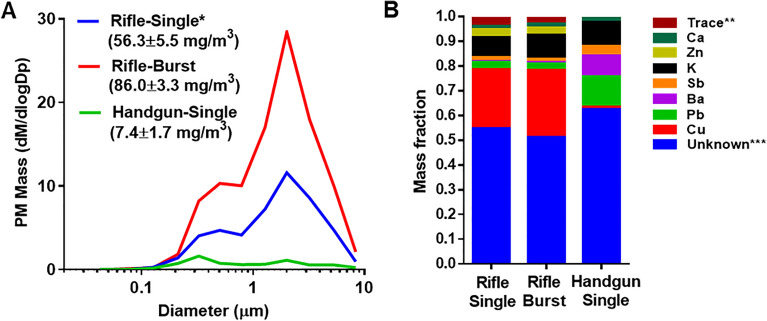
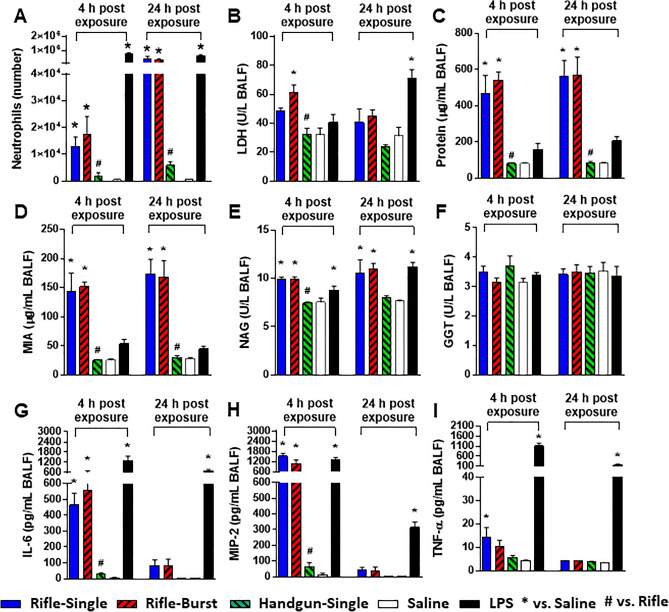
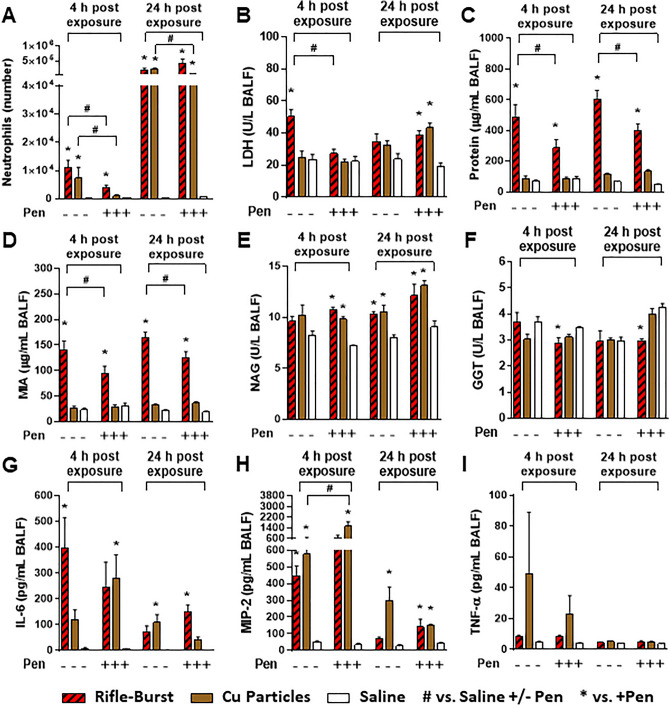
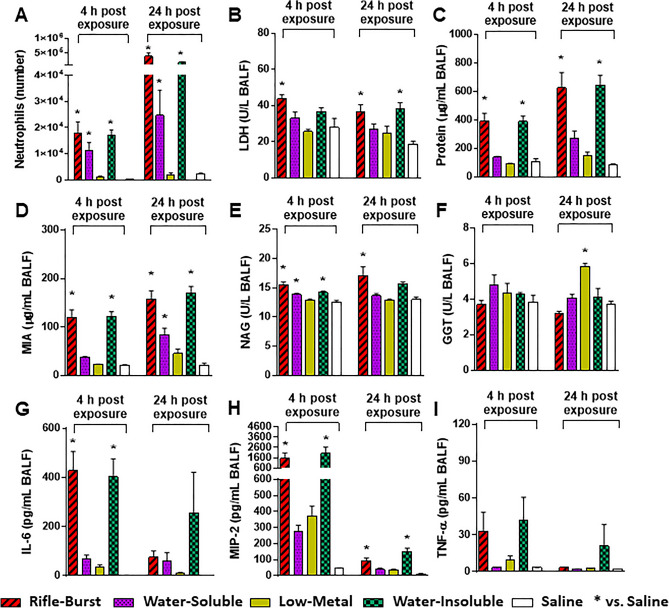
Smoke emissions produced by firearms contain hazardous chemicals, but little is known if their properties change depending on firearm and ammunition type and whether such changes affect toxicity outcomes. Pulmonary toxicity was assessed in mice exposed by oropharyngeal aspiration to six different types of smoke-related particulate matter (PM) samples; (1) handgun PM, (2) rifle PM, (3) copper (Cu) particles (a surrogate for Cu in the rifle PM) with and without the Cu chelator penicillamine, (4) water-soluble components of the rifle PM, (5) soluble components with removal of metal ions, and (6) insoluble components of the rifle PM. Gun firing smoke PM was in the respirable size range but the chemical composition varied with high levels of Pb in the handgun and Cu in the rifle smoke. The handgun PM did not induce appreciable lung toxicity at 4 and 24 h post-exposure while the rifle PM significantly increased lung inflammation and reduced lung function. The same levels of pure Cu particles alone and the soluble components from the rifle fire PM increased neutrophil numbers but did not cause appreciable cellular damage or lung function changes when compared to the negative (saline) control. Penicillamine treated rifle PM or Cu, slightly reduced lung inflammation and injury but did not improve the lung function decrements. Chelation of the soluble metal ions from the rifle fire PM neutralized the lung toxicity while the insoluble components induced the lung toxicity to the same degree as the rifle PM. The results show that different firearm types can generate contrasting chemical spectra in their emissions and that the rifle PM effects were mostly driven by water-insoluble components containing high levels of Cu. These findings provide better knowledge of hazardous substances in gun firing smoke and their potential toxicological profile.
枪支产生的烟雾排放物含有危险化学品,但人们知之甚少的是,这些特性是否会因枪支和弹药类型的不同而发生变化,以及这种变化是否会影响毒性结果。通过口咽吸入的方式,将 6 种不同类型的与烟雾有关的颗粒物(PM)样本暴露于小鼠体内,评估其肺部毒性;这些样本分别是:(1)手枪 PM;(2)步枪 PM;(3)含有和不含有铜螯合剂青霉胺的铜(Cu)颗粒(作为步枪 PM 中 Cu 的替代品);(4)步枪 PM 的水溶性成分;(5)去除金属离子后的可溶性成分;以及(6)步枪 PM 的不溶性成分。枪支射击烟雾 PM 的粒径处于可吸入范围,但化学成分因手枪中的 Pb 含量高和步枪烟雾中的 Cu 含量高而有所不同。手枪 PM 在暴露后 4 小时和 24 小时内没有引起明显的肺毒性,而步枪 PM 则显著增加了肺部炎症并降低了肺功能。与阴性(盐水)对照相比,单独的相同水平的纯 Cu 颗粒和来自步枪火 PM 的可溶性成分增加了中性粒细胞数量,但没有引起明显的细胞损伤或肺功能变化。青霉胺处理过的步枪 PM 或 Cu 稍微减轻了肺部炎症和损伤,但没有改善肺功能下降。从步枪火 PM 中鳌合可溶性金属离子可中和肺部毒性,而不溶性成分则使肺部毒性达到与步枪 PM 相同的程度。研究结果表明,不同类型的枪支在排放物中可产生截然不同的化学光谱,而步枪 PM 的影响主要由含有高水平 Cu 的水不溶性成分驱动。这些发现为枪支射击烟雾中的有害物质及其潜在的毒理学特征提供了更好的了解。