Department of anesthesiology, Union Hospital, Fujian Medical University, XinQuan Road 29th, 350001, Fuzhou, Fujian, China.
Department of Clinical Medicine, Fujian Health College, 366th GuanKou, 350101, Fuzhou, Fujian, China.
BMC Anesthesiol. 2022 Dec 1;22(1):367. doi: 10.1186/s12871-022-01918-9.
Emergent endotracheal intubation (ETI) is a serious complication after Oesophagectomy. It is still unclear that perioperative risk factors and prognosis of these patients with ETI.
Between January 2015 and December 2018, 21 patients who received ETI after esophagectomy were enrolled (ETI group) at the department of thoracic surgery, Fujian Union hospital, China. Each study subject matched one patient who underwent the same surgery in the current era were included (control group). Patient characteristics and perioperative factors were collected.
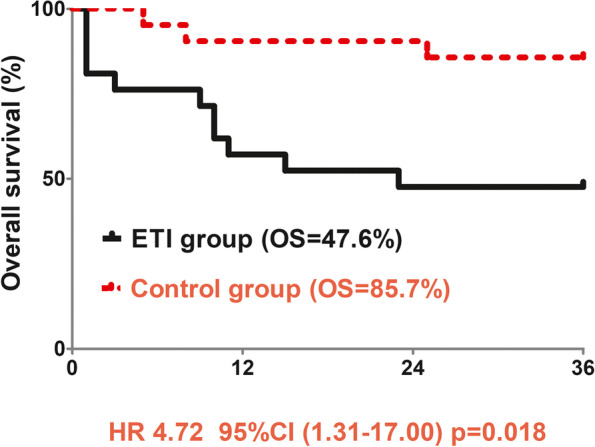
Patients with ETI were older than those without ETI (p = 0.022). The patients with history of smoking in ETI group were significantly more than those in control group (p = 0.013). The stay-time of postanesthesia care unit (PACU) in ETI group was significantly longer than that in control group (p = 0.001). The incidence of anastomotic leak or electrolyte disorder in ETI group was also higher than that in control group (p = 0.014; p = 0.002). Logistic regression analysis indicated history of smoke (HR 6.43, 95%CI 1.39-29.76, p = 0.017) and longer stay time of PACU (HR 1.04, 95%CI 1.01-1.83, p = 0.020) both were independently associated with higher risks of ETI. The 3-year overall survival (OS) rates were 47.6% in patients with ETI and 85.7% in patients without ETI (HR 4.72, 95%CI 1.31-17.00, p = 0.018). COX regression analysis indicated ETI was an independent risk factor affecting the OS.
The study indicated that history of smoking and longer stay-time in PACU both were independently associated with higher risks of ETI; and ETI was an independent risk factor affecting the OS of patients after esophagectomy.
This trial was retrospectively registered with the registration number of ChiCTR2000038549.
急诊气管插管(ETI)是食管切除术后的严重并发症。目前仍不清楚这些 ETI 患者的围手术期危险因素和预后。
2015 年 1 月至 2018 年 12 月,在中国福建医科大学附属协和医院胸外科收治了 21 例食管切除术后接受 ETI 的患者(ETI 组)。每个研究对象匹配一个在当前时代接受相同手术的患者(对照组)。收集患者特征和围手术期因素。
ETI 组患者年龄大于无 ETI 组(p=0.022)。ETI 组有吸烟史的患者明显多于对照组(p=0.013)。ETI 组患者在麻醉后监护病房(PACU)的停留时间明显长于对照组(p=0.001)。ETI 组吻合口漏或电解质紊乱的发生率也高于对照组(p=0.014;p=0.002)。Logistic 回归分析表明,吸烟史(HR 6.43,95%CI 1.39-29.76,p=0.017)和 PACU 停留时间较长(HR 1.04,95%CI 1.01-1.83,p=0.020)均与 ETI 风险增加独立相关。ETI 组患者 3 年总生存率(OS)为 47.6%,无 ETI 组为 85.7%(HR 4.72,95%CI 1.31-17.00,p=0.018)。COX 回归分析表明,ETI 是影响 OS 的独立危险因素。
该研究表明,吸烟史和 PACU 停留时间较长均与 ETI 风险增加独立相关;ETI 是影响食管切除术后患者 OS 的独立危险因素。
本试验在中国临床试验注册中心注册,注册号为 ChiCTR2000038549。