Department of Economics, University of Lausanne, Lausanne 1015, Switzerland.
Department of Ecology and Evolution, University of Lausanne, Lausanne 1015, Switzerland.
Proc Natl Acad Sci U S A. 2022 Dec 6;119(49):e2210082119. doi: 10.1073/pnas.2210082119. Epub 2022 Dec 2.
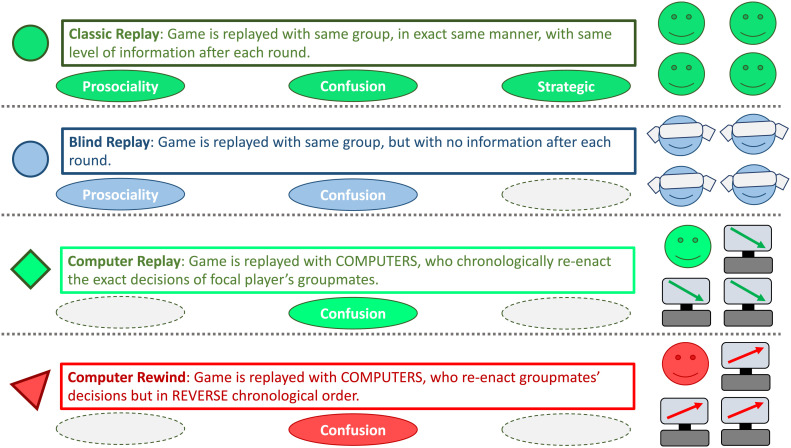
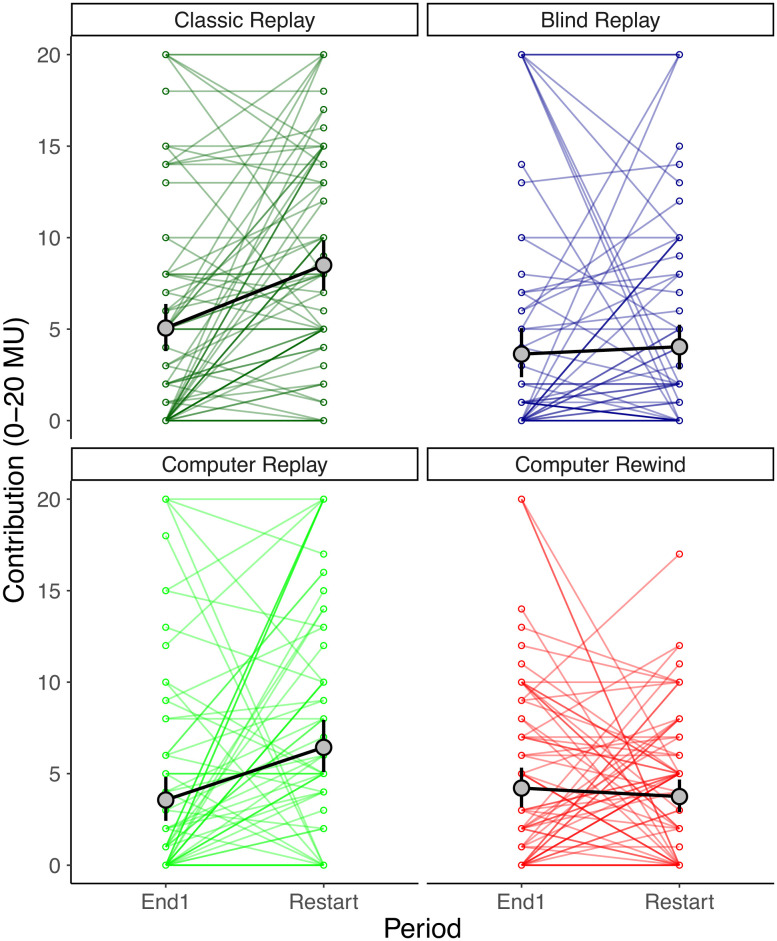
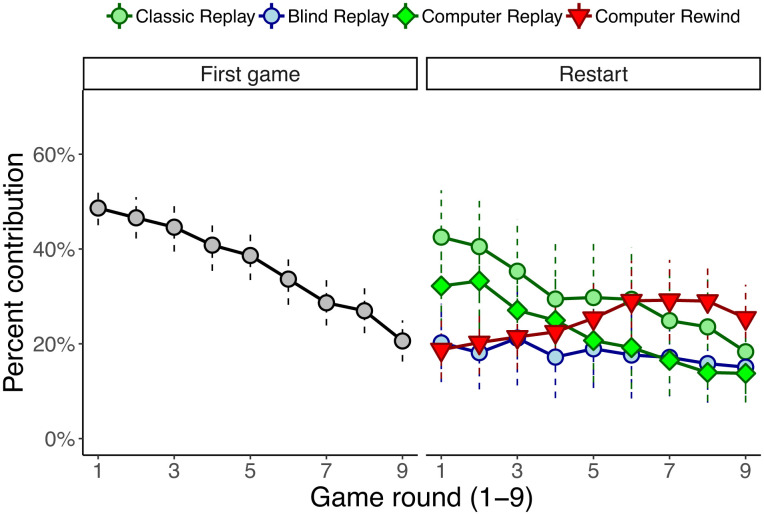
Do economic games show evidence of altruistic or self-interested motivations in humans? A huge body of empirical work has found contrasting results. While many participants routinely make costly decisions that benefit strangers, consistent with the hypothesis that humans exhibit a biologically novel form of altruism (or "prosociality"), many participants also typically learn to pay fewer costs with experience, consistent with self-interested individuals adapting to an unfamiliar environment. Key to resolving this debate is explaining the famous "restart effect," a puzzling enigma whereby failing cooperation in public goods games can be briefly rescued by a surprise restart. Here we replicate this canonical result, often taken as evidence of uniquely human altruism, and show that it 1) disappears when cooperation is invisible, meaning individuals can no longer affect the behavior of their groupmates, consistent with strategically motivated, self-interested, cooperation; and 2) still occurs even when individuals are knowingly grouped with computer players programmed to replicate human decisions, consistent with confusion. These results show that the restart effect can be explained by a mixture of self-interest and irrational beliefs about the game's payoffs, and not altruism. Consequently, our results suggest that public goods games have often been measuring self-interested but confused behaviors and reject the idea that conventional theories of evolution cannot explain the results of economic games.
经济游戏是否能证明人类具有利他主义或自利动机?大量的实证研究得出了相互矛盾的结果。虽然许多参与者经常做出对陌生人有益的高成本决策,这与人类表现出一种生物学上新颖的利他主义(或“亲社会性”)的假设一致,但许多参与者也通常会随着经验的增加而减少成本,这与自利个体适应陌生环境的情况一致。解决这一争论的关键是解释著名的“重启效应”,这是一个令人费解的谜团,即在公共物品游戏中合作失败可以通过突然的重启短暂挽救。在这里,我们复制了这一经典结果,通常被视为独特的人类利他主义的证据,并且表明:1)当合作变得不可见时,这种效应就会消失,这意味着个人无法再影响他们的同伴的行为,这与策略性的、自利的合作一致;2)即使个人知道自己是与按照人类决策编程的计算机玩家分组的,这种效应仍然会发生,这与困惑有关。这些结果表明,重启效应可以用自利和对游戏收益的非理性信念的混合来解释,而不是利他主义。因此,我们的结果表明,公共物品游戏通常衡量的是自利但困惑的行为,并拒绝了传统的进化理论无法解释经济游戏结果的观点。