Michael Barber Centre for Collaborative Mass Spectrometry, Department of Chemistry, Manchester Institute of Biotechnology, The University of Manchester, 131 Princess Street, ManchesterM1 7DN, U.K.
Department of Chemistry, The University of Manchester, Oxford Road, ManchesterM13 9PL, U.K.
J Am Chem Soc. 2022 Dec 14;144(49):22528-22539. doi: 10.1021/jacs.2c07522. Epub 2022 Dec 2.
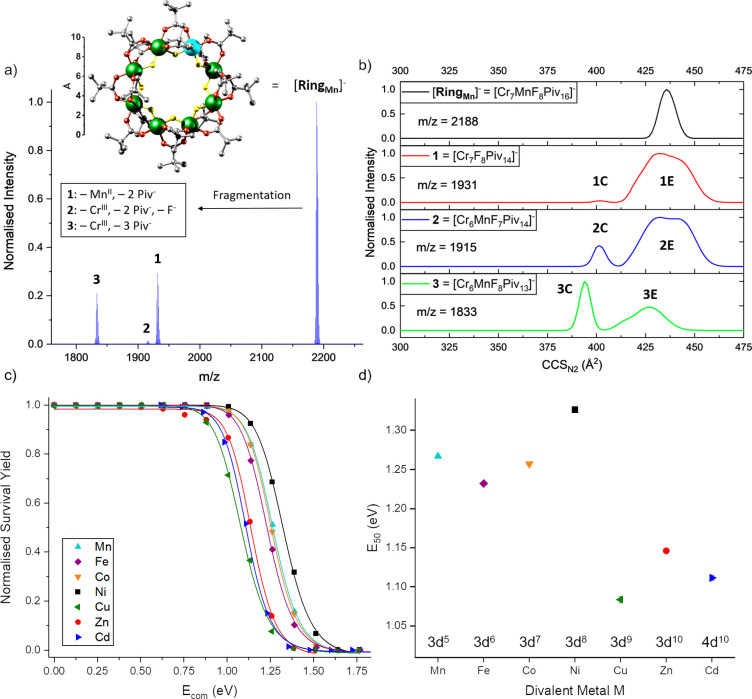
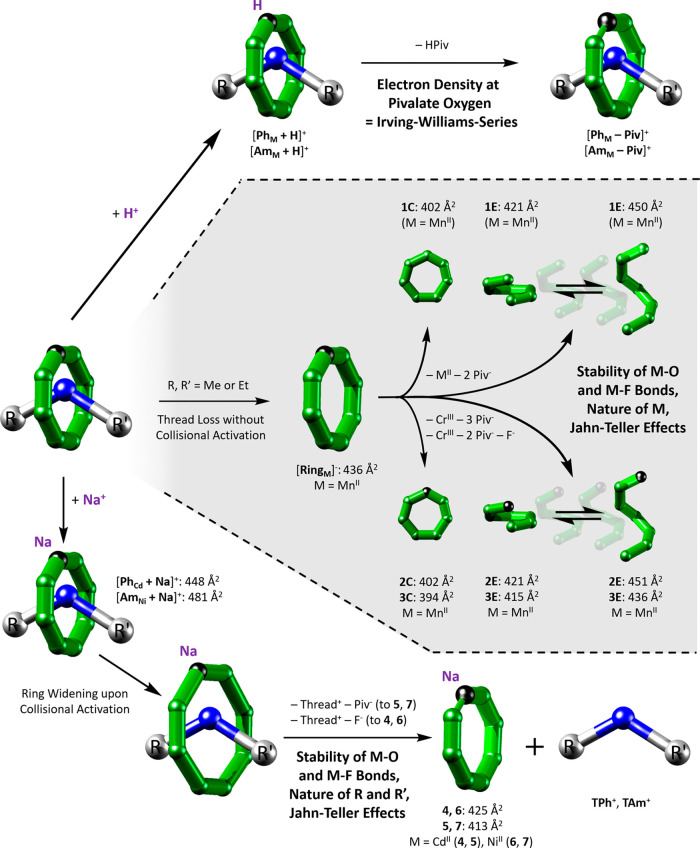
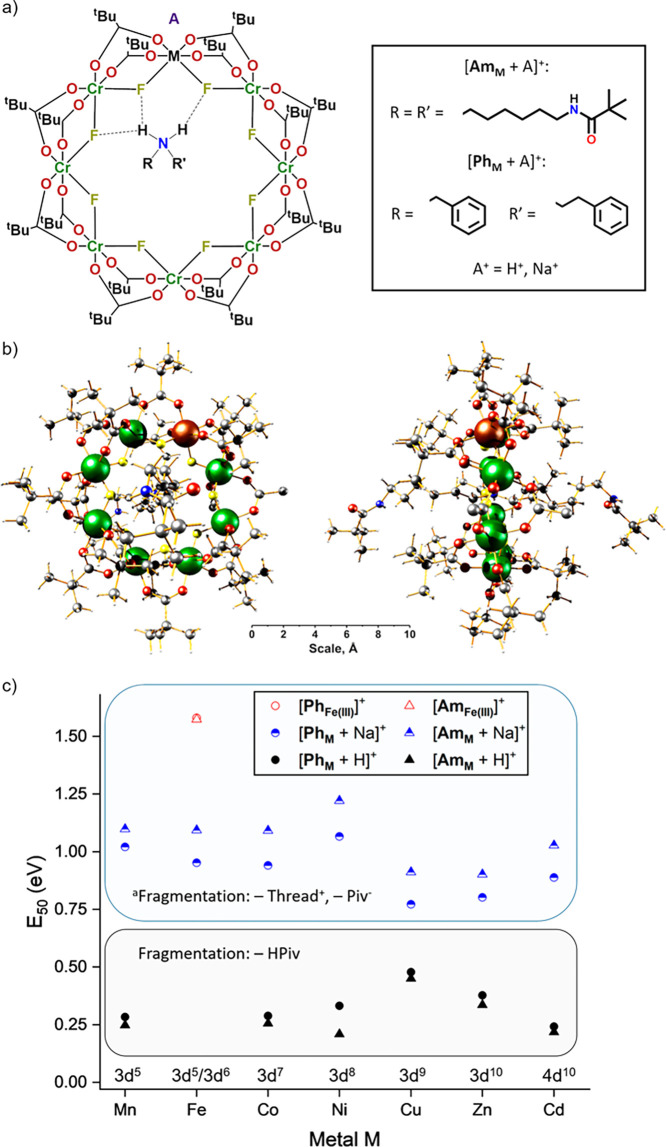
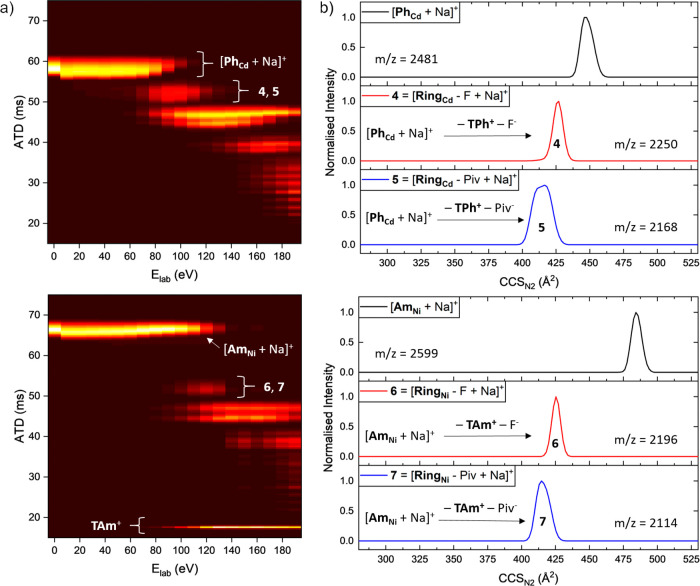
Understanding the fundamental reactivity of polymetallic complexes is challenging due to the complexity of their structures with many possible bond breaking and forming processes. Here, we apply ion mobility mass spectrometry coupled with density functional theory to investigate the disassembly mechanisms and energetics of a family of heterometallic rings and rotaxanes with the general formula [NHRR'][CrMF(OCBu)] with M = Mn, Fe, Co, Ni, Cu, Zn, Cd. Our results show that their stability can be tuned both by altering the d-metal composition in the macrocycle and by the end groups of the secondary ammonium cation [NHRR']. Ion mobility probes the conformational landscape of the disassembly process from intact complex to structurally distinct isobaric fragments, providing unique insights to how a given divalent metal tunes the structural dynamics.
由于多金属配合物结构的复杂性,其中存在许多可能的键断裂和形成过程,因此理解其基本反应性具有挑战性。在这里,我们应用离子淌度质谱联用密度泛函理论研究了一系列具有通式 [NHRR'][CrMF(OCBu)] 的杂金属环和轮烷的离解机制和热力学,其中 M = Mn、Fe、Co、Ni、Cu、Zn、Cd。我们的结果表明,通过改变大环中的 d 金属组成以及仲铵阳离子 [NHRR'] 的端基,可以调节它们的稳定性。离子淌度探测从完整配合物到结构不同的等压碎片的离解过程的构象景观,为特定二价金属如何调节结构动力学提供了独特的见解。