Priyadarsinee Lipsa, Sarma Himakshi, Sastry G Narahari
Advanced Computation and Data Sciences Division, CSIR-North East Institute of Science and Technology, Jorhat, Assam 785006 India.
Academy of Scientific and Innovative Research (AcSIR), Ghaziabad, India.
J Chem Sci (Bangalore). 2022;134(4):114. doi: 10.1007/s12039-022-02110-9. Epub 2022 Nov 23.
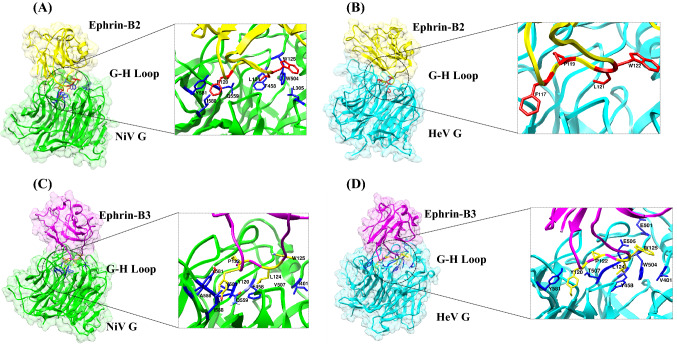
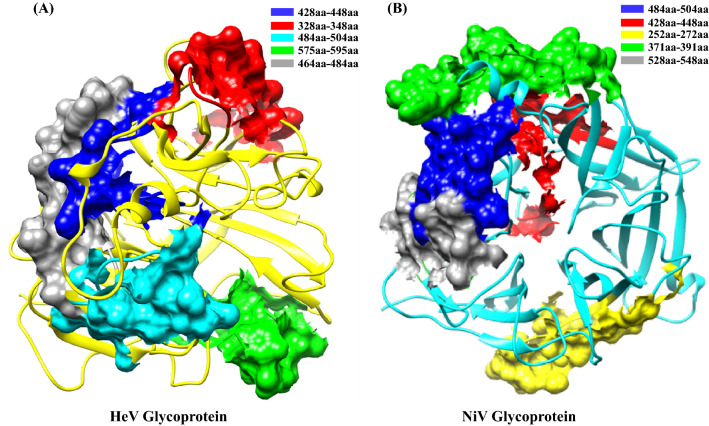
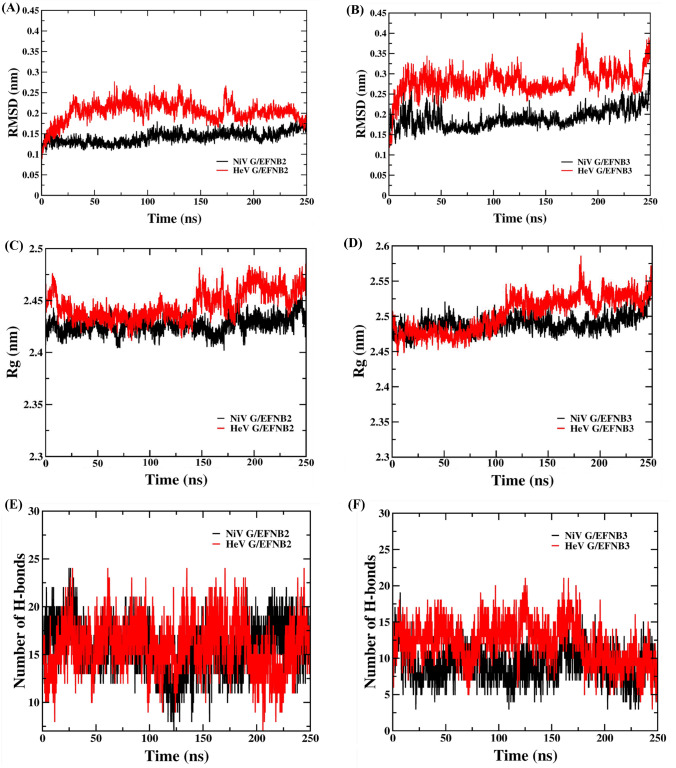
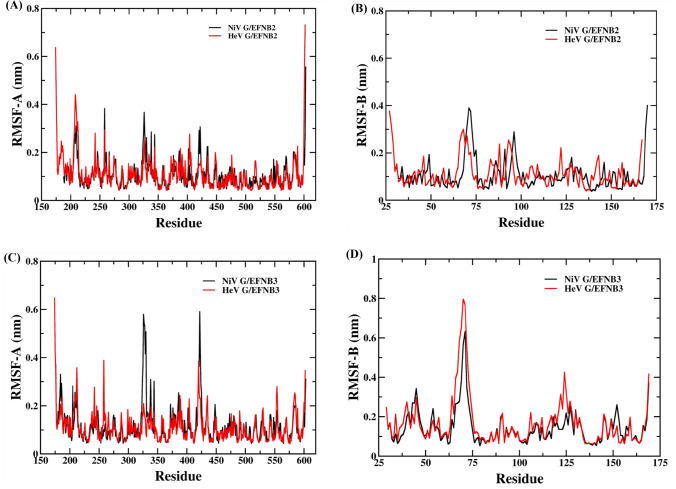
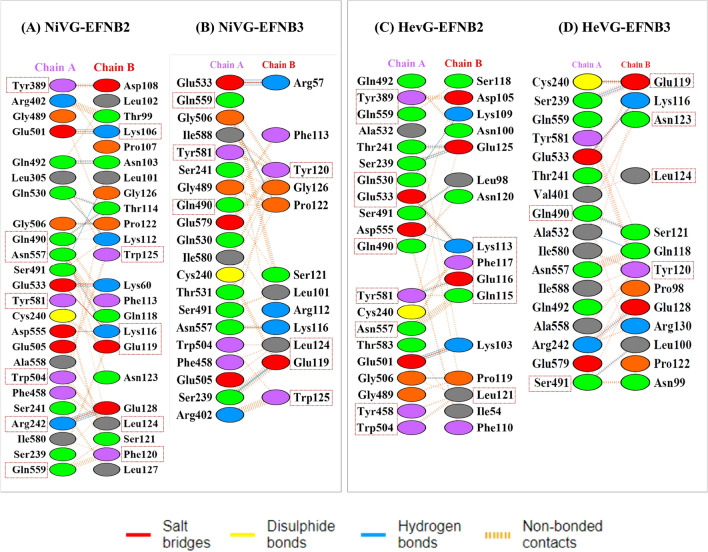
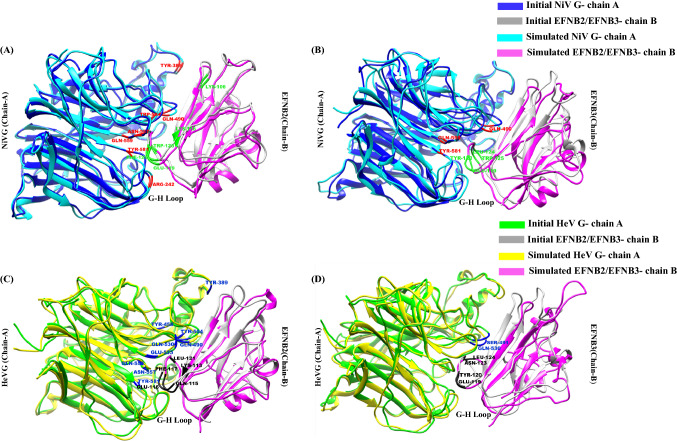
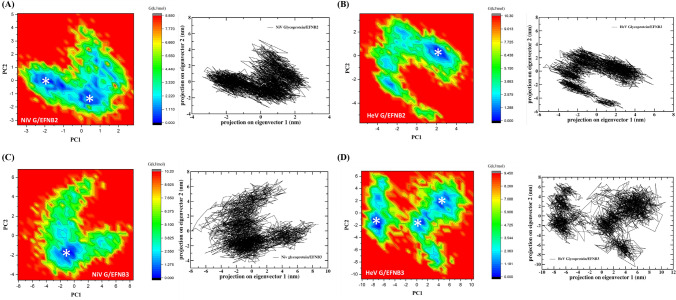
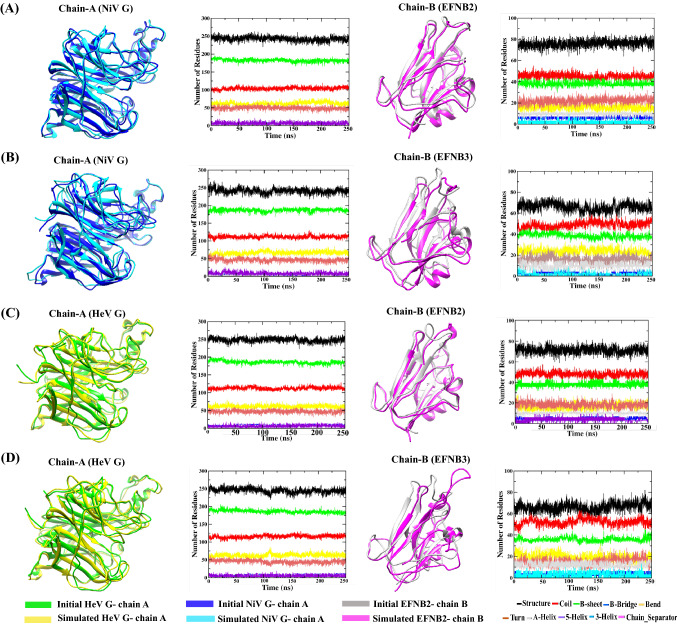
Nipah virus (NiV) and Hendra virus (HeV) are highly pathogenic paramyxovirus which belongs to Henipavirus family, causes severe respiratory disease, and may lead to fatal encephalitis infections in humans. NiV and HeV glycoproteins (G) bind to the highly conserved human ephrin-B2 and B3 (EFNB2 & EFNB3) cell surface proteins to mediate the viral entry. In this study, various molecular modelling approaches were employed to understand protein-protein interaction (PPI) of NiV and HeV glycoprotein (84% sequence similarity) with Human EFN (B2 and B3) to investigate the molecular mechanism of interaction at atomic level. Our computational study emphasized the PPI profile of both the viral glycoproteins with EFN (B2 and B3) in terms of non-bonded contacts, H-bonds, salt bridges, and identification of interface hotspot residues which play a critical role in the formation of complexes that mediate viral fusion and entry into the host cell. According to the reports, EFNB2 is considered to be more actively involved in the attachment with the NiV and HeV glycoprotein; interestingly the current computational study has displayed more conformational stability in HeV/NiV glycoprotein with EFNB2 complex with relatively high binding energy as compared to EFNB3. During the MD simulation, the number of H-bond formations was observed to be less in the case of EFNB3 complexes, which may be the possible reason for less conformational stability in the EFNB3 complexes. The current detailed interaction study on the PPI may put a path forward in designing peptide inhibitors to obstruct the interaction of viral glycoproteins with host proteins, thereby inhibiting viral entry.
The viral attachment and fusion of Nipah and Hendra virus was explored through the interaction between viral glycoprotein and the host cell surface ephrin protein. The MD simulation results displayed more stability in Nipah and Hendra glycoprotein with EFNB2 as compared to EFNB3. The residue Glu533 in the central cavity of HeV/NiV glycoprotein protein identified as the potential hotspot in binding with the G-H loop of EFNB2.
The online version contains supplementary material available at 10.1007/s12039-022-02110-9.
尼帕病毒(NiV)和亨德拉病毒(HeV)是属于亨尼帕病毒科的高致病性副粘病毒,可引起严重的呼吸道疾病,并可能导致人类致命的脑炎感染。NiV和HeV糖蛋白(G)与高度保守的人类Ephrin-B2和B3(EFNB2和EFNB3)细胞表面蛋白结合,以介导病毒进入。在本研究中,采用了各种分子建模方法来了解NiV和HeV糖蛋白(序列相似性84%)与人类EFN(B2和B3)的蛋白质-蛋白质相互作用(PPI),以研究原子水平上相互作用的分子机制。我们的计算研究强调了两种病毒糖蛋白与EFN(B2和B3)在非键接触、氢键、盐桥方面的PPI概况,以及鉴定在介导病毒融合和进入宿主细胞的复合物形成中起关键作用的界面热点残基。根据报道,EFNB2被认为更积极地参与与NiV和HeV糖蛋白的结合;有趣的是,当前的计算研究显示,与EFNB3相比,HeV/NiV糖蛋白与EFNB2复合物具有更高的结合能,构象稳定性更高。在分子动力学模拟期间,观察到EFNB3复合物中氢键形成的数量较少,这可能是EFNB3复合物构象稳定性较低的可能原因。目前对PPI的详细相互作用研究可能为设计肽抑制剂以阻碍病毒糖蛋白与宿主蛋白的相互作用从而抑制病毒进入指明方向。
通过病毒糖蛋白与宿主细胞表面Ephrin蛋白之间的相互作用,探索了尼帕病毒和亨德拉病毒的病毒附着和融合。分子动力学模拟结果显示,与EFNB3相比,NiV和HeV糖蛋白与EFNB2的稳定性更高。HeV/NiV糖蛋白中央腔中的残基Glu533被确定为与EFNB2的G-H环结合的潜在热点。
在线版本包含可在10.1007/s12039-022-02110-9获取的补充材料。