Department of Medical Microbiology and Infection Prevention, University Medical Center Groningen, University of Groningen, Netherlands.
Center for Translational Research in Oncology, Instituto do Câncer do Hospital das Clínicas, da Faculdade de Medicina, da Universidade de São Paulo, São Paulo, Brazil.
PLoS Comput Biol. 2022 Dec 6;18(12):e1010076. doi: 10.1371/journal.pcbi.1010076. eCollection 2022 Dec.
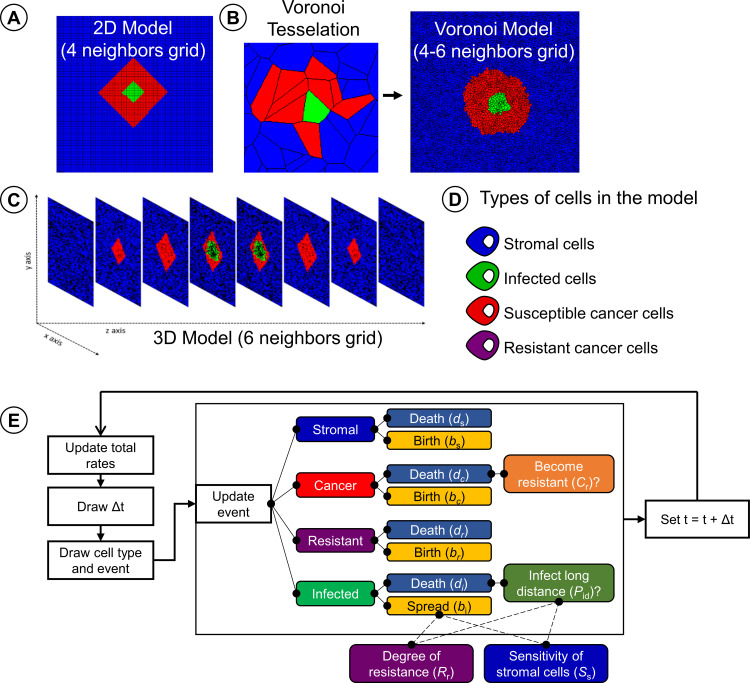
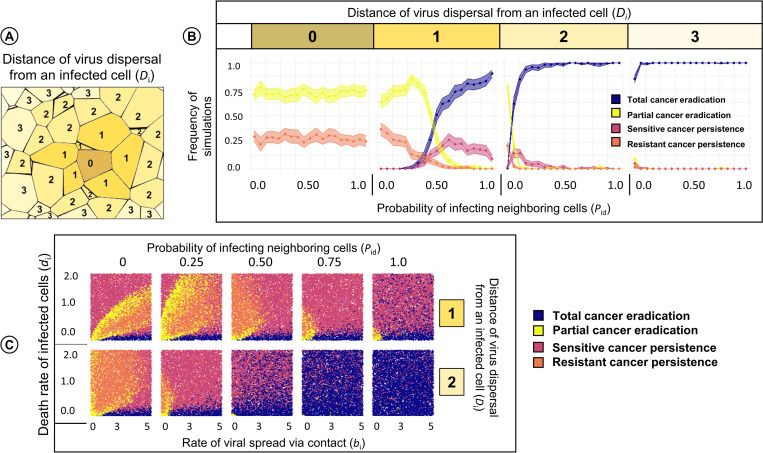
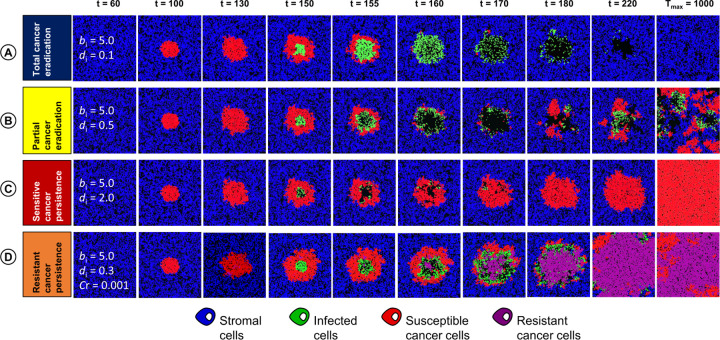
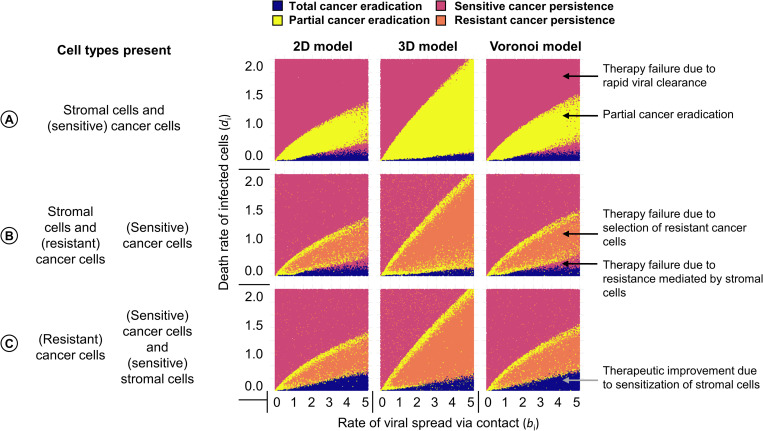
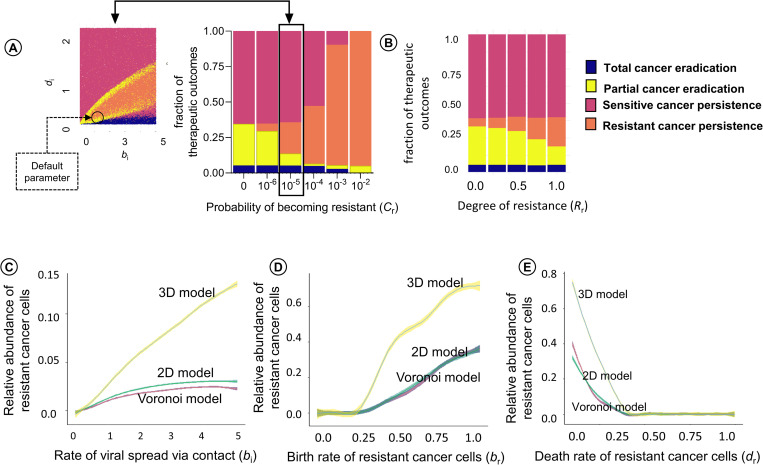
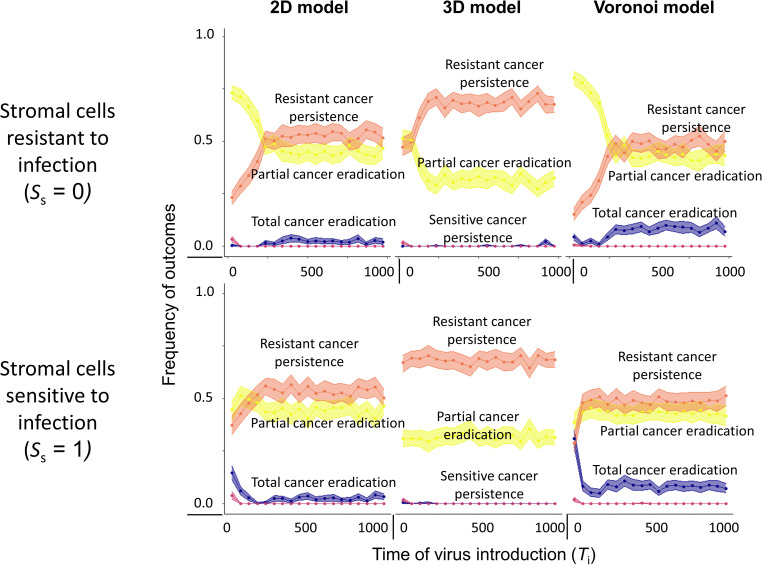
Oncolytic virotherapy is a promising form of cancer treatment that uses native or genetically engineered viruses to target, infect and kill cancer cells. Unfortunately, this form of therapy is not effective in a substantial proportion of cancer patients, partly due to the occurrence of infection-resistant tumour cells. To shed new light on the mechanisms underlying therapeutic failure and to discover strategies that improve therapeutic efficacy we designed a cell-based model of viral infection. The model allows us to investigate the dynamics of infection-sensitive and infection-resistant cells in tumour tissue in presence of the virus. To reflect the importance of the spatial configuration of the tumour on the efficacy of virotherapy, we compare three variants of the model: two 2D models of a monolayer of tumour cells and a 3D model. In all model variants, we systematically investigate how the therapeutic outcome is affected by the properties of the virus (e.g. the rate of viral spread), the tumour (e.g. production rate of resistant cells, cost of resistance), the healthy stromal cells (e.g. degree of resistance to the virus) and the timing of treatment. We find that various therapeutic outcomes are possible when resistant cancer cells arise at low frequency in the tumour. These outcomes depend in an intricate but predictable way on the death rate of infected cells, where faster death leads to rapid virus clearance and cancer persistence. Our simulations reveal three different causes of therapy failure: rapid clearance of the virus, rapid selection of resistant cancer cells, and a low rate of viral spread due to the presence of infection-resistant healthy cells. Our models suggest that improved therapeutic efficacy can be achieved by sensitizing healthy stromal cells to infection, although this remedy has to be weighed against the toxicity induced in the healthy tissue.
溶瘤病毒治疗是一种有前途的癌症治疗形式,它使用天然或基因工程病毒来靶向、感染和杀死癌细胞。不幸的是,这种治疗形式在相当一部分癌症患者中并不有效,部分原因是感染抗性肿瘤细胞的发生。为了深入了解治疗失败的机制,并发现提高治疗效果的策略,我们设计了一种基于细胞的病毒感染模型。该模型使我们能够在存在病毒的情况下研究肿瘤组织中感染敏感和感染抗性细胞的动力学。为了反映肿瘤的空间结构对病毒治疗效果的重要性,我们比较了该模型的三种变体:单层肿瘤细胞的两个 2D 模型和一个 3D 模型。在所有模型变体中,我们系统地研究了治疗效果如何受到病毒(例如病毒传播率)、肿瘤(例如抗性细胞的产生率、抗性成本)、健康基质细胞(例如对病毒的抗性程度)和治疗时间的特性的影响。我们发现,当抗性癌细胞在肿瘤中以低频率出现时,可能会出现各种治疗结果。这些结果以复杂但可预测的方式依赖于感染细胞的死亡率,其中更快的死亡导致病毒迅速清除和癌症持续存在。我们的模拟揭示了三种治疗失败的原因:病毒迅速清除、抗性癌细胞迅速选择和由于存在感染抗性健康细胞导致病毒传播率低。我们的模型表明,通过使健康基质细胞对感染敏感,可以提高治疗效果,尽管这一补救措施必须权衡对健康组织的毒性。