Department of Vascular Surgery, The First Hospital of Changsha, Changsha, Hunan, China.
Hunan Provincial Key Laboratory of Emergency and Critical Care Metabonomics, Institute of Emergency Medicine, The First Affiliated Hospital of Hunan Normal University (Hunan Provincial People's Hospital), Changsha, Hunan, China.
Cardiovasc Ther. 2022 Nov 14;2022:3889419. doi: 10.1155/2022/3889419. eCollection 2022.
Small heat shock protein-1 (HSPB1) is a small heat shock protein that participates in many cellular processes and alleviates stress-induced cell injury. Autophagy protects cells from many types of stress and plays a key role in preventing stress in arteriosclerosis obliterans (ASO). However, the roles of HSPB1 in autophagy and apoptosis in the context of ASO pathogenesis remain unclear.
In vivo and in vitro studies were used to determine whether HSPB1 is associated with ASO progression. The expression of HSPB1 was measured in normal and sclerotic blood vessels. The role of HSPB1 and its potential downstream signaling pathway were determined in VSMCs by overexpressing and silencing HSPB1.
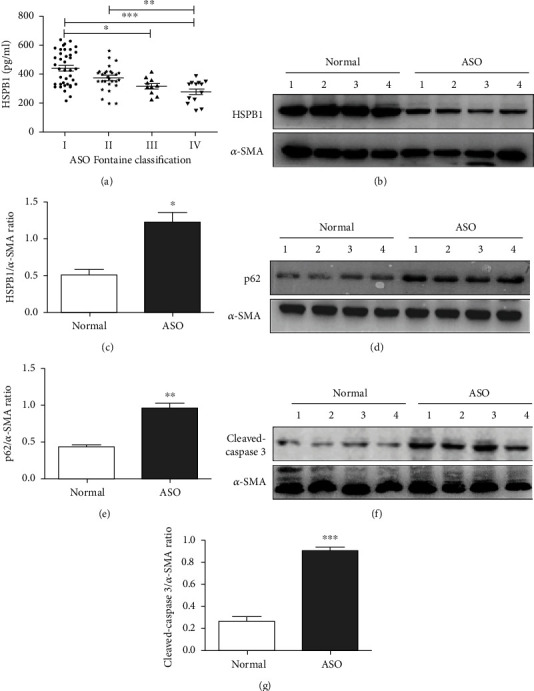
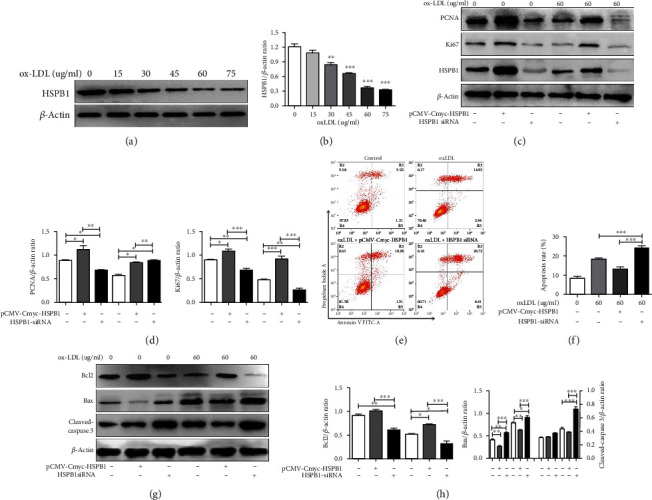
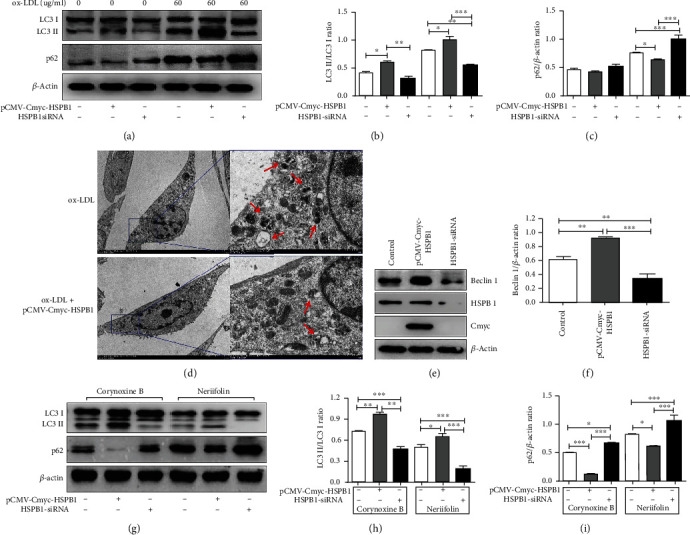
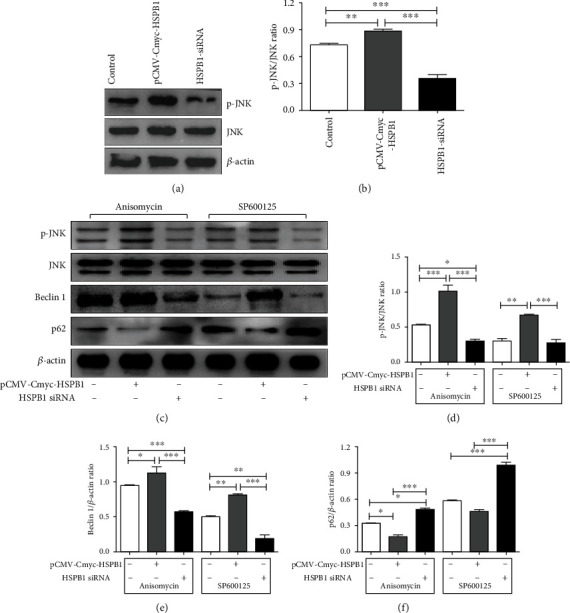
A total of 91 ASO patients admitted to and treated at our hospital from Sep. 2020 to Sep. 2021 were selected, and plasma HSPB1 expression was assessed. We divided the patients with ASO into the grade I ( = 39), II ( = 29), III ( = 10), and IV ( = 13) groups according to Fontaine's classification. Plasma HSPB1 levels were markedly decreased in patients with grade III ( = 10) and IV ( = 13) ASO compared with patients with grade I ASO. Furthermore, HSPB1 expression was significantly decreased, and p62 and cleaved caspase-3 were increased in the sclerotic vasculature compared to the normal vasculature ( < 0.05). Overexpression of HSPB1 promoted apoptosis of VSMCs following ox-LDL treatment. Knockdown of HSPB1 led to a marked increase in the expression of LC3II and Beclin-1 in ox-LDL-stimulated VSMCs, whereas knockdown of HSPB1 attenuated these changes ( < 0.05). Importantly, overexpression of HSPB1 promoted the dephosphorylation of JNK in ox-LDL-stimulated VSMCs. Conversely, downregulation of HSPB1 induced the opposite change.
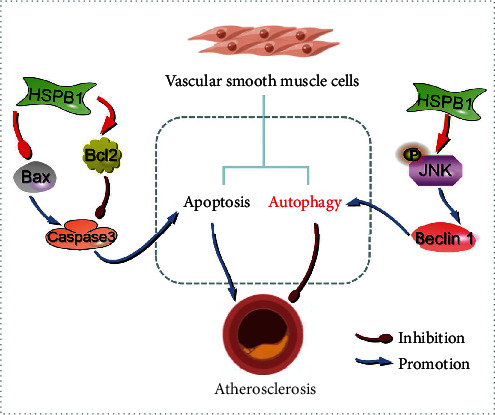
Loss of HSPB1 promotes VSMC autophagy and inhibits VSMC apoptosis, which are associated with ASO. HSPB1 and its downstream signaling pathways could be potential therapeutic targets for ASO treatment.
小分子热休克蛋白-1(HSPB1)是一种参与多种细胞过程的小分子热休克蛋白,可减轻应激诱导的细胞损伤。自噬可保护细胞免受多种类型的应激,并在预防动脉硬化闭塞症(ASO)应激中发挥关键作用。然而,HSPB1 在 ASO 发病机制中自噬和细胞凋亡中的作用尚不清楚。
采用体内和体外研究方法,确定 HSPB1 是否与 ASO 进展有关。测量正常和硬化血管中 HSPB1 的表达。通过过表达和沉默 HSPB1 来确定 HSPB1 及其潜在下游信号通路在 VSMCs 中的作用。
共选择 2020 年 9 月至 2021 年 9 月期间我院收治的 91 例 ASO 患者,评估其血浆 HSPB1 表达。根据 Fontaine 分类,我们将 ASO 患者分为 I 级(n=39)、II 级(n=29)、III 级(n=10)和 IV 级(n=13)组。与 I 级 ASO 患者相比,III 级(n=10)和 IV 级(n=13)ASO 患者的血浆 HSPB1 水平明显降低。此外,与正常血管相比,硬化血管中 HSPB1 表达降低,p62 和 cleaved caspase-3 表达增加(<0.05)。过表达 HSPB1 促进 ox-LDL 处理后的 VSMCs 凋亡。HSPB1 敲低导致 ox-LDL 刺激的 VSMCs 中 LC3II 和 Beclin-1 的表达明显增加,而 HSPB1 敲低则减弱了这些变化(<0.05)。重要的是,过表达 HSPB1 促进 ox-LDL 刺激的 VSMCs 中 JNK 的去磷酸化。相反,下调 HSPB1 则引起相反的变化。
HSPB1 的缺失促进了 VSMC 的自噬,抑制了 VSMC 的凋亡,与 ASO 有关。HSPB1 及其下游信号通路可能是 ASO 治疗的潜在靶点。