Demir Benli Merve, Tatari Hasan, Balcı Ali, Peker Ahmet, Şimşek Kürşat, Yüksel Oğuz, Birsu Topcugil Kırık Ayşe, Tarhan Mehmet Ali
Department of Sports Medicine, Health Sciences University, Bozyaka Training and Research Hospital, Izmir, Türkiye.
Department of Orthopaedics and Traumatology, Dokuz Eylül University, Faculty of Medicine, Izmir, Türkiye.
Turk J Phys Med Rehabil. 2022 Aug 25;68(3):372-380. doi: 10.5606/tftrd.2022.8113. eCollection 2022 Sep.
This study aims to compare the efficacy of the eccentric exercise (EE) and extracorporeal shock wave therapy (ESWT) on chronic midportion Achilles tendinopathy and evaluate the efficacy of these treatment modalities on tendon thickness, vascularity, and elasticity.
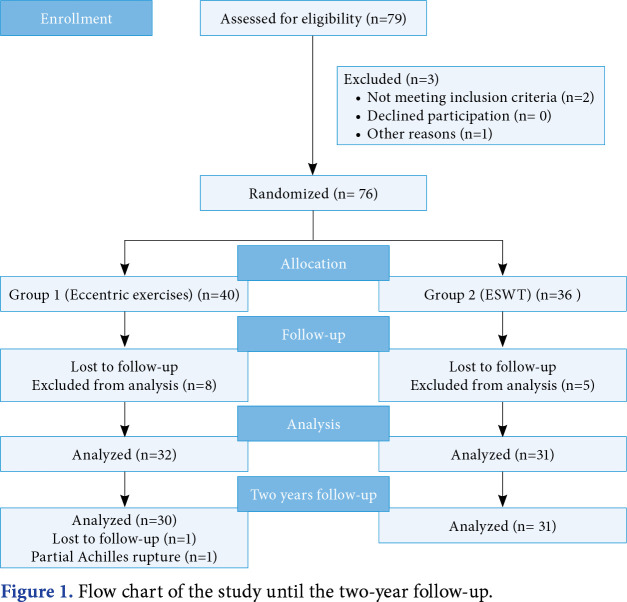
In this randomized controlled trial, a total of 63 patients (40 females, 23 males; mean age: 37.3±12.2; range, 18 to 55 years) with chronic midportion Achilles tendinopathy were enrolled between April 2017 and December 2019. The patients were allocated randomly to two groups: the first group was treated with EE every day for three months with the Alfredson protocol, and the second group received four sessions of ESWT at weekly intervals. The study was terminated at the end of three months. Visual Analog Scales (VAS), Victorian Institute of Sports Assessment-Achilles (VISA-A) questionnaires, and ultrasonography measurements were assessed before and after treatment. Patient pain was evaluated at the two-year follow-up.
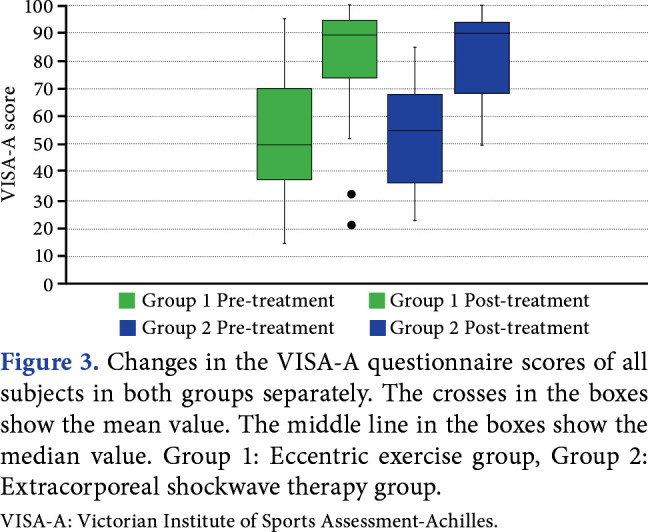
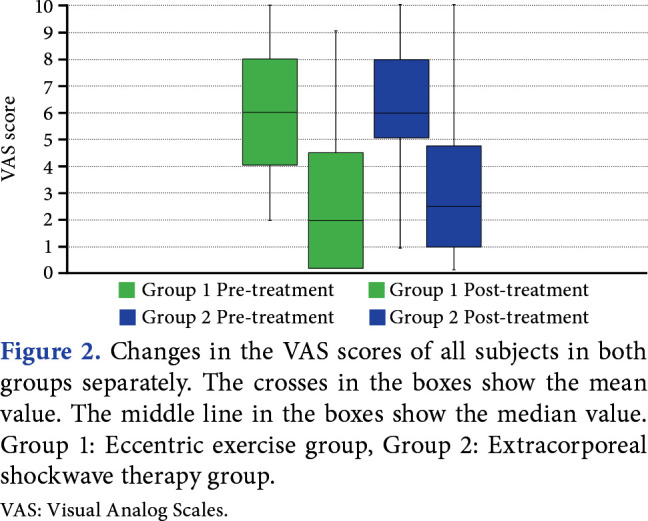
At the three-month follow up, VAS scores decreased, and VISA-A scores increased in both groups (p<0.001). At the two-year-follow-up, VAS scores significantly decreased in the EE group (p<0.001), but the difference was statistically insignificant in the ESWT group (p=0.095). Tendon thickness and stiffness increased in the EE group (p=0.003 and p=0.03, respectively) while the difference was statistically insignificant in the ESWT group after treatment (p=0.173 and p=0.702, respectively).
Eccentric exercise and ESWT are efficient in the short term, whereas EE is efficient on tendon pain in the long term. While EE increases tendon thickness and stiffness, ESWT has no effect on these measures.
本研究旨在比较离心运动(EE)和体外冲击波疗法(ESWT)对慢性跟腱中部肌腱病的疗效,并评估这些治疗方式对肌腱厚度、血管形成和弹性的疗效。
在这项随机对照试验中,2017年4月至2019年12月期间共纳入63例慢性跟腱中部肌腱病患者(40例女性,23例男性;平均年龄:37.3±12.2岁;范围18至55岁)。患者被随机分为两组:第一组按照阿尔弗雷德森方案每天进行离心运动,为期三个月,第二组每周接受一次,共四次体外冲击波治疗。研究在三个月结束时终止。治疗前后评估视觉模拟量表(VAS)、维多利亚运动评估机构跟腱量表(VISA - A)问卷以及超声测量结果。在两年随访时评估患者疼痛情况。
在三个月随访时,两组的VAS评分均降低,VISA - A评分均升高(p<0.001)。在两年随访时,离心运动组的VAS评分显著降低(p<0.001),但体外冲击波治疗组差异无统计学意义(p = 0.095)。离心运动组治疗后肌腱厚度和硬度增加(分别为p = 0.003和p = 0.03),而体外冲击波治疗组治疗后差异无统计学意义(分别为p = 0.173和p = 0.702)。
离心运动和体外冲击波疗法在短期内有效,而离心运动在长期对肌腱疼痛有效。离心运动增加肌腱厚度和硬度,而体外冲击波疗法对这些指标无影响。