Department of Population Health, New York University Grossman School of Medicine, New York, NY, USA.
Department of Epidemiology, College of Public Health and Health Professions, College of Medicine, University of Florida, Gainesville, FL, USA.
J Psychopharmacol. 2023 Aug;37(8):802-808. doi: 10.1177/02698811221140006. Epub 2022 Dec 7.
The use of ketamine, a controlled dissociative anesthetic, has become more widespread in recent years with recreational/nonmedical use increasing and ketamine becoming more widely available in clinics to treat depression.
We examined recent trends in adverse effects related to ketamine use.
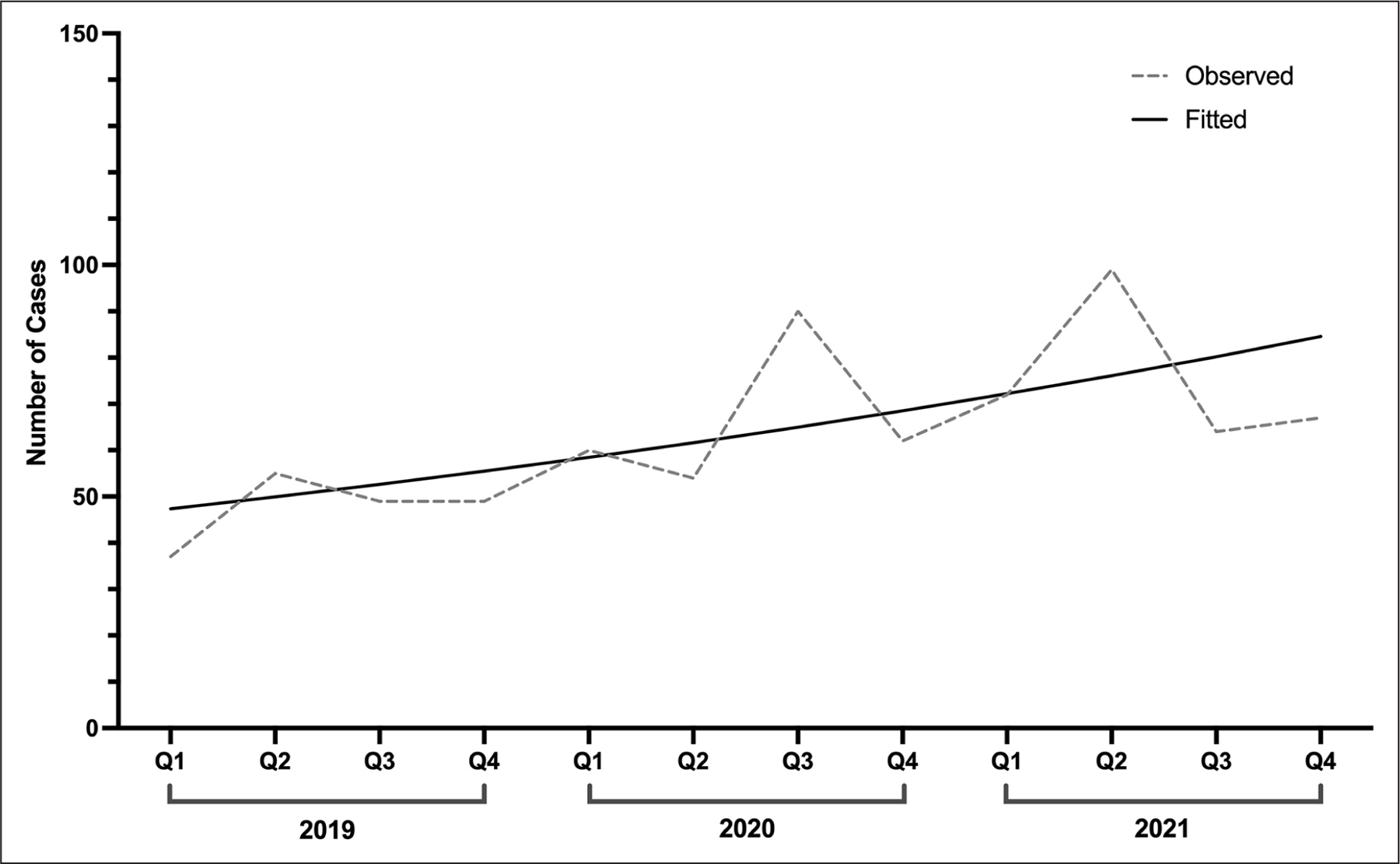
US National Poison Control data were examined, focusing on ketamine exposures among those aged ⩾13 between 2019 and 2021 ( = 758). We examined quarterly trends in exposure and delineated correlates of patients experiencing a major adverse effect or death.
The number of reported exposures increased 81.1% from 2019 Quarter 1 through 2021 Quarter 4, from 37 to 67 ( = 0.018). The majority of patients were male (57.1%), and the plurality of cases involved intentional misuse or "abuse" (39.5%), followed by suspected suicide attempt (19.7%) and unintentional exposure (18.9%). A fifth (19.6%) experienced a major adverse effect or death. A third (33.4%) co-used other drugs; the drugs most commonly co-used were benzodiazepines (14.6%), alcohol (10.3%), and opioids (8.7%). Co-use of hydroxybutyrate (GHB; adjusted prevalence ratio (aPR) = 3.43, 95% confidence interval (CI): 1.57-7.46) and opioids (aPR = 2.44, 95% CI: 1.46-4.08) was associated with increased risk for a major adverse effect or death, as was injection-only administration (aPR = 2.68, 95% CI: 1.21-5.92).
Although still rare, poisonings involving ketamine have increased in recent years. Polydrug use-particularly with opioids or GHB-appears to be a particular risk factor for more serious adverse effects. As prevalence of use increases, it is important to monitor adverse effects and co-occurring behaviors to inform timely prevention and harm reduction as needed.
近年来,作为一种被管制的分离性麻醉剂,氯胺酮的使用越来越广泛,其娱乐/非医疗用途不断增加,同时在诊所中也越来越广泛地用于治疗抑郁症。
我们研究了与氯胺酮使用相关的不良影响的最新趋势。
我们检查了美国国家毒物控制中心的数据,重点关注 2019 年至 2021 年期间年龄 ⩾13 岁的氯胺酮暴露情况(共 758 例)。我们分析了暴露的季度趋势,并描述了经历严重不良影响或死亡的患者的相关因素。
报告的暴露数量从 2019 年第 1 季度到 2021 年第 4 季度增加了 81.1%,从 37 例增加到 67 例(P=0.018)。大多数患者为男性(57.1%),多数病例涉及故意误用或“滥用”(39.5%),其次是疑似自杀企图(19.7%)和意外暴露(18.9%)。五分之一(19.6%)的患者经历了严重不良影响或死亡。三分之一(33.4%)的患者同时使用了其他药物;最常共同使用的药物是苯二氮䓬类(14.6%)、酒精(10.3%)和阿片类药物(8.7%)。同时使用羟丁酸钠(GHB;调整后的患病率比[aPR] = 3.43,95%置信区间[CI]:1.57-7.46)和阿片类药物(aPR = 2.44,95% CI:1.46-4.08)与严重不良影响或死亡的风险增加相关,仅注射给药(aPR = 2.68,95% CI:1.21-5.92)也是如此。
尽管仍然很少见,但近年来涉及氯胺酮的中毒事件有所增加。多药使用-特别是与阿片类药物或 GHB 一起使用-似乎是更严重不良影响的一个特定危险因素。随着使用率的增加,监测不良反应和同时发生的行为以告知及时预防和减少伤害非常重要。