Edwards Caitlyn, Orellana Elisa, Rawlings Kelly, Rodriguez-Pla Mirta, Venkatesan Aarathi
Vida Health, San Francisco, CA, United States.
JMIR Form Res. 2022 Dec 7;6(12):e40278. doi: 10.2196/40278.
Several barriers to diabetes treatment and care exist, particularly in underserved medical communities.
This study aimed to evaluate a novel, culturally adapted, Spanish-language mHealth diabetes program for glycemic control.
Professional Spanish translators, linguists, and providers localized the entirety of the Vida Health Diabetes Management Program into a culturally relevant Spanish-language version. The Spanish-language Vida Health Diabetes Management Program was used by 182 (n=119 women) Spanish-speaking adults with diabetes. This app-based program provided access to culturally adapted educational content on diabetes self-management, one-on-one remote counseling and coaching sessions, and on-demand in-app messaging with bilingual (Spanish and English) certified health coaches, registered dietitian nutritionists, and certified diabetes care and education specialists. Hemoglobin A (HbA) was the primary outcome measure, and a 2-tailed, paired t test was used to evaluate changes in HbA before and after program use. To determine the relationship between program engagement and changes in glycemic control, a cluster-robust multiple regression analysis was employed.
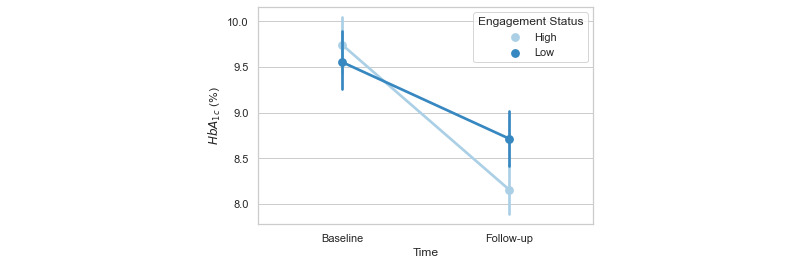
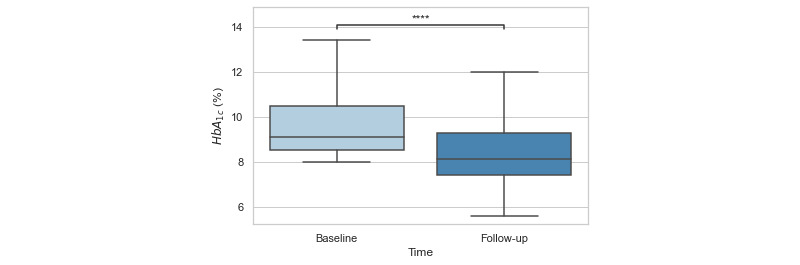
We observed a significant decrease in HbA of -1.23 points between baseline (mean 9.65%, SD 1.56%) and follow-up (mean 8.42%, SD 1.44%; P<.001). Additionally, we observed a greater decrease in HbA among participants with high program engagement (high engagement: -1.59%, SD 1.97%; low engagement: -0.84%, SD 1.64%; P<.001).
This work highlights improvements in glycemic control that were clinically as well as statistically significant among Spanish-preferring adults enrolled in the Vida Health Spanish Diabetes Management Program. Greater improvements in glycemic control were observed among participants with higher program engagement. These results provide needed support for the use of digital health interventions to promote meaningful improvements in glycemic control in a medically underserved community.
糖尿病治疗与护理存在诸多障碍,尤其是在医疗服务不足的社区。
本研究旨在评估一项针对血糖控制的、经过文化调适的新型西班牙语移动健康糖尿病项目。
专业西班牙语翻译人员、语言学家和医疗服务提供者将整个Vida Health糖尿病管理项目本地化,转化为具有文化相关性的西班牙语版本。182名(n = 119名女性)讲西班牙语的成年糖尿病患者使用了西班牙语版的Vida Health糖尿病管理项目。这个基于应用程序的项目提供了经过文化调适的糖尿病自我管理教育内容、一对一远程咨询和辅导课程,以及与具备双语(西班牙语和英语)资质的健康教练、注册营养师和认证糖尿病护理与教育专家进行的按需应用内消息交流。糖化血红蛋白(HbA)是主要结局指标,采用双尾配对t检验来评估项目使用前后HbA的变化。为了确定项目参与度与血糖控制变化之间的关系,采用了聚类稳健多元回归分析。
我们观察到,基线时(平均9.65%,标准差1.56%)与随访时(平均8.42%,标准差1.44%;P <.001)糖化血红蛋白显著下降了1.23个百分点。此外,我们观察到项目参与度高的参与者糖化血红蛋白下降幅度更大(高参与度:-1.59%,标准差1.97%;低参与度:-0.84%,标准差1.64%;P <.001)。
这项研究突出了在参加Vida Health西班牙糖尿病管理项目的偏好西班牙语的成年人中,血糖控制在临床和统计学上均有显著改善。项目参与度较高的参与者血糖控制改善更为明显。这些结果为使用数字健康干预措施促进医疗服务不足社区的血糖控制取得有意义的改善提供了必要支持。