Institute of Pharmacology and Toxicology, University of Zürich, Winterthurerstrasse 190, 8057 Zürich, Switzerland.
Department of Chemistry, University of Zürich, Winterthurerstrasse 190, 8057 Zürich, Switzerland.
Cell Chem Biol. 2022 Dec 15;29(12):1729-1738.e8. doi: 10.1016/j.chembiol.2022.11.007. Epub 2022 Dec 7.
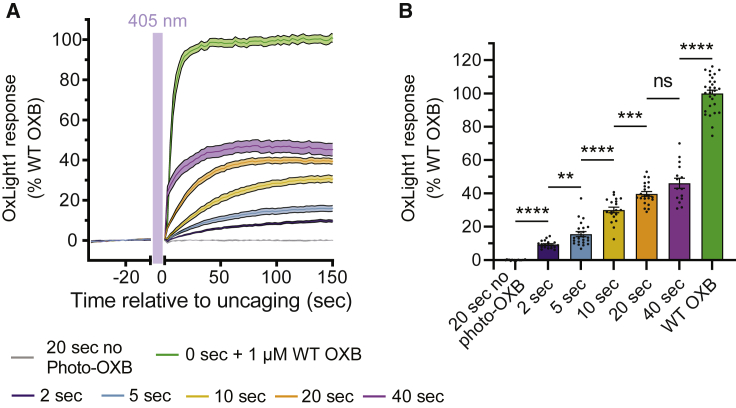
Orexin neuropeptides carry out important neuromodulatory functions in the brain, yet tools to precisely control the activation of endogenous orexin signaling are lacking. Here, we developed a photocaged orexin-B (photo-OXB) through a C-terminal photocaging strategy. We show that photo-OXB is unable to activate its cognate receptors in the dark but releases functionally active native orexin-B upon uncaging by illumination with UV-visible (UV-vis) light (370-405 nm). We established an all-optical assay combining photo-OXB with a genetically encoded orexin biosensor and used it to characterize the efficiency and spatial profile of photo-OXB uncaging. Finally, we demonstrated that photo-OXB enables optical control over orexin signaling with fine temporal precision both in vitro and ex vivo. Thus, our photocaging strategy and photo-OXB advance the chemical biological toolkit by introducing a method for the optical control of peptide signaling and physiological function.
食欲素神经肽在大脑中发挥着重要的神经调质功能,但缺乏精确控制内源性食欲素信号激活的工具。在这里,我们通过 C 端光笼化策略开发了一种光笼化的食欲素-B(photo-OXB)。我们表明,photo-OXB 在黑暗中无法激活其同源受体,但在通过 UV-可见(UV-vis)光(370-405nm)照射去笼化后释放功能活性的天然食欲素-B。我们建立了一种结合 photo-OXB 和基因编码的食欲素生物传感器的全光学测定法,并使用它来表征 photo-OXB 去笼化的效率和空间分布。最后,我们证明 photo-OXB 能够在体外和体内以精细的时间精度对食欲素信号进行光学控制。因此,我们的光笼化策略和 photo-OXB 通过引入一种用于肽信号和生理功能光学控制的方法,推进了化学生物学工具包。