Institute of Molecular and Cell Biology, Mannheim University of Applied Sciences, 68163 Mannheim, Germany.
Interdisciplinary Center for Neurosciences, Heidelberg University, 69120 Heidelberg, Germany.
Cells. 2022 Nov 24;11(23):3753. doi: 10.3390/cells11233753.
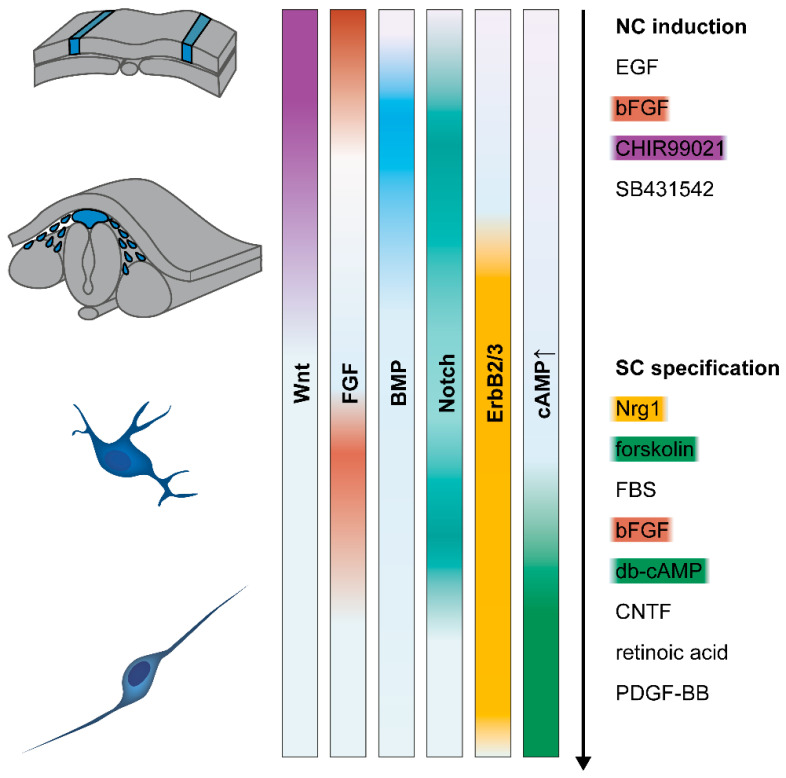
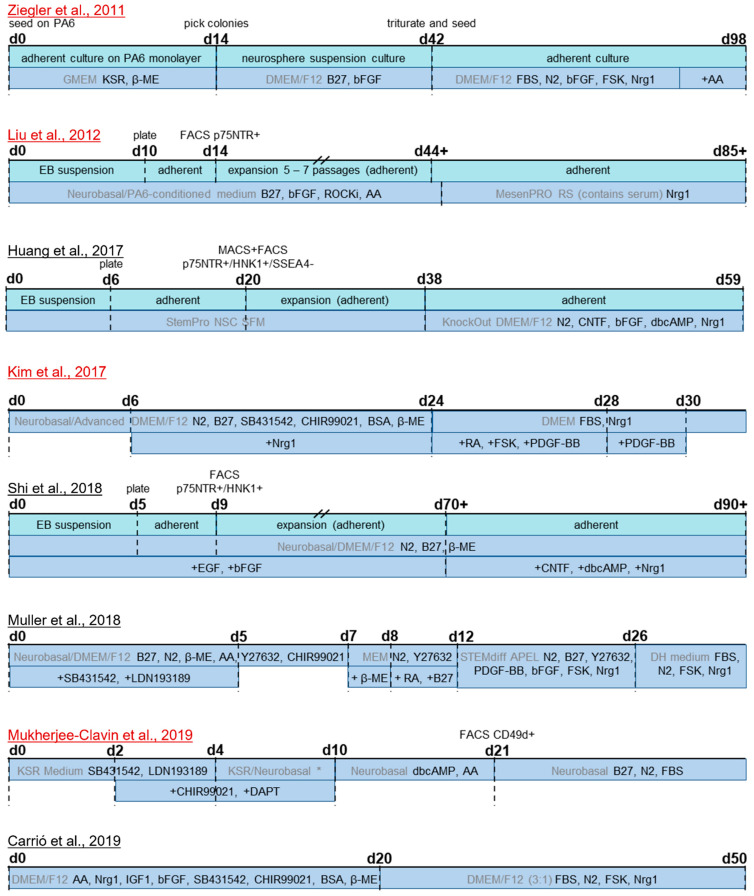
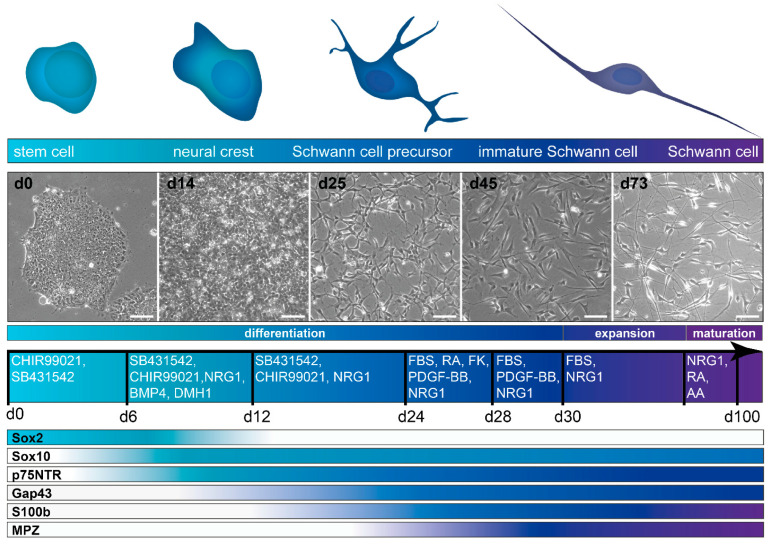
Schwann cells are glial cells of the peripheral nervous system. They exist in several subtypes and perform a variety of functions in nerves. Their derivation and culture in vitro are interesting for applications ranging from disease modeling to tissue engineering. Since primary human Schwann cells are challenging to obtain in large quantities, in vitro differentiation from other cell types presents an alternative. Here, we first review the current knowledge on the developmental signaling mechanisms that determine neural crest and Schwann cell differentiation in vivo. Next, an overview of studies on the in vitro differentiation of Schwann cells from multipotent stem cell sources is provided. The molecules frequently used in those protocols and their involvement in the relevant signaling pathways are put into context and discussed. Focusing on hiPSC- and hESC-based studies, different protocols are described and compared, regarding cell sources, differentiation methods, characterization of cells, and protocol efficiency. A brief insight into developments regarding the culture and differentiation of Schwann cells in 3D is given. In summary, this contribution provides an overview of the current resources and methods for the differentiation of Schwann cells, it supports the comparison and refinement of protocols and aids the choice of suitable methods for specific applications.
许旺细胞是周围神经系统的神经胶质细胞。它们存在于几种亚型中,在神经中执行多种功能。它们的起源和体外培养对于从疾病建模到组织工程的各种应用都很有趣。由于难以大量获得原代人许旺细胞,因此体外从其他细胞类型分化为另一种选择。在这里,我们首先回顾了决定神经嵴和许旺细胞体内分化的发育信号机制的最新知识。接下来,概述了从多能干细胞来源体外分化许旺细胞的研究。将那些方案中常用的分子及其在相关信号通路中的参与置于上下文中进行讨论。重点介绍基于 hiPSC 和 hESC 的研究,针对细胞来源、分化方法、细胞特征和方案效率,对不同的方案进行了描述和比较。简要介绍了许旺细胞在 3D 中培养和分化的最新进展。总之,本综述提供了许旺细胞分化的最新资源和方法概述,支持方案的比较和优化,并有助于为特定应用选择合适的方法。