
暴露于环境空气污染与英国老年人痴呆症的发病:ELSA 队列研究。
Exposure to Ambient Air Pollution and the Incidence of Dementia in the Elderly of England: The ELSA Cohort.
机构信息
Environmental Research Group, School of Public Health, Imperial College, London W12 0BZ, UK.
MRC Centre for Environment and Health, Imperial College, London W12 0BZ, UK.
出版信息
Int J Environ Res Public Health. 2022 Nov 29;19(23):15889. doi: 10.3390/ijerph192315889.
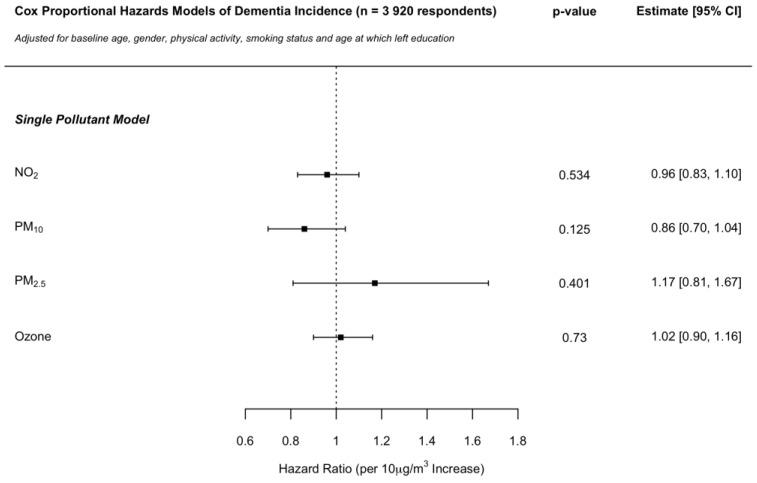
Increasing evidence suggests an adverse association between ambient air pollution and the incidence of dementia in adult populations, although results at present are mixed and further work is required. The present study investigated the relationships between NO, PM, PM and ozone on dementia incidence in a cohort of English residents, aged 50 years and older, followed up between 2004 and 2017 (English Longitudinal Study of Ageing; = 8525). Cox proportional hazards models were applied to investigate the association between time to incident dementia and exposure to pollutants at baseline. Hazard ratios (HRs) were calculated per 10 μg/m. Models were adjusted for age, gender, physical activity, smoking status and level of education (the latter as a sensitivity analysis). A total of 389 dementia cases were identified during follow-up. An increased risk of developing dementia was suggested with increasing exposure to PM (HR: 1.10; 95% confidence interval (CI): 0.88, 1.37), whilst NO, PM and ozone exhibited no discernible relationships. Hazard ratios were 0.97 (CI: 0.89, 1.05) for NO; 0.98 (CI: 0.89, 1.08) for PM; 1.01 (CI: 0.94, 1.09) for ozone. In the London sub-sample (39 dementia cases), a 10 μg/m increase in PM was found to be associated with increased risk of dementia by 16%, although not statistically significant (HR: 1.16; CI: 0.90, 1.48), and the magnitude of effect for PM increased, whilst NO and ozone exhibited similar associations as observed in the England-wide study. Further work is required to fully elucidate the potentially adverse associations between air pollution exposure and dementia incidence.
越来越多的证据表明,环境空气污染与成年人痴呆症的发病率之间存在不利关联,尽管目前的结果喜忧参半,需要进一步的研究。本研究调查了在英格兰居民队列中,NO、PM、PM 和臭氧与痴呆症发病率之间的关系,这些居民年龄在 50 岁及以上,随访时间为 2004 年至 2017 年(英国老龄化纵向研究;=8525)。应用 Cox 比例风险模型来研究暴露于基线污染物与痴呆症发病时间之间的关联。每 10 μg/m 的风险比(HR)。模型调整了年龄、性别、身体活动、吸烟状况和教育水平(后者作为敏感性分析)。在随访期间共发现 389 例痴呆病例。随着 PM 暴露量的增加,发展为痴呆症的风险增加(HR:1.10;95%置信区间(CI):0.88,1.37),而 NO、PM 和臭氧则没有明显的关系。NO 的 HR 为 0.97(CI:0.89,1.05);PM 的 HR 为 0.98(CI:0.89,1.08);臭氧的 HR 为 1.01(CI:0.94,1.09)。在伦敦子样本(39 例痴呆病例)中,发现 PM 每增加 10 μg/m,痴呆症的风险增加 16%,尽管没有统计学意义(HR:1.16;CI:0.90,1.48),并且 PM 的效应幅度增加,而 NO 和臭氧则表现出与全英研究相同的关联。需要进一步的研究来充分阐明空气污染暴露与痴呆症发病率之间可能存在的不利关联。

 Zotero 插件