Department of Chemistry, M. V. Lomonosov Moscow State University, Leninskie Gory 1-3, 119991 Moscow, Russia.
N. D. Zelinsky Institute of Organic Chemistry, Leninsky Pr. 47, 119334 Moscow, Russia.
Molecules. 2022 Dec 2;27(23):8468. doi: 10.3390/molecules27238468.
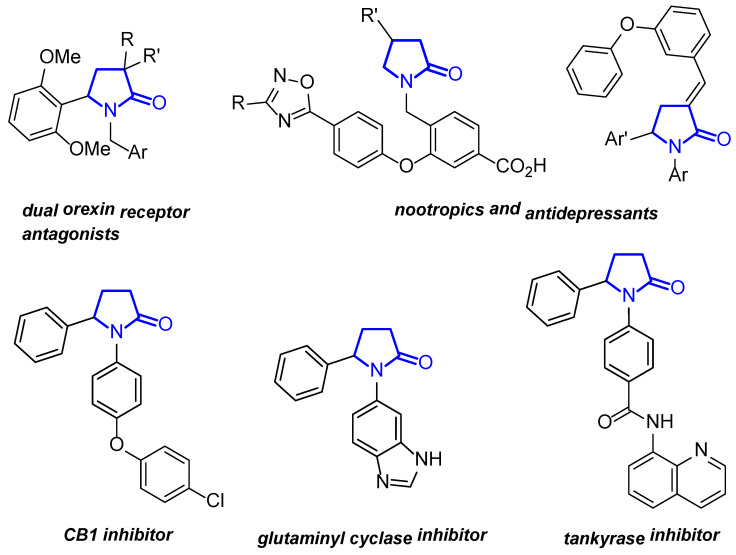
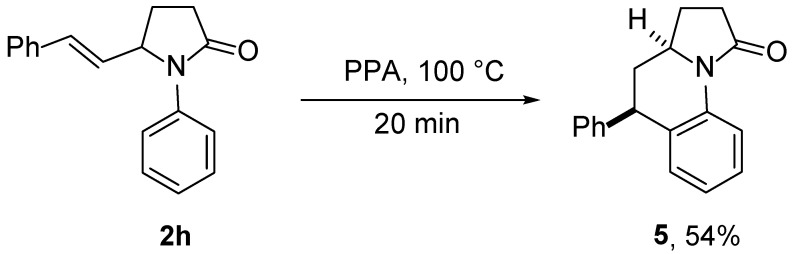
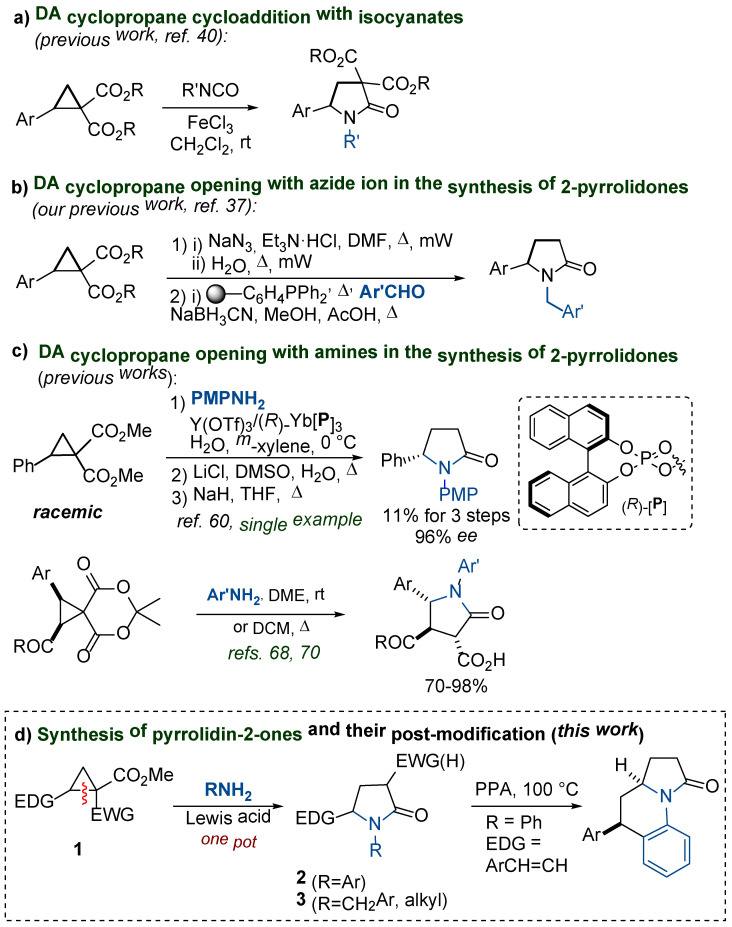
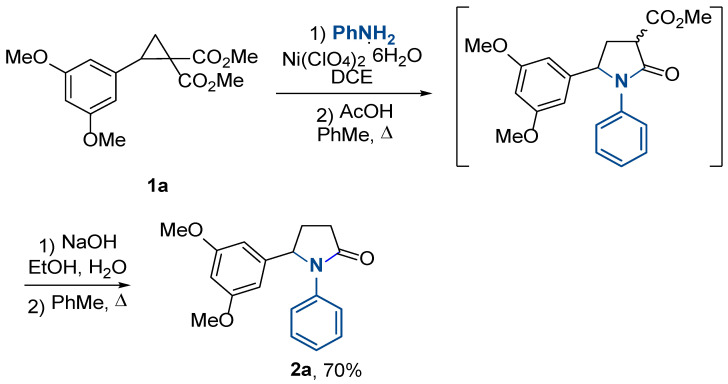
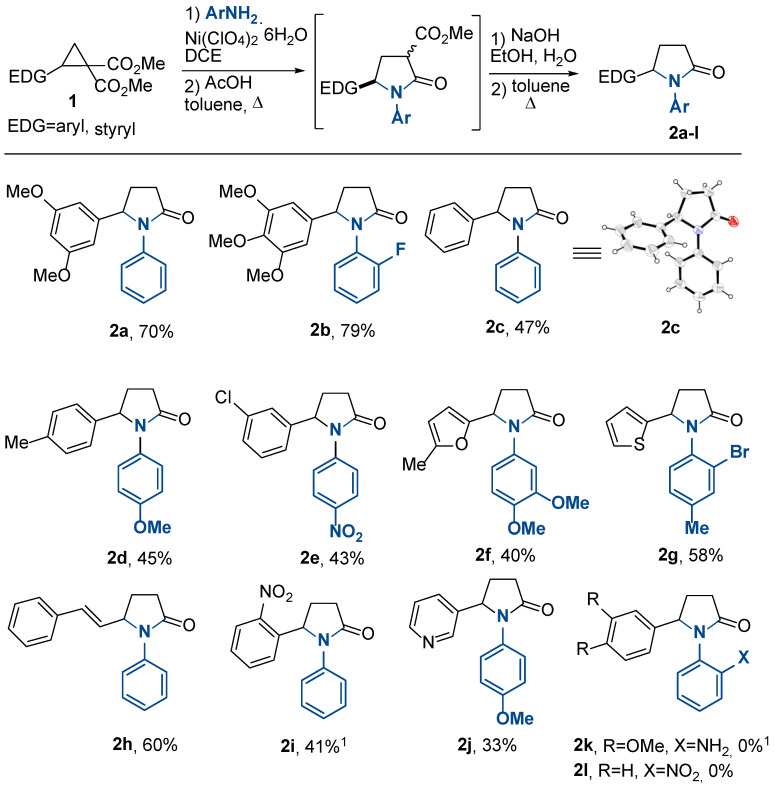
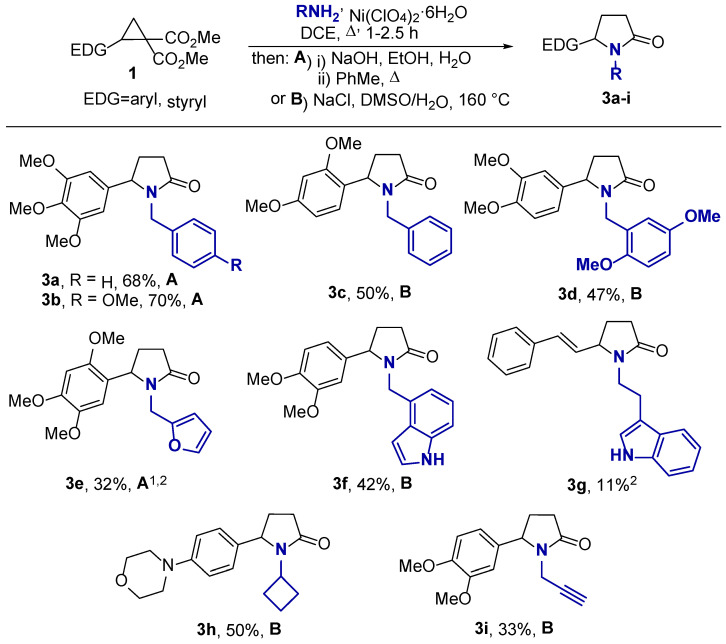
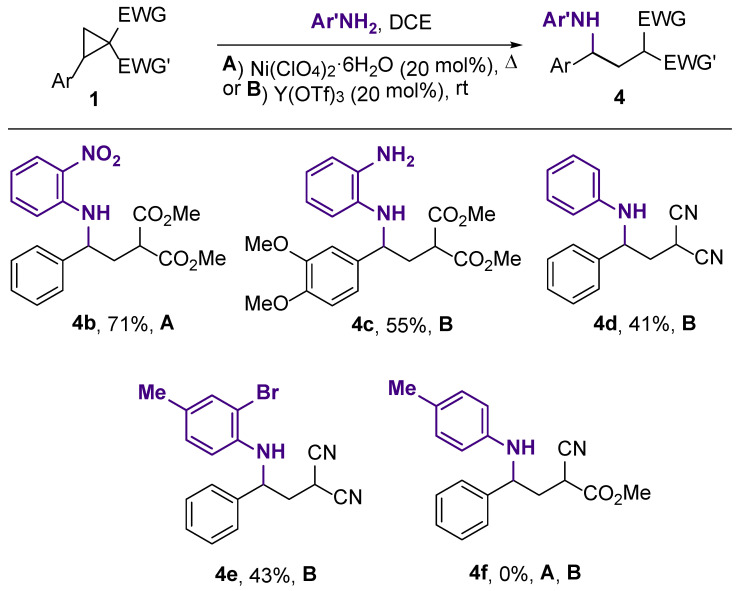
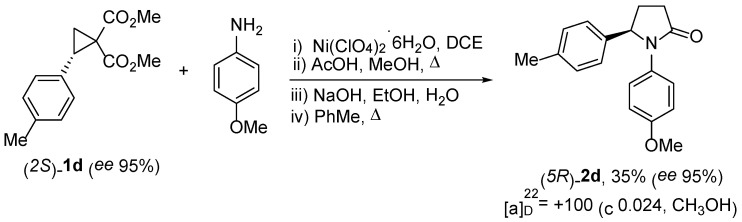
We developed a straightforward synthetic route to pharmacologically important 1,5-substituted pyrrolidin-2-ones from donor-acceptor cyclopropanes bearing an ester group as one of the acceptor substituents. This method includes a Lewis acid-catalyzed opening of the donor-acceptor cyclopropane with primary amines (anilines, benzylamines, etc.) to γ-amino esters, followed by in situ lactamization and dealkoxycarbonylation. The reaction has a broad scope of applicability; a variety of substituted anilines, benzylamines, and other primary amines as well as a wide range of donor-acceptor cyclopropanes bearing (hetero)aromatic or alkenyl donor groups and various acceptor substituents can be involved in this transformation. In this process, donor-acceptor cyclopropanes react as 1,4-,-dielectrophiles, and amines react as 1,1-dinucleophiles. The resulting di- and trisubstituted pyrrolidin-2-ones can be also used in subsequent chemistry to obtain various nitrogen-containing polycyclic compounds of interest to medicinal chemistry and pharmacology, such as benz[]indolizidine derivatives.
我们开发了一种从带有酯基作为吸电子取代基之一的供体-受体环丙烷制备具有药理重要性的 1,5-取代吡咯烷-2-酮的直线路径。该方法包括路易斯酸催化供体-受体环丙烷与伯胺(苯胺、苄胺等)开环得到γ-氨基酯,然后进行原位内酰胺化和脱烷氧基羰基化。该反应具有广泛的适用性;各种取代苯胺、苄胺和其他伯胺以及带有(杂)芳基或烯基供体基团和各种吸电子取代基的各种供体-受体环丙烷都可以参与这种转化。在这个过程中,供体-受体环丙烷作为 1,4-,-二亲电试剂反应,而胺作为 1,1-二亲核试剂反应。所得的二取代和三取代吡咯烷-2-酮也可用于后续化学合成,以获得各种对药物化学和药理学有兴趣的含氮多环化合物,如苯并[吲哚里嗪]衍生物。