• 文献检索
  • 文档翻译
  • 深度研究
  • 学术资讯
  • Suppr Zotero 插件Zotero 插件
  • 邀请有礼
  • 套餐&价格
  • 历史记录
应用&插件
Suppr Zotero 插件Zotero 插件浏览器插件Mac 客户端Windows 客户端微信小程序
定价
高级版会员购买积分包购买API积分包
服务
文献检索文档翻译深度研究API 文档MCP 服务
关于我们
关于 Suppr公司介绍联系我们用户协议隐私条款
关注我们

Suppr 超能文献

核心技术专利:CN118964589B侵权必究
粤ICP备2023148730 号-1Suppr @ 2026

文献检索

告别复杂PubMed语法,用中文像聊天一样搜索,搜遍4000万医学文献。AI智能推荐,让科研检索更轻松。

立即免费搜索

文件翻译

保留排版,准确专业,支持PDF/Word/PPT等文件格式,支持 12+语言互译。

免费翻译文档

深度研究

AI帮你快速写综述,25分钟生成高质量综述,智能提取关键信息,辅助科研写作。

立即免费体验

基于深度学习的物联网(IoT)设备恶意软件检测。

Malware Detection in Internet of Things (IoT) Devices Using Deep Learning.

机构信息

Department of Computer Science, Shaheed Zulfikar Ali Bhutto Institute of Science and Technology, Islamabad Campus, Islamabad 44000, Pakistan.

Department of Creative Technologies, Faculty of Computing and Artificial Intelligence, Air University, Islamabad 44000, Pakistan.

出版信息

Sensors (Basel). 2022 Nov 29;22(23):9305. doi: 10.3390/s22239305.

DOI:10.3390/s22239305
PMID:36502007
原文链接:https://pmc.ncbi.nlm.nih.gov/articles/PMC9735444/
Abstract

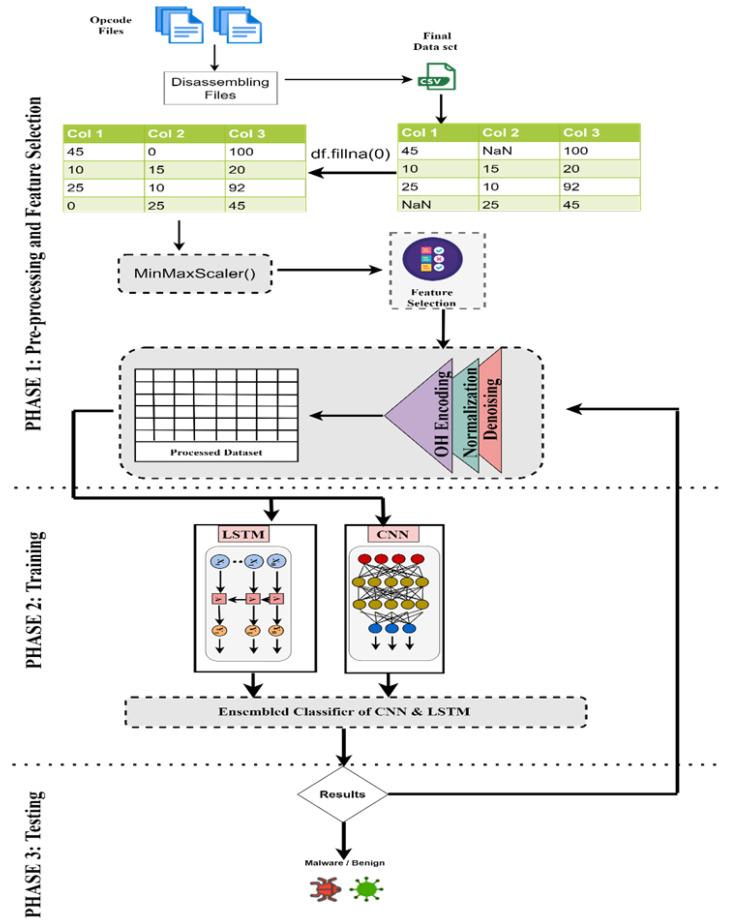
Internet of Things (IoT) devices usage is increasing exponentially with the spread of the internet. With the increasing capacity of data on IoT devices, these devices are becoming venerable to malware attacks; therefore, malware detection becomes an important issue in IoT devices. An effective, reliable, and time-efficient mechanism is required for the identification of sophisticated malware. Researchers have proposed multiple methods for malware detection in recent years, however, accurate detection remains a challenge. We propose a deep learning-based ensemble classification method for the detection of malware in IoT devices. It uses a three steps approach; in the first step, data is preprocessed using scaling, normalization, and de-noising, whereas in the second step, features are selected and one hot encoding is applied followed by the ensemble classifier based on CNN and LSTM outputs for detection of malware. We have compared results with the state-of-the-art methods and our proposed method outperforms the existing methods on standard datasets with an average accuracy of 99.5%.

摘要

物联网 (IoT) 设备的使用随着互联网的普及呈指数级增长。随着物联网设备上数据容量的增加,这些设备容易受到恶意软件攻击;因此,恶意软件检测成为物联网设备中的一个重要问题。需要一种有效、可靠和高效的机制来识别复杂的恶意软件。近年来,研究人员已经提出了多种用于恶意软件检测的方法,但是,准确的检测仍然是一个挑战。我们提出了一种基于深度学习的集成分类方法,用于检测物联网设备中的恶意软件。它使用三步法;在第一步中,使用缩放、归一化和去噪对数据进行预处理,而在第二步中,选择特征并应用独热编码,然后基于 CNN 和 LSTM 的输出进行集成分类器以检测恶意软件。我们将结果与最先进的方法进行了比较,我们的方法在标准数据集上的平均准确率为 99.5%,优于现有的方法。
https://cdn.ncbi.nlm.nih.gov/pmc/blobs/da3d/9735444/f0842ffaea85/sensors-22-09305-g005.jpg
https://cdn.ncbi.nlm.nih.gov/pmc/blobs/da3d/9735444/bf48030f809e/sensors-22-09305-g001.jpg
https://cdn.ncbi.nlm.nih.gov/pmc/blobs/da3d/9735444/66dcb80e7e33/sensors-22-09305-g002.jpg
https://cdn.ncbi.nlm.nih.gov/pmc/blobs/da3d/9735444/deecc7342b73/sensors-22-09305-g003.jpg
https://cdn.ncbi.nlm.nih.gov/pmc/blobs/da3d/9735444/3521527877f6/sensors-22-09305-g004.jpg
https://cdn.ncbi.nlm.nih.gov/pmc/blobs/da3d/9735444/f0842ffaea85/sensors-22-09305-g005.jpg
https://cdn.ncbi.nlm.nih.gov/pmc/blobs/da3d/9735444/bf48030f809e/sensors-22-09305-g001.jpg
https://cdn.ncbi.nlm.nih.gov/pmc/blobs/da3d/9735444/66dcb80e7e33/sensors-22-09305-g002.jpg
https://cdn.ncbi.nlm.nih.gov/pmc/blobs/da3d/9735444/deecc7342b73/sensors-22-09305-g003.jpg
https://cdn.ncbi.nlm.nih.gov/pmc/blobs/da3d/9735444/3521527877f6/sensors-22-09305-g004.jpg
https://cdn.ncbi.nlm.nih.gov/pmc/blobs/da3d/9735444/f0842ffaea85/sensors-22-09305-g005.jpg

相似文献

1
Malware Detection in Internet of Things (IoT) Devices Using Deep Learning.基于深度学习的物联网(IoT)设备恶意软件检测。
Sensors (Basel). 2022 Nov 29;22(23):9305. doi: 10.3390/s22239305.
2
A Novel Detection and Multi-Classification Approach for IoT-Malware Using Random Forest Voting of Fine-Tuning Convolutional Neural Networks.基于卷积神经网络微调随机森林投票的物联网恶意软件新型检测与多分类方法。
Sensors (Basel). 2022 Jun 6;22(11):4302. doi: 10.3390/s22114302.
3
Biserial Miyaguchi-Preneel Blockchain-Based Ruzicka-Indexed Deep Perceptive Learning for Malware Detection in IoMT.基于双序列 Miyaguchi-Preneel 区块链的 Ruzicka 索引深度感知学习在 IoMT 中的恶意软件检测。
Sensors (Basel). 2021 Oct 27;21(21):7119. doi: 10.3390/s21217119.
4
IoT malware detection architecture using a novel channel boosted and squeezed CNN.使用新型通道增强与压缩卷积神经网络的物联网恶意软件检测架构
Sci Rep. 2022 Sep 15;12(1):15498. doi: 10.1038/s41598-022-18936-9.
5
Transfer Learning for Image-Based Malware Detection for IoT.基于图像的物联网恶意软件检测的迁移学习。
Sensors (Basel). 2023 Mar 20;23(6):3253. doi: 10.3390/s23063253.
6
OpCode-Level Function Call Graph Based Android Malware Classification Using Deep Learning.基于 OpCode 级函数调用图的深度学习的安卓恶意软件分类。
Sensors (Basel). 2020 Jun 29;20(13):3645. doi: 10.3390/s20133645.
7
Artificial intelligence-driven malware detection framework for internet of things environment.用于物联网环境的人工智能驱动的恶意软件检测框架。
PeerJ Comput Sci. 2023 May 29;9:e1366. doi: 10.7717/peerj-cs.1366. eCollection 2023.
8
Cross Deep Learning Method for Effectively Detecting the Propagation of IoT Botnet.基于交叉深度学习的物联网僵尸网络传播检测方法
Sensors (Basel). 2022 May 20;22(10):3895. doi: 10.3390/s22103895.
9
MDABP: A Novel Approach to Detect Cross-Architecture IoT Malware Based on PaaS.MDABP:一种基于 PaaS 的新型跨体系结构 IoT 恶意软件检测方法。
Sensors (Basel). 2023 Mar 13;23(6):3060. doi: 10.3390/s23063060.
10
IoT malware: An attribute-based taxonomy, detection mechanisms and challenges.物联网恶意软件:基于属性的分类法、检测机制与挑战。
Peer Peer Netw Appl. 2023 May 10:1-52. doi: 10.1007/s12083-023-01478-w.

引用本文的文献

1
A Review of the Authentication Techniques for Internet of Things Devices in Smart Cities: Opportunities, Challenges, and Future Directions.智慧城市中物联网设备认证技术综述:机遇、挑战与未来方向
Sensors (Basel). 2025 Mar 7;25(6):1649. doi: 10.3390/s25061649.
2
OEDL: an optimized ensemble deep learning method for the prediction of acute ischemic stroke prognoses using union features.OEDL:一种使用联合特征预测急性缺血性中风预后的优化集成深度学习方法。
Front Neurol. 2023 Jun 21;14:1158555. doi: 10.3389/fneur.2023.1158555. eCollection 2023.

本文引用的文献

1
Multi-view classification with convolutional neural networks.基于卷积神经网络的多视图分类。
PLoS One. 2021 Jan 12;16(1):e0245230. doi: 10.1371/journal.pone.0245230. eCollection 2021.