Dong Liying, Liu Shufang, Li Jing, Tharreau Didier, Liu Pei, Tao Dayun, Yang Qinzhong
Agricultural Environment and Resources Institute/Key Laboratory of Green Prevention and Control of Agricultural Transboundary Pests of Yunnan Province, Yunnan Academy of Agricultural Sciences, Kunming 650205, China.
Food Crops Research Institute, Yunnan Academy of Agricultural Sciences, Kunming 650205, China.
Plant Pathol J. 2022 Dec;38(6):679-684. doi: 10.5423/PPJ.NT.02.2022.0017. Epub 2022 Dec 1.
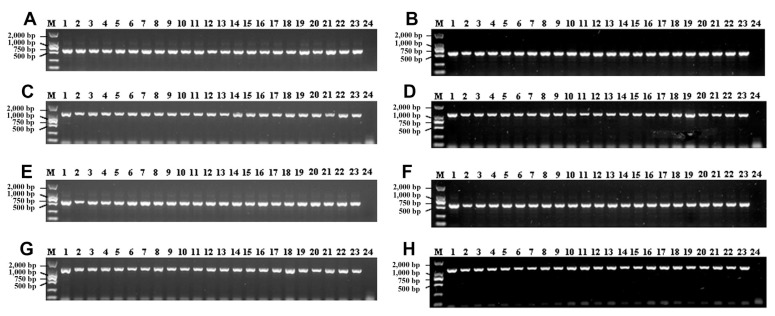
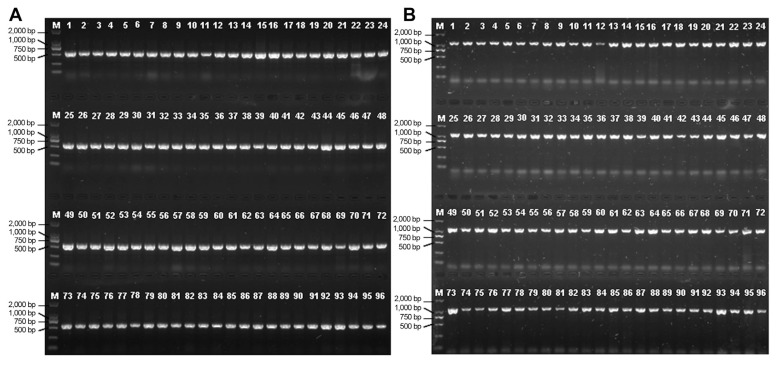
Rice blast is one of the most destructive diseases of rice worldwide, and the causative agent is the filamentous ascomycete Magnaporthe oryzae. With the successful cloning of more and more avirulence genes from M. oryzae, the direct extraction of M. oryzae genomic DNA from infected rice tissue would be useful alternative for rapid monitoring of changes of avirulence genes without isolation and cultivation of the pathogen. In this study, a fast, low-cost and reliable method for DNA preparation of M. oryzae from a small piece of infected single rice leaf or neck lesion was established. This single step method only required 10 min for DNA preparation and conventional chemical reagents commonly found in the laboratory. The AvrPik and AvrPi9 genes were successfully amplified with the prepared DNA. The expected DNA fragments from 570 bp to 1,139 bp could be amplified even three months after DNA preparation. This method was also suitable for DNA preparation from M. oryzae strains stored on the filter paper. All together these results indicate that the DNA preparation method established in this study is reliable, and could meet the basic needs for polymerase chain reaction-based analysis of M. oryzae.
稻瘟病是全球最具破坏性的水稻病害之一,其病原体是丝状子囊菌稻瘟病菌。随着越来越多的稻瘟病菌无毒基因被成功克隆,直接从受感染的水稻组织中提取稻瘟病菌基因组DNA将是一种有用的替代方法,可在不分离和培养病原体的情况下快速监测无毒基因的变化。在本研究中,建立了一种从一小片受感染的单株水稻叶片或颈部病斑中制备稻瘟病菌DNA的快速、低成本且可靠的方法。这种单步方法只需10分钟即可制备DNA,且使用的是实验室常见的常规化学试剂。用制备的DNA成功扩增出了AvrPik和AvrPi9基因。即使在DNA制备三个月后,也能扩增出570 bp至1,139 bp的预期DNA片段。该方法也适用于从保存在滤纸上的稻瘟病菌菌株中制备DNA。所有这些结果表明,本研究建立的DNA制备方法是可靠的,能够满足基于聚合酶链反应分析稻瘟病菌的基本需求。